Germany
Germany cryptids, folklore, monsters, and ghost stories come from sharply different regional traditions across the country. Alpine legends tell of strange mountain creatures, while forests and river valleys carry stories of spirits, dragons, and haunted places. Northern coastal folklore adds shipboard beings and sea traditions, while castles and old towns preserve stories of spectral women and restless dead.
Regional folklore often changes with the landscape and the communities that preserved it. Bavaria and the Alps produced very different creatures from those found along the Rhine or North Sea coast. Forests, mountains, rivers, castles, and old trading towns each developed their own local legends and supernatural traditions. Some figures stayed closely tied to a particular region, while others spread through literature, tourism, and popular culture.
Tatzelwurm (Bavarian Alps)
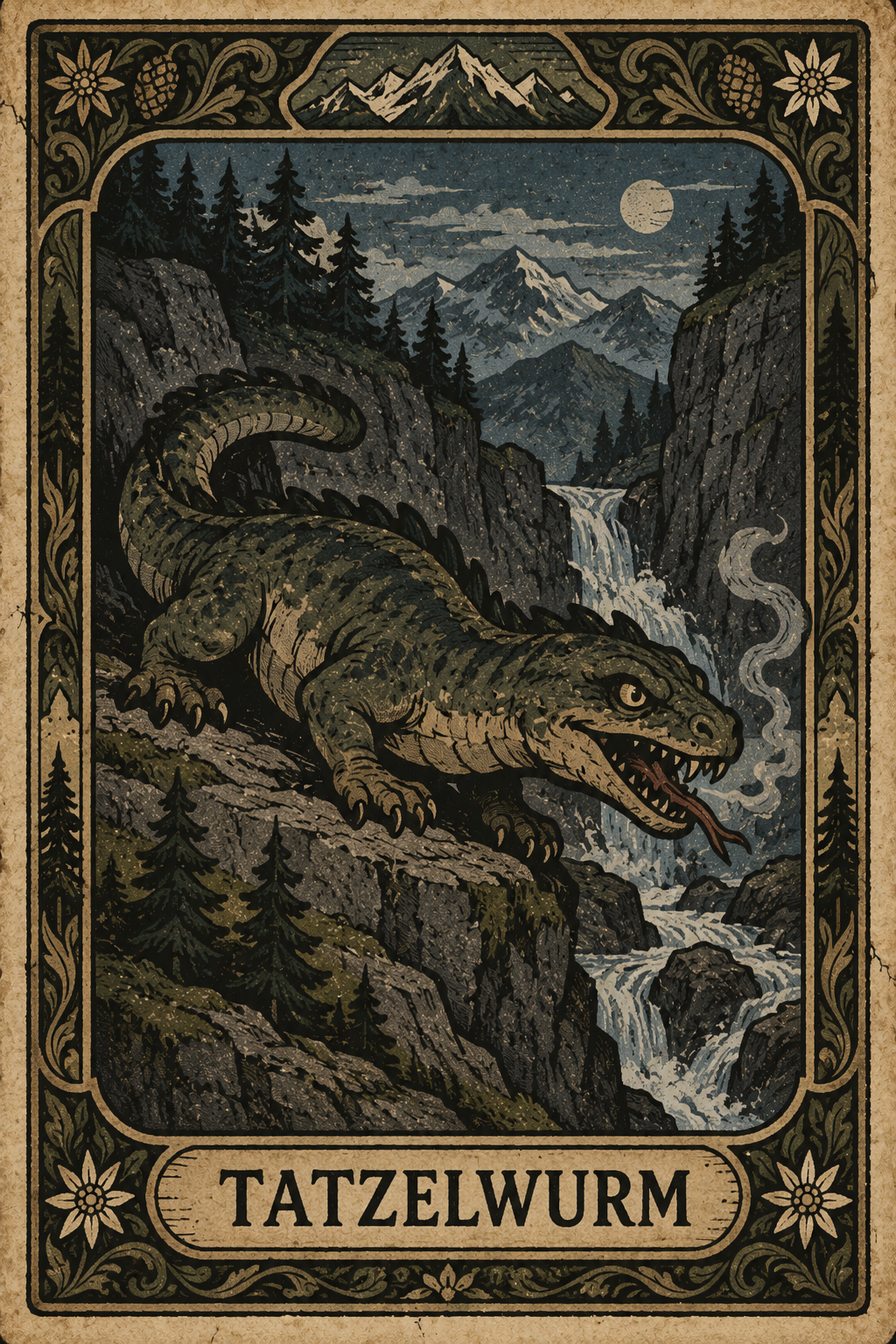
The Tatzelwurm is a legendary Alpine creature said to hide in caves, gorges, and rocky mountain country. Descriptions vary, but it is often short, thick-bodied, and reptilian, with small clawed legs. Some Bavarian tales make it more dragon-like, with scales, sharp teeth, smoke, fire, and even wings. The German Alpine Club describes Tatzelwürmer between fifty centimeters and two meters long, living in Alpine caves. One legend from the Aschauer Klamm tells of a fierce Tatzelwurm waiting deep inside the gorge.
Near Oberaudorf, the creature’s name became fixed to the landscape around a gorge and waterfall. In 1868, an inn displayed a painted sign showing a fire-breathing Tatzelwurm above the remains of its victims. The German Alpine Club recorded in 1888 that the surrounding place soon became known as Tatzelwurm. The nearby Tatzelwurm waterfalls still carry the creature’s name. Local tradition warns that careless visitors can tumble into the gorge and become the Tatzelwurm’s next meal.
Klabautermann (North Sea and Baltic Coasts / Northern Germany)
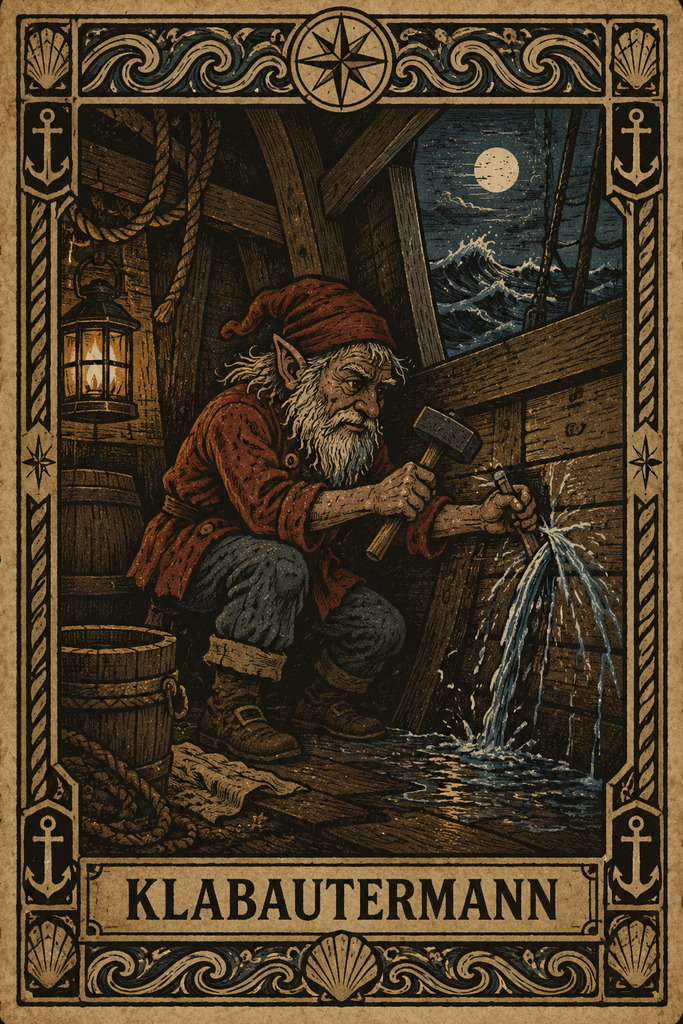
The Klabautermann is a shipboard kobold from North German folklore, especially along the North and Baltic Sea coasts. Usually unseen, he lives aboard wooden ships and helps sailors by repairing leaks, moving cargo, and warning of danger. An 1840 Pomeranian account describes him as barely two feet tall, wearing a red jacket and sailor’s trousers. Sailors more often heard him hammering, banging, and working below deck than actually saw him. He could wake a sleeping captain when the ship was in danger. Crews sometimes left him favorite foods at night to keep his favor.
The same stories made seeing the Klabautermann a frightening omen. Anyone who saw him directly was said to be near death. If a doomed ship could no longer be saved, the Klabautermann finally abandoned it. His noisy leap into the sea warned the crew that the vessel was lost. Some traditions said his spirit entered a ship through timber cut from a tree above a child’s grave. Friedrich Ranke described him as the shipboard counterpart of the household kobold among Low German sailors.
White Lady of the Hohenzollerns (Berlin / Brandenburg and Franconia)
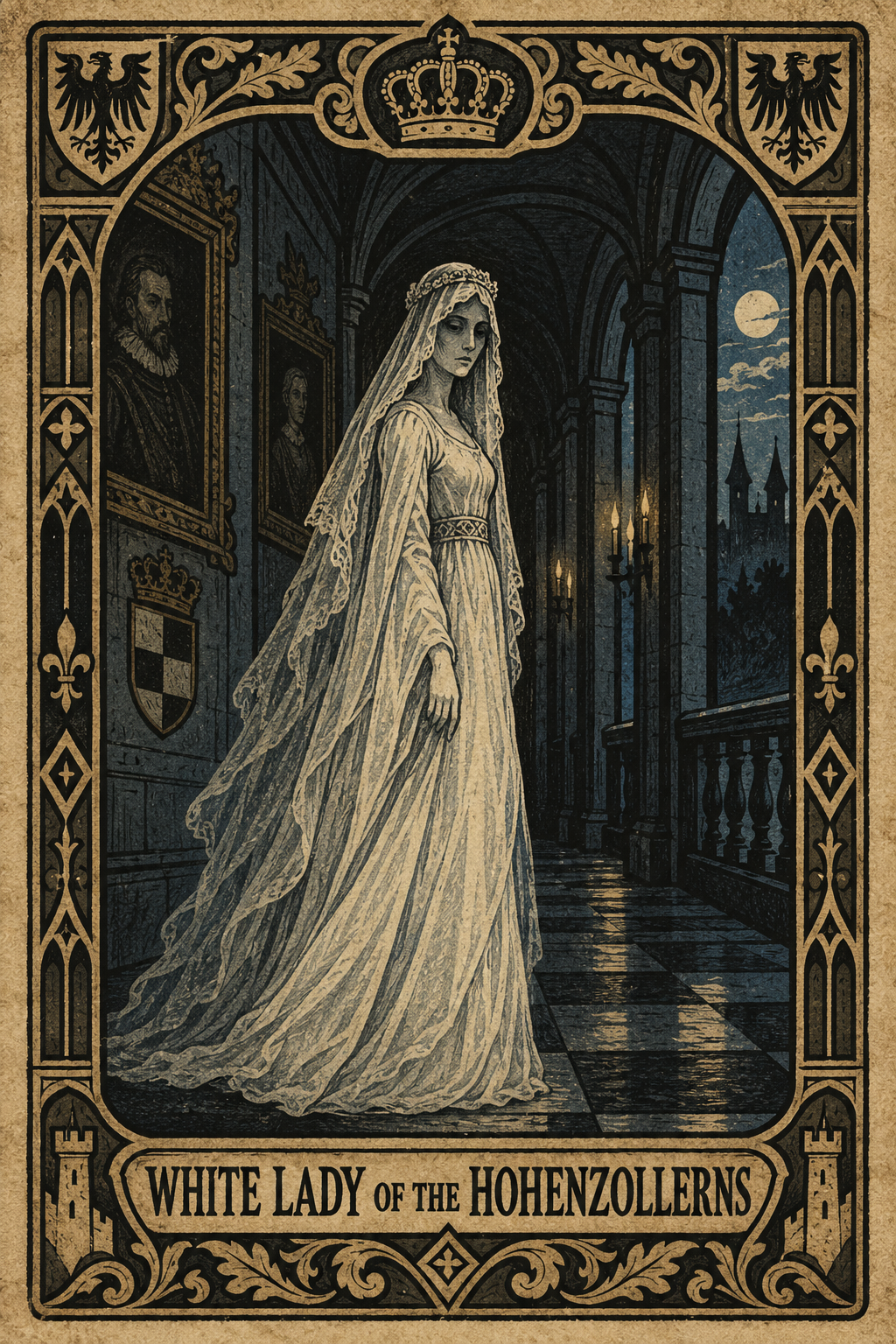
The White Lady is a ghost tied to the Hohenzollern family and their castles across Germany. She appears dressed in white, often veiled, walking silently through halls and rooms. Her arrival was said to warn of a death or major event within the ruling family. The best-known story identifies her as Kunigunde of Orlamünde, a widow linked with Plassenburg in Franconia. In the legend, she kills her children after misunderstanding a remark from Albrecht of Hohenzollern. Her punishment is to wander the family’s castles as a death-warning spirit.
Stories of the White Lady spread from Plassenburg to Bayreuth, Ansbach, Berlin Palace, and other Hohenzollern residences. A Berlin tradition describes her in a long white dress and widow’s veil, moving silently through palace corridors. She was feared as a warning of death, not simply as a wandering ghost. Reports connected her appearances with Hohenzollern deaths for centuries. Around 1840, Baron Max von Welden reportedly saw her at Abenberg Castle and fired a pistol at the apparition. Paintings, museum collections, and Hohenzollern sites still preserve different versions of the White Lady story.
Loreley (Sankt Goarshausen / Rhineland-Palatinate)
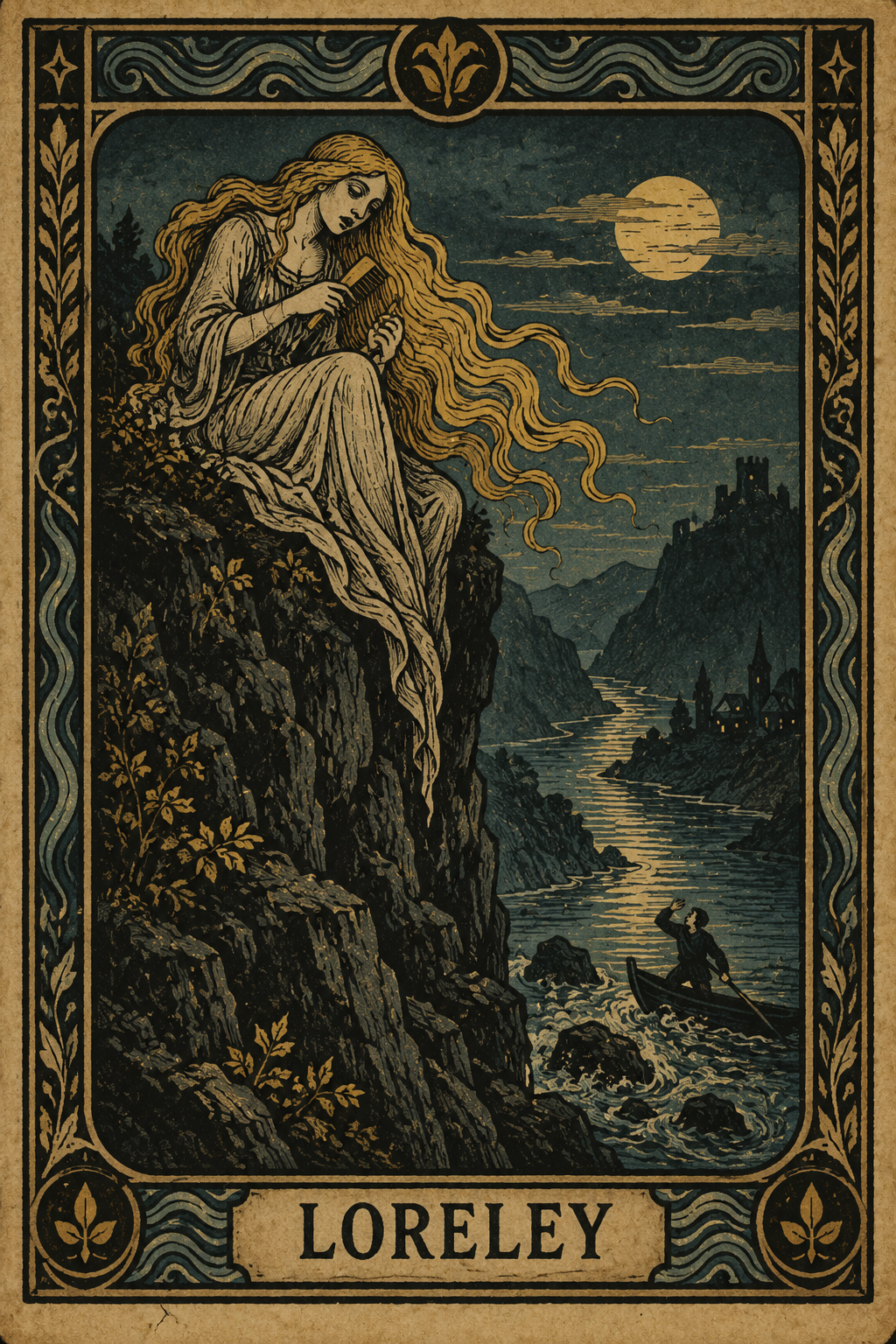
The Loreley is a legendary woman tied to the steep Rhine cliff near Sankt Goarshausen. Long before her famous story, the rock was known for dangerous currents, reefs, and strange echoes. Older tales blamed those echoes on dwarfs, mountain spirits, or nymphs. In 1801, Clemens Brentano gave the rock its first female figure, a beautiful enchantress called Lore Lay. She bewitched men and finally threw herself from the cliff into the Rhine.
In 1824, Heinrich Heine reshaped the legend into the version now known around the world. His Loreley sits above the river, combing her golden hair and singing as a boatman looks upward. Entranced, he misses the rocks below and is swallowed by the Rhine. Friedrich Silcher later set Heine’s poem to music, spreading the story even farther. A 1983 Loreley statue still stands on the harbor mole below the cliff at Sankt Goarshausen.
Pied Piper of Hamelin (Hamelin / Lower Saxony)
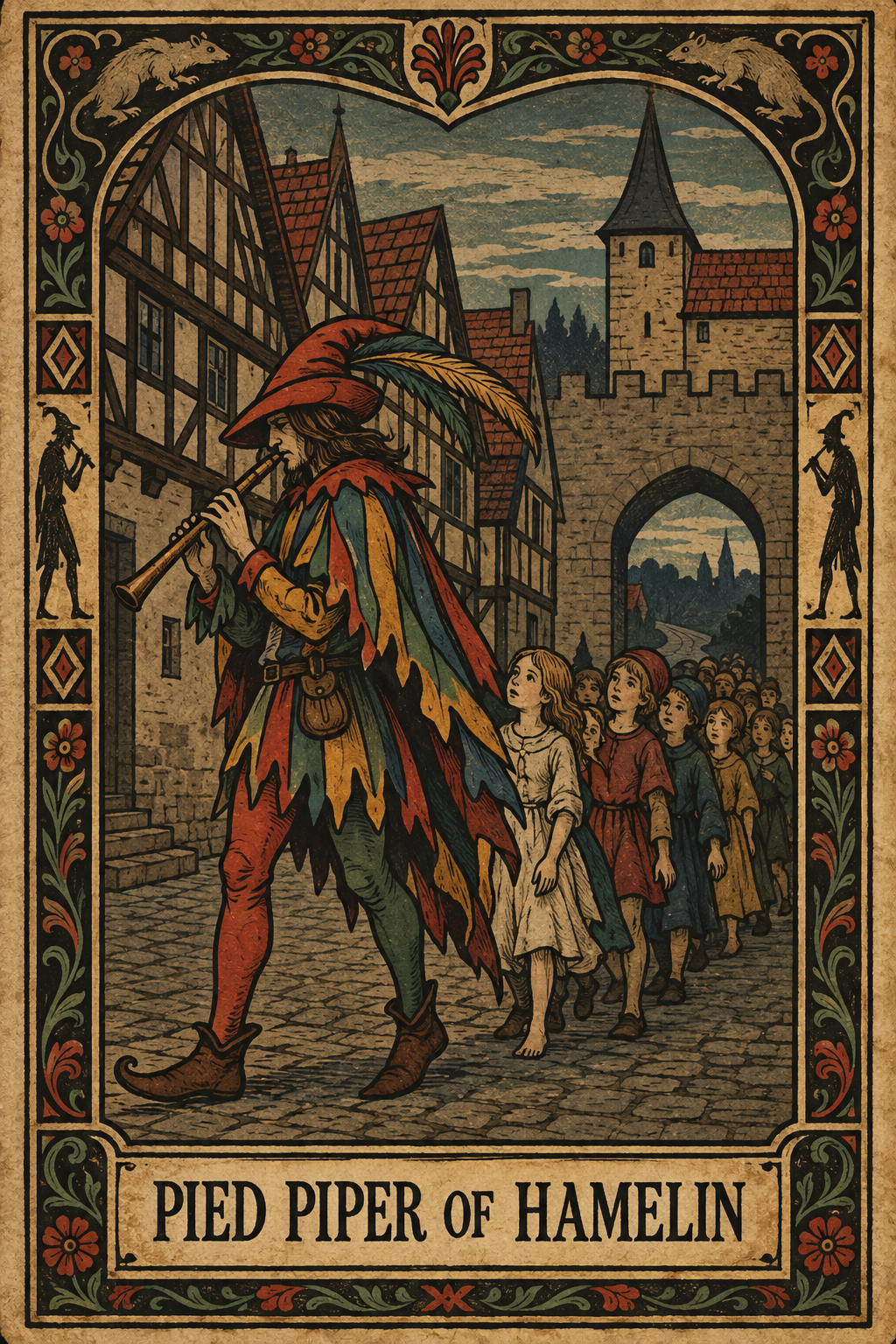
The Pied Piper legend centers on Hamelin, where tradition says 130 children vanished on June 26, 1284. Early versions focused on a brightly dressed piper leading the children away, without any rats. Later retellings added a plague of rats and the town’s refusal to pay him. In the familiar story, he pipes the rats into the Weser, where they drown. Cheated of his reward, he returns and leads Hamelin’s children through the eastern gate. Some versions say they vanished into a mountain, while others place their reappearance in Transylvania.
Hamelin tied the story closely to the town itself, especially Bungelosenstraße, where tradition says the children passed. Music and dancing were traditionally forbidden there in memory of their disappearance. The Brothers Grimm published the legend as The Children of Hameln in German Legends in 1816. Their version helped spread the rat-catcher, unpaid reward, revenge, and missing children around the world. Hamelin still marks June 26 as the traditional date of the disappearance with events and Pied Piper performances.
Wolpertinger (Bavaria)
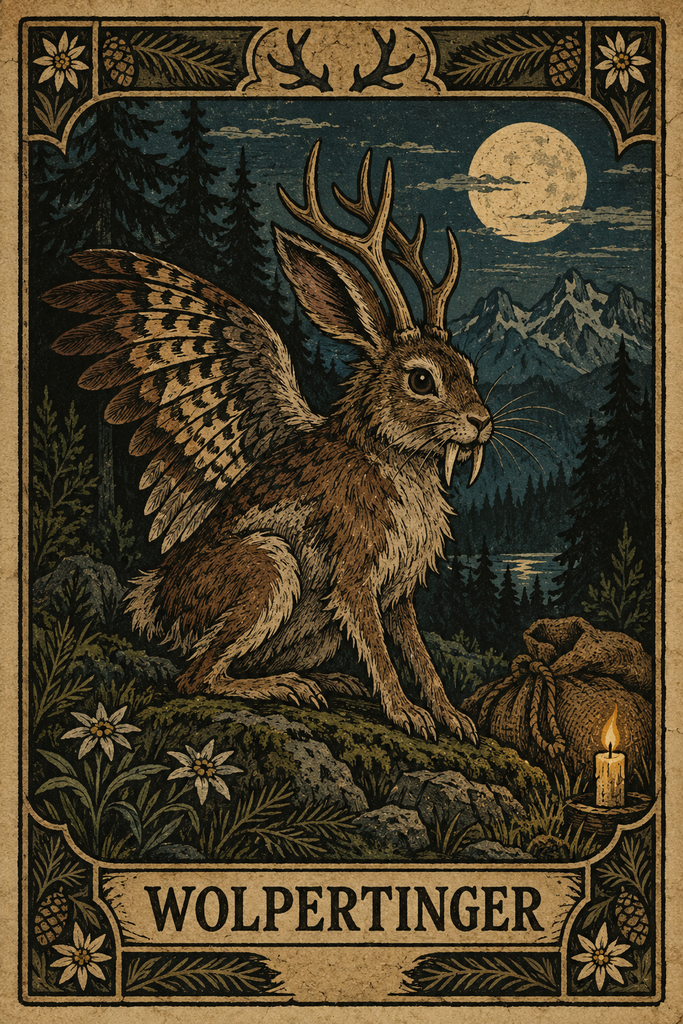
The Wolpertinger is Bavaria’s famous patchwork beast, made from the parts of several woodland animals. Most versions resemble a rabbit with antlers, wings, fangs, or bird legs. Others combine foxes, ducks, squirrels, pheasants, deer, and martens in increasingly strange combinations. One Alpine legend says the first Wolpertinger came from a romance between a hare and a deer. Their offspring supposedly bred with other forest animals, explaining why no two Wolpertingers look exactly alike. Bavarian stories place the shy creatures deep in forests and mountain country.
Stories offer equally unusual ways to catch one. The official Bavaria tourism site recommends a full moon, a potato sack, a candle, and a stick. The candle attracts the creature, which hunters then drive into the waiting sack. Other traditions say only an attractive young woman can spot one while accompanied by the right local man. Mounted Wolpertingers became fixtures in Bavarian inns and souvenir shops through imaginative taxidermy. Bavarian Radio notes that one can be seen in Munich’s German Hunting and Fishing Museum.