Alaska
Alaska cryptids and supernatural traditions come from very different parts of the state. Coastal communities tell stories tied to the sea and islands, while the Interior has its own lake creatures, wild beings, disappearances, and remote-settlement legends. Mining camps, fishing towns, aviation routes, and abandoned communities added newer stories alongside much older traditions.
Many Alaska legends come from living Alaska Native cultures, where supernatural beings belong to specific communities and traditions rather than a single statewide mythology. Other stories developed around shipwrecks, unexplained aircraft losses, isolated lakes, and encounters far from established towns. That mix gives Alaska folklore a range few states can match
Hairy Man of the Alaskan Bush (Western Alaska and the Alaska Bush)
Hairy Man is an Alaska Bigfoot-like figure reported across remote bush regions. APICDA says many Alaska regions have Hairy Man lore. It describes the Urayuli, or Hairy Man, as a Southwest Alaska figure. Alternate names include Bushman, Big Man, Tent Monster, Nant’ina, and Woodsman. Descriptions mention a shaggy figure six to ten feet tall with glowing eyes. Some stories warn that the Dena’ina Nant’ina steals children and raises them wild.
The Delta Discovery places Hairy Man reports in the Yukon-Kuskokwim Delta. In the Bethel area, one 1960s story centered on Gabriel Fox. That account described a boy who left the Children’s Home near Kwethluk. Local tellings said he survived in the wilderness by becoming a Hairy Man. Later regional reports mention tracks, glowing eyes, strong smells, thrown rocks, and strange sounds. Sightings range from Chevak to Pilot Station and along the Kuskokwim River.

Kushtaka (Otter Man)
The Kushtaka, or Kóoshdaa káa, is a shapeshifting being from Tlingit tradition in Southeast Alaska. The name is often translated as “land otter man.” Stories place the Kushtaka along rivers, shorelines, and dangerous coastal passages. It can appear as a human, an otter, or something between the two. Tellings say it imitates a crying baby or a distressed person. That trick draws the unwary toward water, forest, or rocky shore.
Many Kushtaka stories treat it as a dangerous trickster that drowns or transforms its victims. Some versions say the victim becomes another Kushtaka. Other tellings give the being a more ambiguous role. In those versions, it rescues people from freezing or drowning, but changes them in the process. Stories about the Kushtaka remain closely tied to Southeast Alaska, especially places like Thomas Bay.

Lake Iliamna Monster (Lake Iliamna, Southwest Alaska)
The Lake Iliamna Monster is a giant aquatic creature reported in Alaska’s largest lake. Accounts usually describe dark, shark-like animals between ten and twenty feet long. Some witnesses report several creatures swimming or hunting together. In 1980, the Anchorage Daily News offered $100,000 for verifiable evidence during a five-month search.
Marine ecologist Bruce Wright recorded hunters seeing two enormous creatures pull swans beneath the lake. One reportedly matched their eighteen-foot skiff in length. In 2017, Mark Stigar found his heavy longline gear dragged fifty yards, tangled, severed, and bent. Stigar and Wright later deployed an underwater camera system in 2019.

Alaskan Triangle (Anchorage, Juneau, and Utqiaġvik)
The Alaskan Triangle is a modern mystery label for wilderness between Anchorage, Juneau, and Utqiaġvik. Discovery describes the region as forests, icy mountains, tundra, and largely unexplored country. The idea gained attention after a 1972 flight vanished between Anchorage and Juneau. Passengers included House Majority Leader Hale Boggs, Representative Nicholas Begich, aide Russell Brown, and pilot Don Jonz.
The official House history says the search used 40 military aircraft and 50 civilian planes. Crews searched 325,000 square miles for 39 days without finding wreckage or survivors. Modern television and paranormal media expanded the Triangle into UFO, Bigfoot, haunting, and missing-plane folklore. Hulu lists The Alaska Triangle as a 2019 mystery docuseries about those themes.

Ghosts of the SS Princess Sophia (Lynn Canal and Juneau)
The SS Princess Sophia was a Canadian Pacific steamship lost in Lynn Canal near Juneau. It departed Skagway on October 23, 1918, carrying more than 350 passengers and crew. The ship struck Vanderbilt Reef around 2:00 a.m. on October 24. It sank the next evening after storms kept rescue vessels from removing passengers. Alaska State Museum calls the wreck the worst shipwreck ever in the Pacific Northwest.
Ghost stories attached themselves less to the reef than to Juneau’s recovery of the dead. Juneau Empire reported that bodies were stored in Front Street cellars after the disaster. At Juneau Drug, manager Brenda Lamas described basement encounters, touches, shocks, and a childlike figure. Author Bjorn Dihle connected those stories to his research for Haunted Inside Passage.

Akhlut (Bering Sea Coast / Western Alaska)
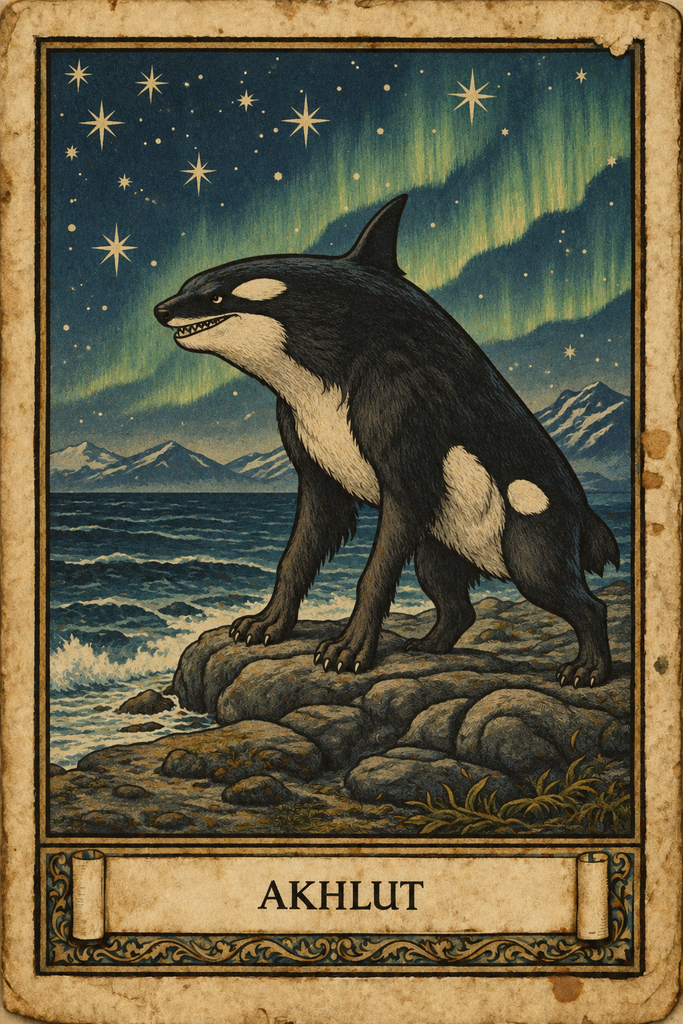
Akhlut is a modern name for a wolf-orca transformation being recorded among Inuit communities along the Bering Sea. Edward William Nelson documented the tradition during his work in northern Alaska. In Nelson’s account, the creature resembles a killer whale at sea and changes into a wolf ashore. People recognized the transformation from wolf tracks ending at the water or beginning there and leading inland. Nelson also described the animals as fierce and dangerous to people.
A 2022 Frontiers study of Kotzebue Sound cites Akhlut alongside traditional Iñupiaq killer-whale stories from Alaska. Those traditions include spirit people described as human on land and killer whales in water. The familiar wolf-orca hybrid image comes largely from later popular retellings. Nelson’s original account remains preserved by the Biodiversity Heritage Library.
Nantiinaq (Portlock and Port Chatham, Southern Kenai Peninsula)
Nantiinaq is a large hairy being in Suqpiaq stories from Portlock and Port Chatham. The abandoned village lies near the southern tip of the Kenai Peninsula, south of Seldovia. Alaska Magazine connects the creature to Port Chatham accounts from the 1930s and 1940s. Stories describe footprints, knocking sounds, uprooted trees, disappearances, and fear of nearby forests.
Homer News reported that Nanwalek and Port Graham people have told Nantiinaq stories for generations. The 2021 Discovery+ series Alaskan Killer Bigfoot brought the legend into national paranormal television. Nanwalek elder Tommy Evans said families were warned to avoid Portlock, Port Chatham, and Chrome Bay.

Palraiyuk or Tizheruk (Bering Sea and Yukon-Kuskokwim Waterways)
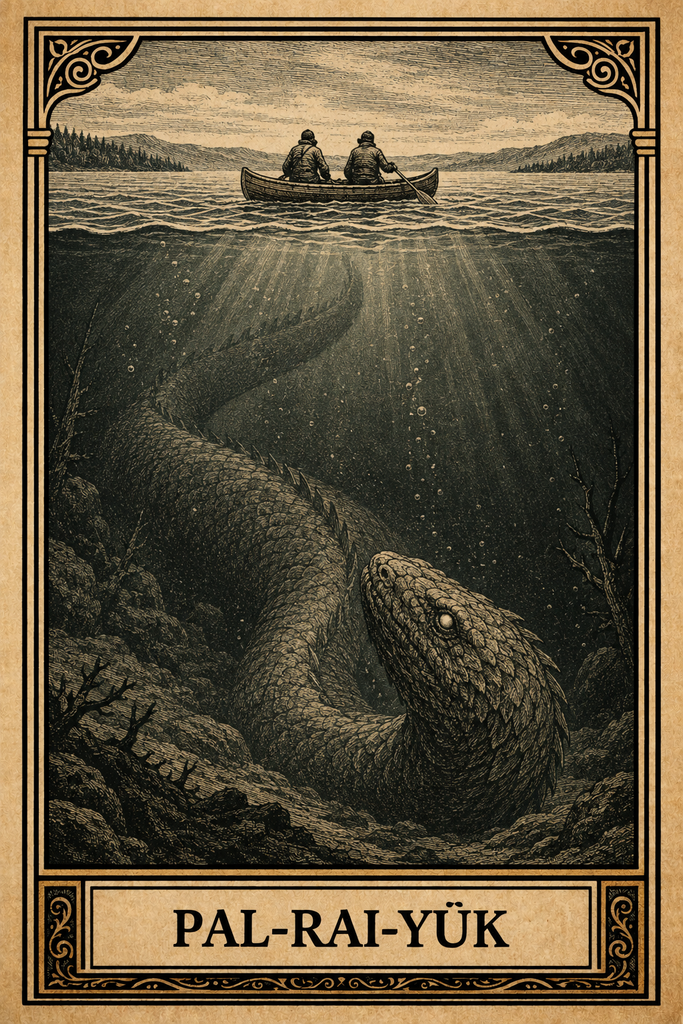
Palraiyuk, also spelled Pal-Rai-Yûk, is a dangerous water monster from Alaska Native Arctic traditions. Sources also link the creature with the name Tizheruk. Bowdoin describes it as lizard-like, sharp-toothed, and many-stomached. It lurks in shallow water and threatens people near the water’s edge.
Penn Museum describes palraiyuk as a sea and marsh creature that preyed upon people and boats. Hunters painted its image on boats as protection from attacks. Bowdoin says nineteenth-century people painted Palraiyuk images on kayaks to ward off danger. A Book of Creatures preserves older story details from Nelson’s Bering Strait material where Raven, the creator trickster, creates the monster and warns First Man to approach lakes and rivers carefully. The creature attacks people at water edges and boats entering its territory.