South Dakota
South Dakota cryptids and folklore stretch across prairie, Missouri River country, the Black Hills, reservation communities, and eastern lakes. Stories include lake monsters, Bigfoot reports, ghost lights, haunted roads, and beings from living Native traditions.
Near Vermillion, Spirit Mound carries Yankton and Lakota traditions of the Can O’ti na, or Little People. Standing Rock has documented Taku-He reports around Little Eagle, while Watertown preserves Lake Kampeska monster stories. The Black Hills add thunder-being traditions, ghost stories, and the Cheyenne Canyon Wiwila legend.
Taku-He (Little Eagle and Standing Rock Reservation)
Taku-He is a South Dakota Bigfoot-like figure tied most clearly to 1977 reports near Little Eagle. The community sits in Corson County on the Standing Rock Reservation. Sitting Bull College describes 28 reported sightings around Little Eagle during that year. A 1978 Minnesota Archaeologist article later collected the accounts from newspaper sources.
Reported witnesses included Phoebe Little Dog, Craig Two Hearts, Nancy Chasing Hawk, Esther Thundershield, and Myron Fast Horse. Other accounts involved police officers Verdell Veo, Bobby Gates, and Selvin Arlen near Elkhorn Buttes. Cryptomundo summarizes reports of tall hairy figures, green eyes, cattle-pasture sightings, tracks, and repeated encounters. The reports made Little Eagle one of South Dakota’s best-known Bigfoot locations.

Wakíŋyaŋ or Thunder Beings (Lakota Tradition and the Black Hills)
Wakíŋyaŋ are Thunder Beings in Lakota tradition, strongly connected with storms and sacred power. Prairie Edge places their seasonal return in the sacred Black Hills. Their arrival comes with thunder, lightning, rain, spring growth, and renewed life. The Thunderbird appears as one physical form of these beings.
Thunder Beings can bring rain, renewal, wind, flood, drought, lightning, and destruction. Ruth H. Hopkins describes Wakíŋyaŋ Oyate ceremonies at Black Elk Peak during the Spring Equinox. She also describes Wakíŋyaŋ Tanka as a guardian connected with thunder dreamers and heyoka.

Walking Sam (Pine Ridge Reservation)
Walking Sam is a modern Pine Ridge legend of a tall, dark, faceless figure encountered at night. One 2014 account described him as seven feet tall, thin, mouthless, and carrying human figures from his arms. The Daily Dot brought that description to wider attention in May 2015. At the time, Pine Ridge ministers told reporters that youths spoke of a “Tall Man spirit.”
The reports appeared during a severe youth suicide crisis on the reservation. Education Week reported seven youth suicides by April 2015, prompting emergency community and federal responses. Walking Sam stories spread through social media, paranormal websites, podcasts, and later South Dakota legend collections. Folklorist Andrea Kitta later examined the figure’s rapid circulation through contemporary legend and online storytelling.

Lake Kampeska Monster (Watertown / Lake Kampeska)
The Lake Kampeska Monster is a nineteenth-century lake-creature legend from Watertown in northeastern South Dakota. In 1886, boat-builders constructing a steamer reported a 20-foot, snake-like animal in the lake. South Dakota Magazine says four prominent Watertown businessmen reported another sighting several days later. They watched it swim before disappearing and suggested it might have been an unusually large lake sturgeon.
Forum News Service later found 1880s newspaper clippings describing another encounter during a lakeside picnic. Witnesses described a 20-foot animal with a scaled tail and a head as large as a yearling calf. The 2021 investigation also noted suspicions that local businessmen had promoted the creature to attract visitors. That August, the Codington County Heritage Museum scheduled a public talk devoted to the Lake Kampeska Monster.

Spirit Mound Little People (Spirit Mound Historic Prairie, South Dakota)
Spirit Mound is associated with little-person traditions recorded near Vermillion in 1804. William Clark recorded Omaha, Otoe, Sioux, and neighboring traditions describing small humanlike spirits living there. He described them as eighteen inches tall, large-headed, watchful, and armed with deadly arrows. The National Park Service also identifies Yankton tradition there with the Can O’ti na, or Little Tree Dwellers. Related Lakota tradition calls them Can O’ti la and describes them as mischievous or helpful spirit beings.
On August 25, 1804, Lewis, Clark, and ten expedition members walked from the Missouri River to Spirit Mound. Clark called it the “Mountain of little people or Spirits,” while the party found no inhabitants. South Dakota Game, Fish and Parks says the expedition instead encountered a broad prairie landscape. The agency now manages Spirit Mound Historic Prairie and began restoring native grasses and wildflowers in 2001.

1992 Yankton River Monster Incident (Missouri River near Yankton, South Dakota)
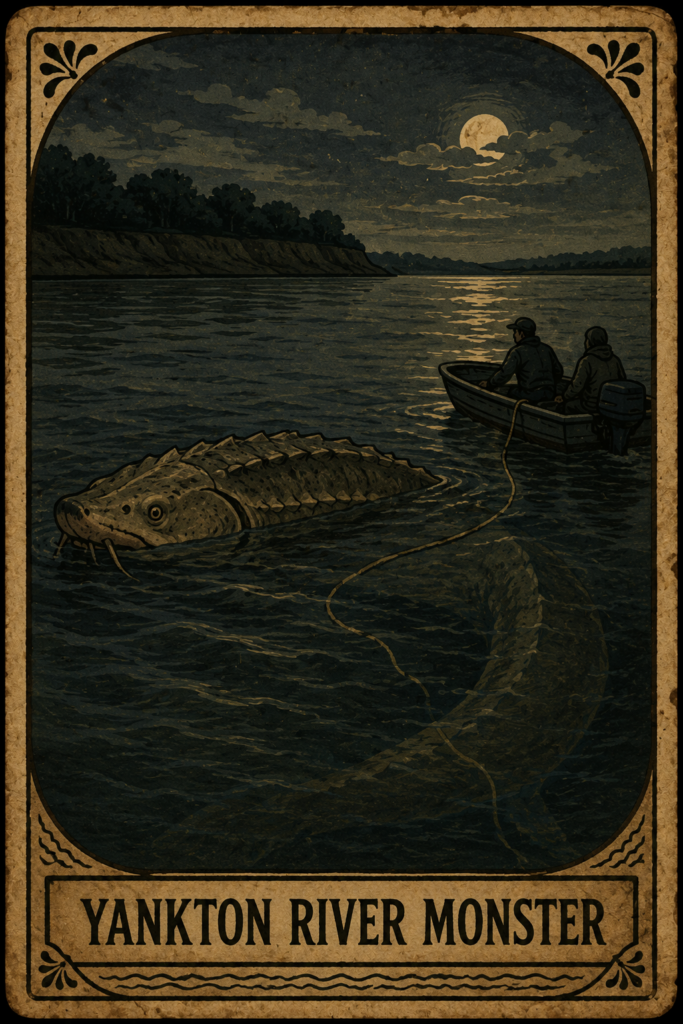
In 1992, a strange boating incident near Yankton sparked talk of a Missouri River monster. South Dakota Magazine later recounted the episode involving a young Yankton couple. They saw a flagged object moving upstream, apparently pulled by a nylon rope. The rope tangled in their propeller, killed the engine, and began towing their boat backward. The husband cut it after roughly 300 yards, with the boat’s transom nearly underwater.
Other fishermen reportedly witnessed the incident, which soon appeared in a Yankton newspaper. The magazine says Yankton buzzed with talk of a river monster afterward. Writer Marilyn Kratz suggested that a large sturgeon might have caused the frightening encounter. Pallid sturgeon inhabit the Missouri River near Yankton, providing a local counterpart to Kratz’s suggestion. South Dakota Magazine revisited the incident in 2017 among the state’s unusual water stories.
Wiwila of Cheyenne Canyon (Southern Black Hills, South Dakota)
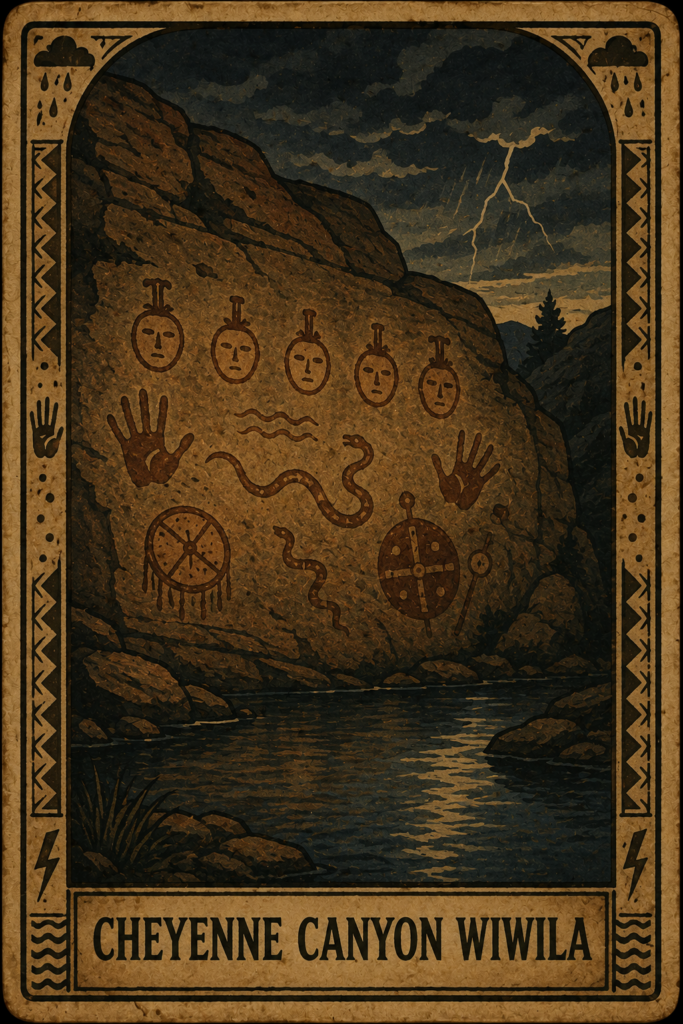
Wiwila are Lakota water beings associated especially with springs and other water sources. Lakota educator Albert White Hat Sr. described Wiwila Wiċaṡa as little men living in or near water. His 2012 Life’s Journey—Zuya says people address them when drinking from these waters. That tradition provides context for a possible Wiwila interpretation at Cheyenne Canyon.
A 2024 Sioux Replications article describes petroglyphs along the Cheyenne River, twelve miles south of Hot Springs. Author Larry Belitz identifies five pecked faces with topknots as possible Wiwila figures. He also connects nearby human figures, snakes, shields, and drums with rain ceremonies and Wakinyan. The petroglyph wall remains on Wild Horse Sanctuary property south of Hot Springs.