Tennessee
Tennessee cryptids and folklore include Appalachian monsters, ghost stories, Cherokee traditions, Civil War hauntings, wildman reports, and strange animal legends. These stories come from mountain communities, river valleys, battlefield sites, caves, and rural roads across the state.
Many Tennessee legends remain tied to specific places, including Adams, White Bluff, McNairy County, Chattanooga, and the eastern mountain region. Others belong to wider Appalachian or Cherokee storytelling traditions that cross modern state lines.
White Bluff Screamer (White Bluff / Dickson County)
The White Bluff Screamer is a Dickson County legend associated with Trace Creek near White Bluff. A local history account places its best-known story in the 1920s. Repeated nighttime screams supposedly drove a father into the woods with his gun. He returned after hearing screams from home and found his wife and seven children killed. Though local historian Tony England disputes the story of the family’s deaths.
Later accounts describe continued screams and occasional sightings around White Bluff. Edward England Jr. said his father heard the Screamer as a teenager during the 1940s. During a 1970s family camping trip, Edward heard something approaching from the woods. He never saw it, but later found large catlike paw prints near the campsite. WKRN revisited the legend in 2023, connecting it with White Bluff and nearby Montgomery Bell State Park.

Tennessee Wildman (McNairy County / Piney)
The Tennessee Wildman appeared in an 1871 newspaper report from McNairy County. The Jackson Whig and Tribune placed the creature between Sobby and Crainsville, around an area called Piney. The report described a seven-foot figure with fiery red eyes and tangled hair extending below its waist. It also gave the figure a long beard, tremendous strength, and hair covering its body.
The newspaper said the Wildman avoided men but approached unaccompanied women while screaming. It reportedly approached houses cautiously, outran pursuers, and cleared tall fences while escaping men and dogs. Residents were said to be searching the woods to capture or drive away the creature. The story reached Maine’s Weekly Eastern Argus by May 4, 1871.

Old Green Eyes (Chickamauga Battlefield / Chattanooga Area)
Old Green Eyes is a ghostly or creature-like figure tied to Chickamauga Battlefield near Chattanooga. Stories usually center on glowing green eyes seen in the battlefield darkness. Some versions describe a lost Civil War soldier, while others describe a fanged, humanoid being. Chattanooga tourism calls Old Green Eyes the battlefield’s most notorious ghost or creature.
The legend remains strongly attached to Snodgrass Hill, wooded roads, and the Chickamauga battlefield landscape. Later retellings vary widely, adding floating heads, panther-like forms, goblins, soldiers, and older supernatural beings. The Green Eyes Festival now celebrates the legend as regional folklore from northwest Georgia and southeast Tennessee. That modern circulation keeps Old Green Eyes active beyond battlefield ghost stories.

Wampus Cat (Tennessee and Appalachian Traditions)
The Wampus Cat is a Southern folklore creature usually described as a strange or oversized cat. Early accounts used “wampus” for mysterious animals, livestock killers, and frightening nighttime creatures. Later versions added glowing eyes, piercing cries, supernatural traits, and other changing characteristics.
Tennessee newspapers gave the Wampus Cat especially vivid life during 1918. The Knoxville Sentinel reported dead animals, strange tracks, rewards, and an armed Thanksgiving hunt. Near Benton, Polk County News reported hunters capturing a mysterious animal from an Ocoee River cave. The Greeneville Daily Sun also reported a “Wampus” near Gethsemane that December. Parents reportedly found children easier to keep indoors after the story spread.

Bell Witch (Adams / Robertson County)
The Bell Witch is a Tennessee haunting legend centered on the Bell family near Adams in Robertson County. The Tennessee State Museum dates the reported disturbances from 1817 through 1821. Stories describe an invisible spirit that spoke, struck family members, moved objects, and sometimes changed shape. John Bell and his daughter Betsy became its principal targets. The legend says the spirit claimed responsibility for John Bell’s death in December 1820.
Martin V. Ingram published An Authenticated History of the Famous Bell Witch in 1894. His book became an important printed source for later versions of the story. The Historic Bell Witch Cave now offers cave and replica-cabin tours near Adams. The Bell Witch Fall Festival has staged Spirit, a theatrical retelling of the legend, since 2002.

The Ghost of Fiddler’s Rock (Johnson County / Stone Mountain)
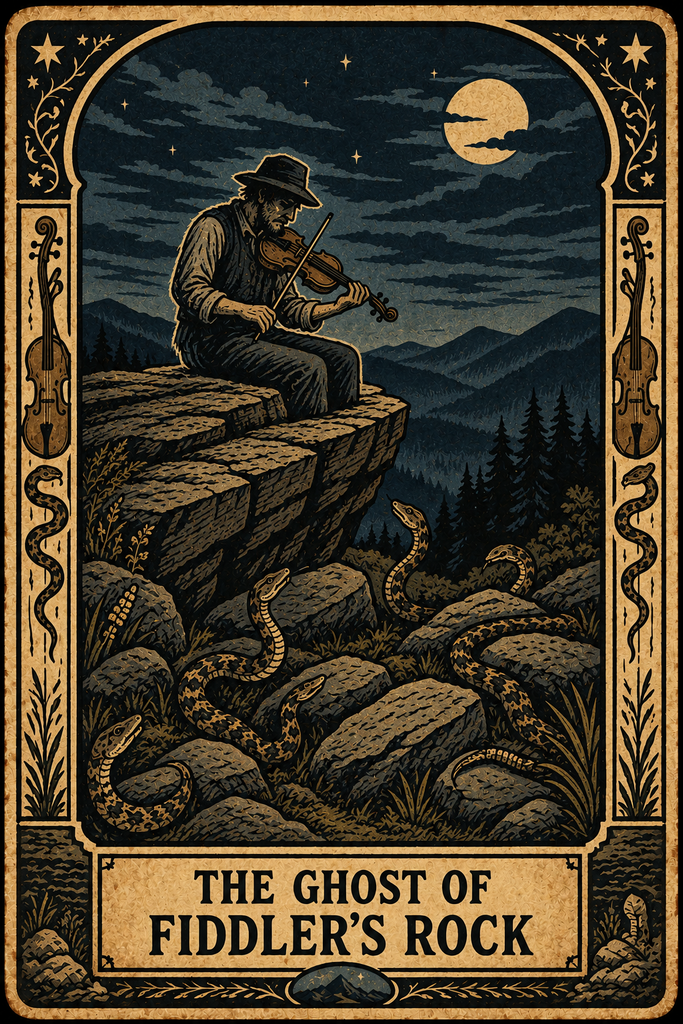
The Ghost of Fiddler’s Rock is a Johnson County legend tied to Stone Mountain east of Mountain City. Kathryn Tucker Windham included the story in her 1977 collection Thirteen Tennessee Ghosts and Jeffrey. Her version follows Martin, a gifted fiddler said to charm rattlesnakes from their dens with music. After repeatedly killing the snakes, Martin returned to the rock at night and was fatally bitten.
Later tellings say phantom fiddle music and screams can still be heard around Fiddler’s Rock. Southern Gothic identifies the site as a sandstone outcrop near Stone Mountain, marked by carvings and old names. Johnson County musician Kody Norris turned the legend into his 2023 song “Fiddler’s Rock.” The song retells Martin Stone’s snake-charming story from Norris’s own East Tennessee upbringing.
The Hill Barghest (University of Tennessee / Knoxville)
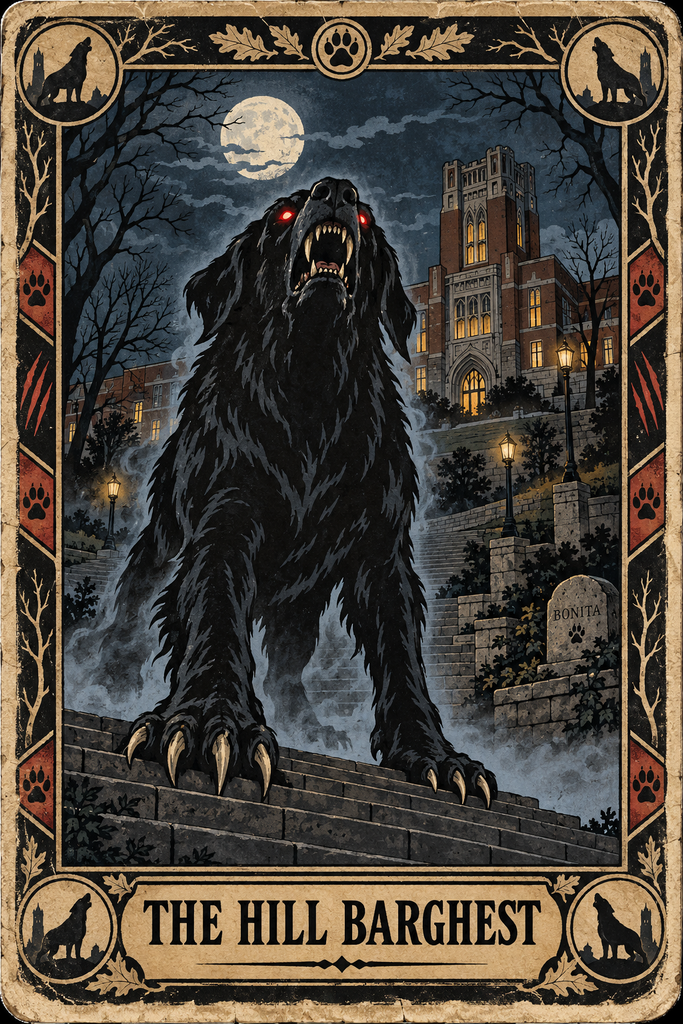
The Hill Barghest is a University of Tennessee campus legend centered on the Hill in Knoxville. UT Libraries’ Volopedia describes a huge spectral dog said to guard the area. Stories give it glowing red eyes, long fangs, enormous claws, and a mournful nighttime howl. Campus lore says the creature’s howling has sometimes prompted calls to UT Police.
The Daily Beacon described the black dog legend in 2012 among UT’s reported hauntings. Some versions connect the hound with Bonita, a Tyson family dog buried on campus. UT’s Torchbearer identifies Bonita as a spaniel given to Isabella Tyson. Her grave remains in the yard of Tyson Alumni House.