Iowa
Iowa folklore stretches from river bluffs and wooded parks to farmland and historic towns, mixing ghost stories, cryptid sightings, and haunted places. Rural bridges, century-old cemeteries, and small-town backroads carry legends tied to specific communities.
These stories grow from local history and thrive in the state’s isolated stretches, where unusual encounters stand out against a backdrop of Midwestern calm. Across Iowa, each region contributes its own strange tales, keeping the state’s folklore alive.
Van Meter Visitor (Van Meter)
The Van Meter Visitor appeared in local reports during several nights in late September 1903. Witnesses described a huge bat-like creature with broad wings and a horn emitting brilliant light. Residents reported a foul odor, enormous tracks, and gunfire that seemed unable to stop it. Prominent townspeople joined the growing list of witnesses as the sightings spread through Van Meter.
The story ended with armed townsmen tracking the creature toward an abandoned coal mine outside Van Meter. Some accounts describe a second, smaller creature entering the mine with it. The Visitor vanished from the town’s nightly reports, but the legend endured for generations. Van Meter now celebrates the creature with an annual festival devoted to its strange 1903 visitation.

Black Angel of Oakland Cemetery (Iowa City)
The Black Angel is an eight-and-a-half-foot bronze grave monument in Iowa City’s Oakland Cemetery. Teresa Dolezal Feldevert commissioned sculptor Mario Korbel after her second husband, Nicholas Feldevert, died in 1911. Her son Eddie Dolezal had already died of meningitis in Iowa City in 1891. The City of Iowa City records the angel’s arrival by flatcar on November 21, 1912. The Smithsonian dates the monument to 1913 and identifies Korbel as its sculptor.
Weathering turned the bronze black, while local folklore supplied darker explanations for the change. A 1981 Daily Iowan feature warned that touching the angel meant death within seven years. Kissing it supposedly shortened the sentence to seven weeks, or twenty-four hours at midnight. Other student traditions claimed kissing a virgin beneath the statue could restore its original color. Iowa PBS still features the Black Angel and notes the Halloween crowds it attracts.

Okoboji Lake Monster (East Okoboji Lake)
East Okoboji Lake has a documented lake-monster report dating to 1903. Charles Bartlett and his wife encountered violent water disturbances while fishing from a small boat. The July 3 Vindicator and Republican account described something moving rapidly just beneath the surface. Bartlett compared its apparent size to an overturned skiff and feared its waves would swamp their boat. He suggested a sea serpent or an extraordinarily large fish but never saw the creature clearly.
On June 23, 2001, another family reported a strange animal while staying at an Okoboji resort. The mother’s original submitted account described a dark green-blue hump rising near their dock. She and her children then saw an oval head resembling a lizard or horse. The animal approached before diving beneath the dock, followed by a heavy impact that shook the structure. George Eberhart later catalogued the encounter in Mysterious Creatures.

Specter of Stony Hollow Road (Burlington, Iowa)
The Specter of Stony Hollow Road is a Burlington ghost legend centered on a woman named Lucinda. Local tradition places her story in the nineteenth century. Lucinda supposedly waited beside the road for a lover who planned to run away with her. When he failed to arrive, she believed he had abandoned her and climbed a nearby bluff. She jumped to her death before learning his wagon had become stuck in mud.
Later versions turn Lucinda into a roadside apparition summoned by calling her name three times. Some say she appears near the cliff or leaves a rose at the visitor’s feet. The rose carries the darker warning that the recipient will die within the following days. Greater Burlington’s tourism organization still features Stony Hollow Road among the area’s famously haunted sites.

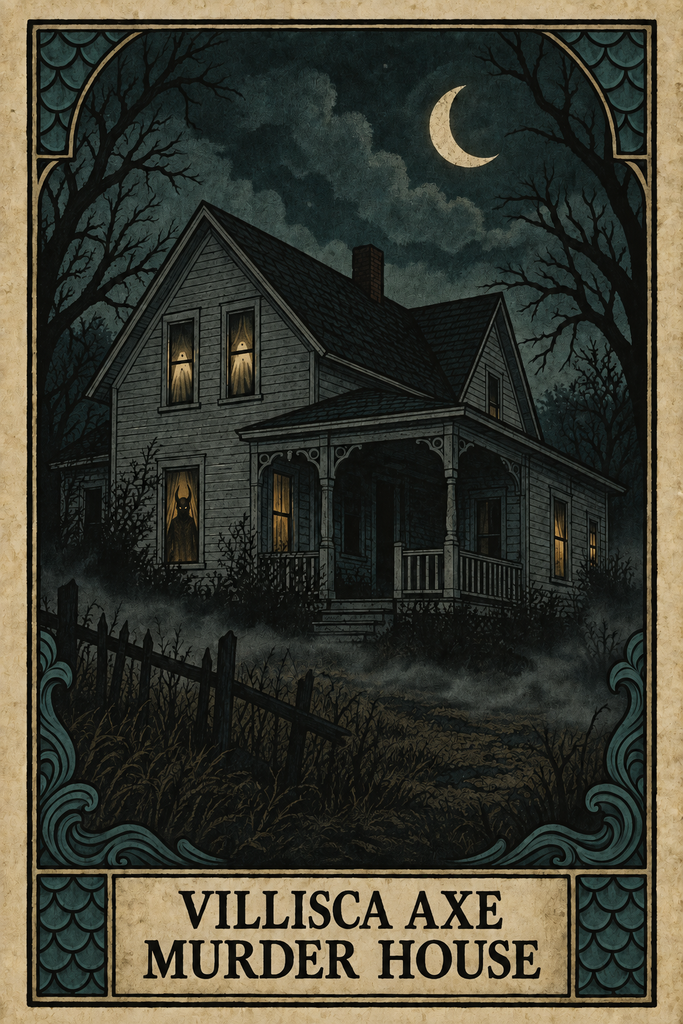
Villisca Axe Murder House Haunting (Villisca, Montgomery County, Iowa)
The Villisca Axe Murder House stands in Villisca, Iowa. On June 10, 1912, someone murdered Josiah and Sarah Moore inside. Their four children also died in the house that night. Two visiting girls, Ina and Lena Stillinger, died there as well. The unsolved killings fixed the house in Iowa memory.
Later legend turned the Villisca house into a major haunting site. Visitors report voices, moving doors, cold spots, and children’s sounds upstairs. Public tours and overnight stays keep the Villisca story active. The house now stands between true crime history and Iowa ghost folklore.