Florida
Florida cryptids range from the Skunk Ape of Big Cypress to river monsters, wild men, giant alligators, and stranger coastal creatures. Swamps dominate many stories, but Florida folklore also grew around beaches, inland rivers, old settlements, and isolated Panhandle communities.
The state has an unusual talent for turning sightings and practical jokes into lasting local legends. Clearwater had mysterious monster tracks, St. Augustine acquired a famous sea carcass, and Cassadaga developed its own supernatural traditions. Newspaper scares, roadside attractions, fearsome critters, hauntings, and reported encounters all belong comfortably in Florida’s crowded bestiary.
Skunk Ape (Everglades and Big Cypress)
The Skunk Ape is Florida’s best-known cryptid, associated especially with the Everglades and Big Cypress. Witnesses describe a large, upright, hair-covered creature distinguished by a powerful, unpleasant odor. Reports increased during the 1960s and 1970s, although earlier Florida encounters also appear in modern histories. In 1997, tourists near Turner River Road reported a hulking ape-like figure among the cypress trees.
In December 2000, the Sarasota County Sheriff’s Office received two anonymous photographs showing a large, reddish, ape-like figure. The images became known as the Myakka Skunk Ape photographs and circulated widely afterward. Florida lawmakers had already considered protecting the creature decades earlier. The State Archives preserves the unsuccessful 1978 Florida Skunk Ape Protection Act and its legislative records.

St. Augustine Monster (Anastasia Island, St. Augustine)
The St. Augustine Monster was a massive carcass found on Anastasia Island in November 1896. Two boys discovered it and reported the find to physician DeWitt Webb. Webb examined the pale, rubbery mass and estimated it weighed at least five tons. Its apparent arm stumps convinced him it might be an enormous octopus. Zoologist Addison E. Verrill initially agreed and named it Octopus giganteus.
Webb sent photographs and tissue to the Smithsonian Institution in 1897. Later tests repeatedly revived and challenged the giant-octopus identification. A 1995 biochemical study found mammalian collagen rather than octopus tissue. Smithsonian testing later identified the surviving material as whale blubber. The Smithsonian still preserves photographs, correspondence, and material from the 1896 carcass.

Devil’s Chair of Cassadaga (Lake Helen Cemetery, Volusia County)
The Devil’s Chair stands in Lake Helen Cemetery, near the Cassadaga Spiritualist Camp. The brick seat occupies the Thatcher family plot and was built as a mourning chair. Local legend says anyone sitting there at midnight may hear the Devil speak. Another version says an unopened beer left overnight will be empty by morning.
The story became widely associated with Cassadaga during the late twentieth century. Cassadaga minister Louis Gates recalled local teenagers secretly drinking beer left beside the chair. Their prank became part of the legend rather than replacing it. The Cassadaga Spiritualist Camp still addresses the Devil’s Chair in its visitor FAQ.

Bardin Booger (Bardin, Putnam County)
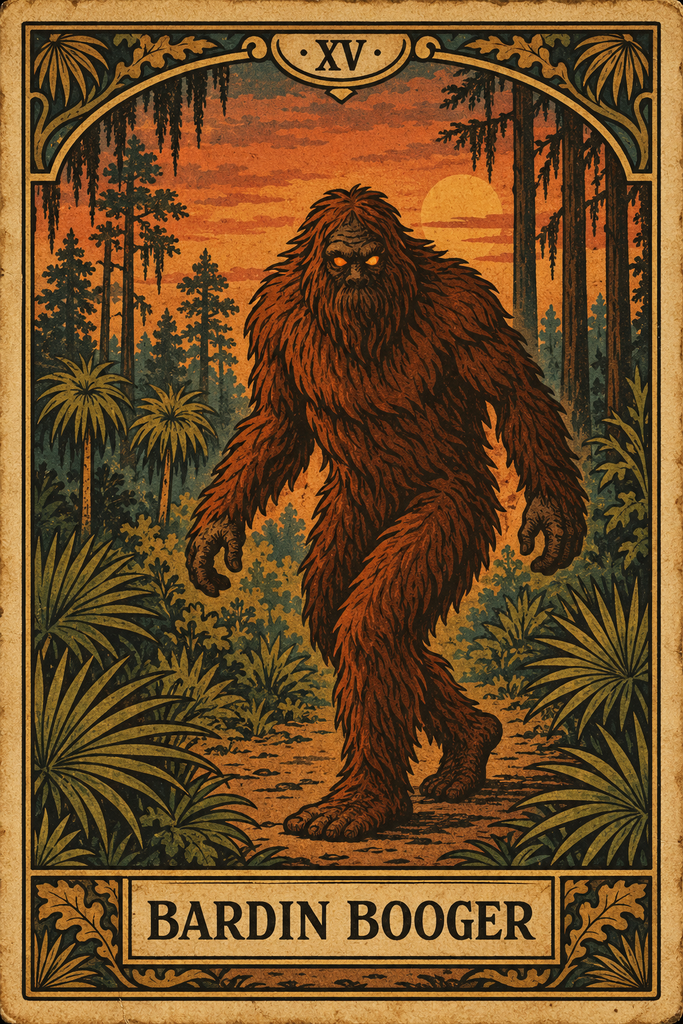
The Bardin Booger is a hairy humanoid from folklore around Bardin, northwest of Palatka in Putnam County. Geoff Dobson’s local history places the first reported sighting near Etoniah Baptist Church during the 1940s. Later stories described large, hairy figures moving through the pine woods, alongside stranger tales shared at Bud’s Grocery. Some residents claimed encounters involving lanterns, stolen clothes, and raids on refrigerators.
Palatka Daily News publisher Jody Delzell coined the name “Bardin Booger” in 1981. His column brought wider attention, while locals answered reporters with pranks, stories, songs, and costumes. Local musician Billy Crain wrote a Bardin Booger song, and Lena Crain appeared publicly in costume. In 2006, the Booger appeared at Palatka’s Azalea Festival carrying an American flag and bouquet of azaleas.
Two-Toed Tom (Esto and the Florida-Alabama Border)
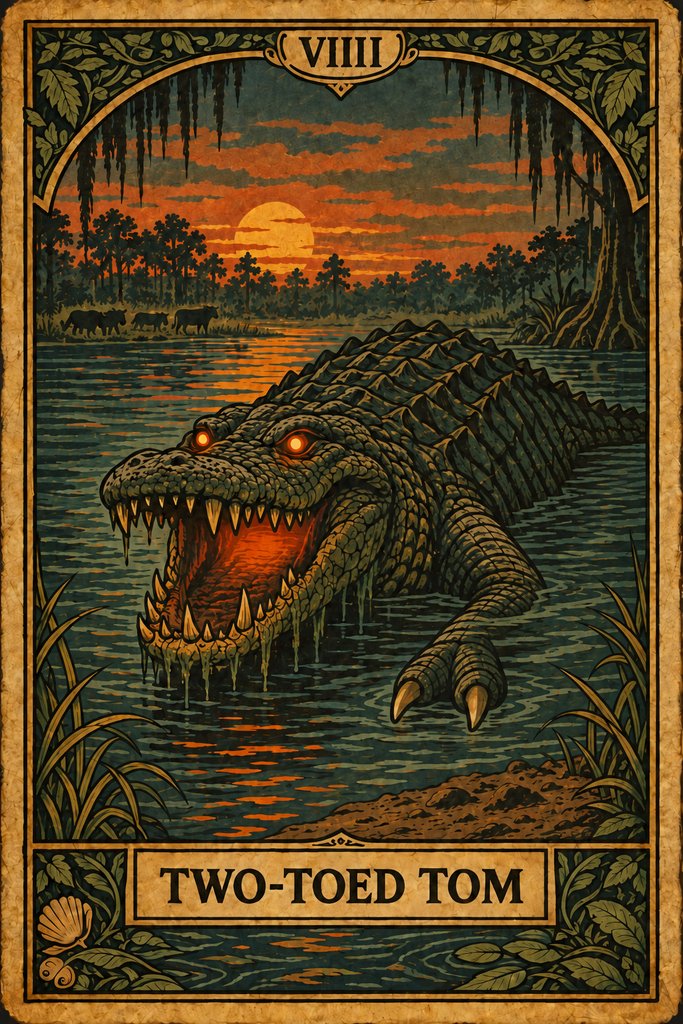
Two-Toed Tom is a giant alligator legend shared across the Florida-Alabama border. Carl Carmer recorded an early version in his 1934 book Stars Fell on Alabama. Stories say a steel trap tore away three toes from one front foot, giving Tom his name. Later Florida accounts placed him in Sand Hammock Lake near Esto and blamed him for missing hogs and young cattle.
In 1987, Esto councilman Ralph Dupree said he had heard the story since about 1922. He claimed he had seen Tom repeatedly after the alligator settled near Esto and Noma. The town launched the Two-Toed Tom Festival in 1987. The annual festival still celebrates the legendary alligator with music, vendors, gator shows, and local storytelling.
St. Johns River Monster (St. Johns River, Central Florida to Jacksonville)
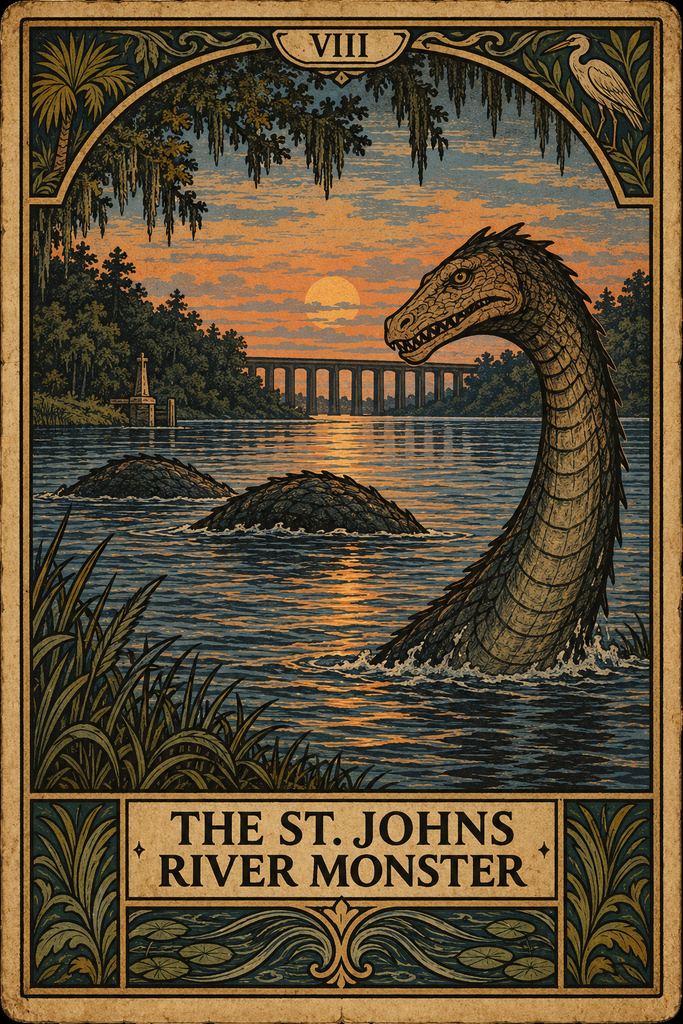
The St. Johns River Monster is a long-running Florida legend reported from Central Florida north through Jacksonville. In October 1953, newspapers reported several witnesses describing a thirty-five-foot river creature with a horn. Reptile-park owner Owen Godwin offered $5,000 for a living specimen meeting his size and horn requirements. Former state attorney J.W. Hunter recalled earlier creatures called “Borinkus” along the river during the 1910s.
In May 1975, five friends near Jacksonville reported a pink, dragon-like creature rising beside their fishing boat. Witness Wallace McLean later drew the creature for newspapers, while Brenda Langley compared it to a dragon. In July 1976, Kathy Kirkland reported connected humps and a basketball-sized head near Stockton Park. McLean’s 1976 newspaper sketch remains the best-known eyewitness image associated with the legend.
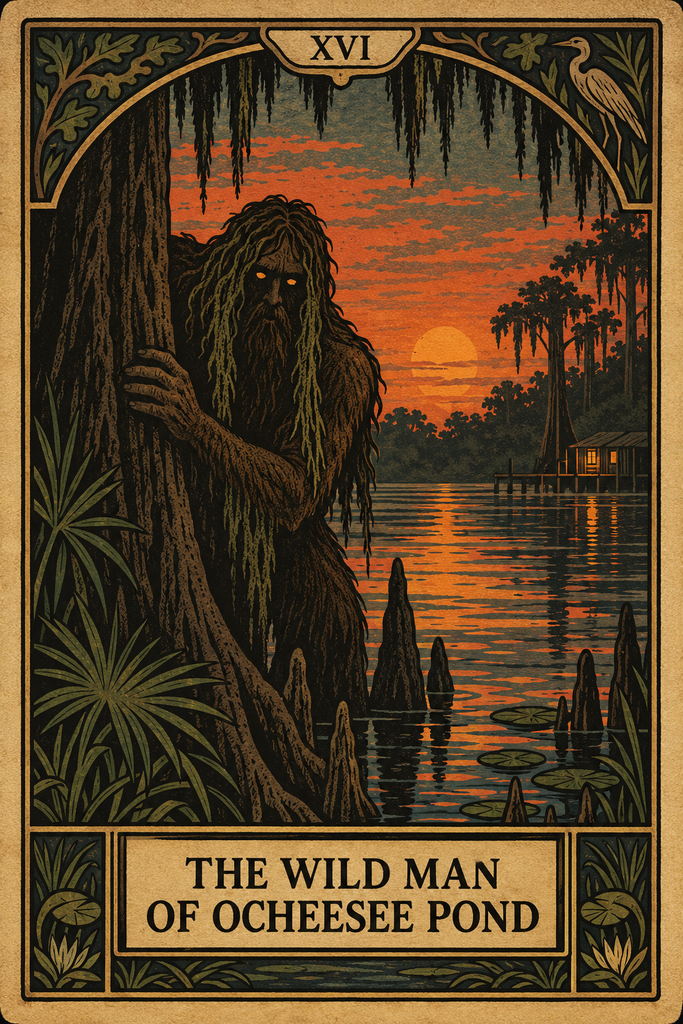
Wild Man of Ocheesee Pond (Ocheesee Pond, Jackson County)
The Wild Man of Ocheesee Pond entered newspaper reports in August 1884. Local men reportedly captured a naked, emaciated figure covered with an extraordinary growth of hair. He had been swimming between islands and apparently surviving on berries. Captors suspected an escaped patient and took him toward Chattahoochee and Tallahassee for identification.
Historian Dale Cox later traced the story through multiple 1884 reports. Those reports said no Florida asylum claimed the captive, and authorities could not determine his identity. Florida’s Office of Greenways and Trails still notes the 1884 capture in its history of Ocheesee Pond. The captive’s fate disappears from the surviving newspaper trail after his return toward Chattahoochee.
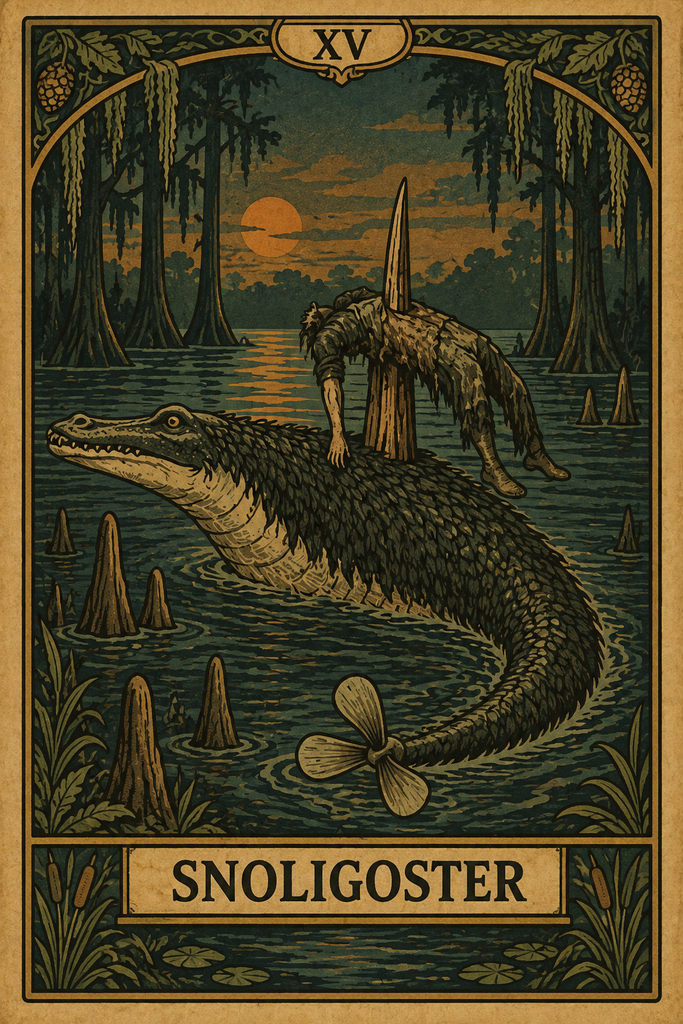
Snoligoster (Lake Okeechobee and Florida Cypress Swamps)
William T. Cox recorded the Snoligoster in his 1910 collection of lumberjack folklore. He placed it particularly in the cypress swamps around Lake Okeechobee, Florida. Cox described a gigantic, fur-covered crocodile shape without legs, carrying a long spike along its back. Three bony plates on its tail supposedly spun like a steamboat propeller, driving it through swamp mud.
Cox attributed one tale to forester Inman F. Eldredge of De Funiak Springs, Florida. In the story, Eldredge saw a dead man impaled on what first resembled a cypress knee. The spike began moving, revealing itself as part of the creature. Coert Du Bois illustrated the Snoligoster in Cox’s volume, giving the creature its earliest known printed image.
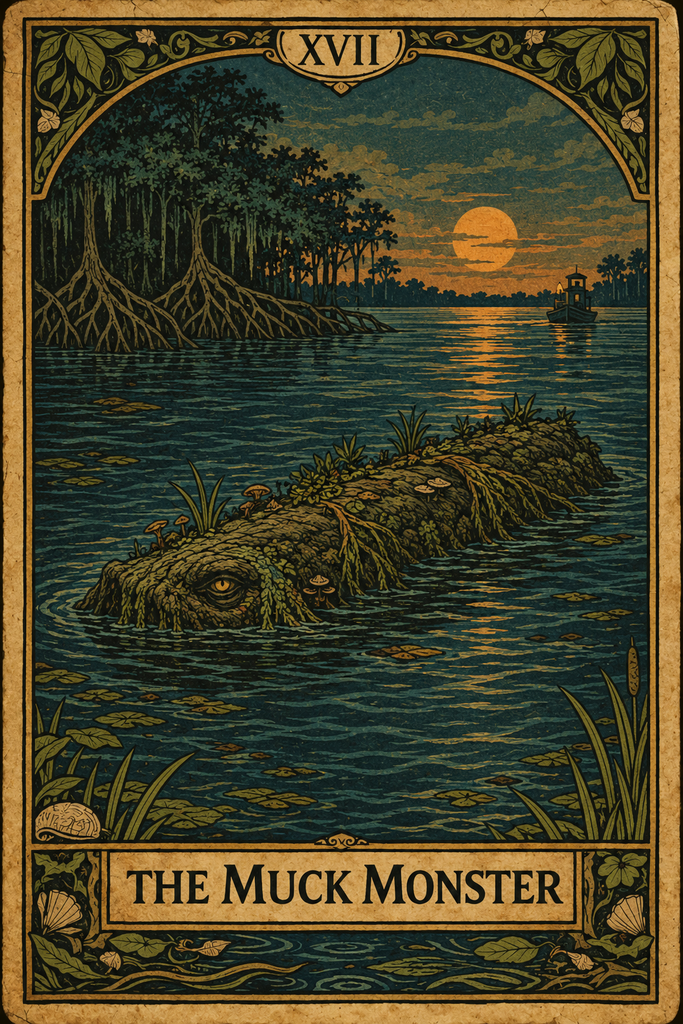
Muck Monster (Lake Worth Lagoon, Palm Beach County)
The Muck Monster entered South Florida folklore after an August 2009 encounter in Lake Worth Lagoon. Lagoon Keepers Greg Reynolds and Don Serrano filmed an unusual wake near Channel Marker 10. Reynolds said the shape repeatedly submerged whenever their boat approached within about ten feet. FWC marine biologist Thomas Reinert reviewed the footage but could not identify the animal.
The story spread quickly, drawing millions of online views and additional reports from the lagoon. In September 2009, West Palm Beach commissioners voted to make the Muck Monster an official city resident. They also planned observation stations where visitors could watch the water for new sightings. By 2015, Palm Beach County tourism campaigns were inviting visitors to search for the creature.
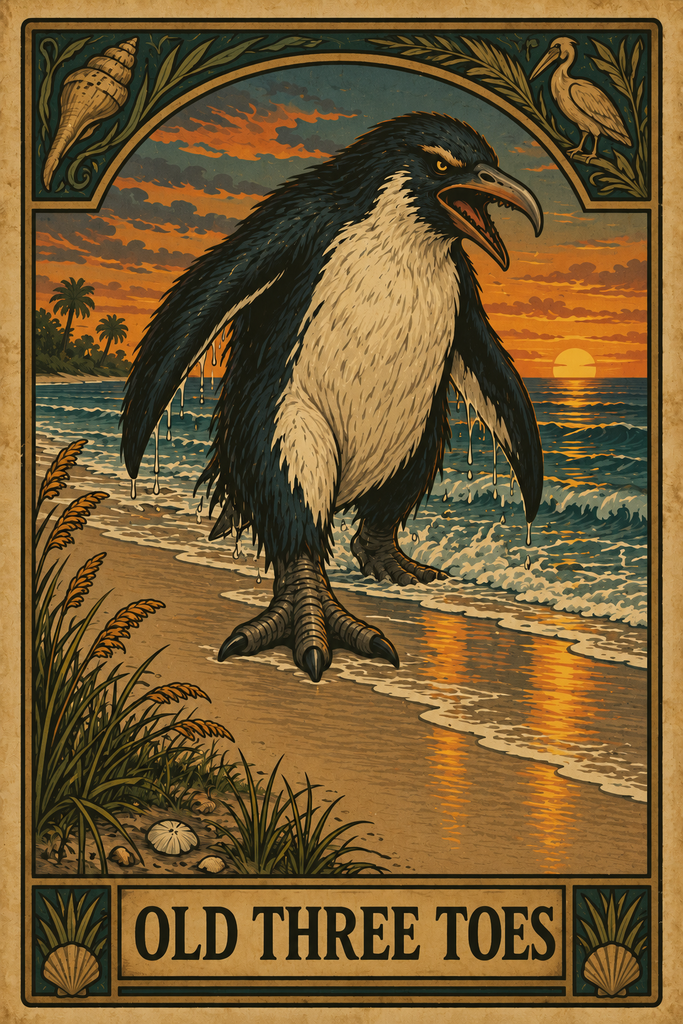
Old Three Toes (Clearwater Beach and Florida Gulf Coast)
In February 1948, enormous three-toed tracks appeared on Clearwater Beach and soon elsewhere along Florida’s Gulf Coast. Newspapers called the mystery the Clearwater Monster, later nicknamed Old Three Toes. Reports soon included sightings of a large swimming animal, some even describing a giant penguin, near Dunedin and other nearby waters.
In 1988, Clearwater mechanic Tony Signorini said he and Al Williams had created the footprints as a prank. He produced the cast-iron three-toed feet they supposedly used and demonstrated how the tracks were made. The confession strongly explains the footprints, although contemporary newspapers also carried separate reports of animals seen offshore. Clearwater newspapers revisited the monster for decades, and the iron feet remained with Signorini’s family after his death.
Two Egg Stump Jumper (Two Egg and Parramore, Jackson County)
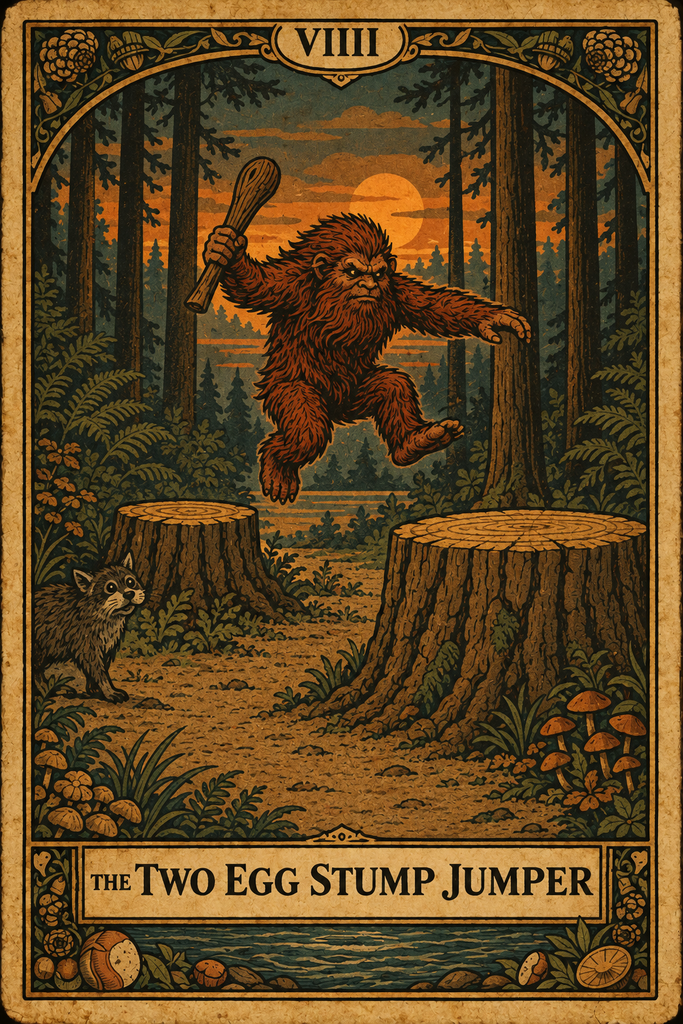
The Two Egg Stump Jumper is a modern cryptid legend from northeastern Jackson County, near old Parramore. In February 2010, local historian Dale Cox reported two unrelated witnesses describing a small upright creature. One saw a pale figure running away at night after hearing noises outside his home. Another saw a small, two-legged “mini-Bigfoot” near swampy ground by Circle Hill Baptist Church.
Cox later reported unusual tracks and described the creature with white or gray hair. Later accounts also place it crossing dirt roads at night near the Parramore swamps. Visit Florida now includes the Stump Jumper among Two Egg’s local supernatural stories. Its coverage also connects the legend with nearby Ocheesee Pond’s older wild-man history.