New Mexico
New Mexico cryptids draw from Indigenous traditions, Spanish colonial folklore, desert legends, hauntings, and modern creature reports. The state’s mesas, mountains, river valleys, and vast desert regions give many stories a strong local setting.
New Mexico folklore includes giant birds, strange desert creatures, ghost stories, and figures such as La Llorona. Chupacabra reports added newer monster traditions during the 1990s. Older legends and modern sightings continue to overlap across the Rio Grande, isolated highways, ranch country, and remote canyons.
La Llorona (Rio Grande)
La Llorona, the Weeping Woman, is one of New Mexico’s best-known ghost legends. New Mexican versions often place her along the Rio Grande, especially near Albuquerque and other river communities. The legend usually describes a woman condemned to wander after drowning her children, crying as she searches for them.
In Albuquerque, family traditions describe her cries moving through the bosque beside the river. A Santa Fe informant also identified La Llorona as a New Mexican legend in 2018. Mesilla preserves the story beside its La Llorona Trail along the Rio Grande.

Giant Birds / Teratorns (Southern New Mexico)
Southern New Mexico has modern reports of unusually large birds later linked by cryptozoologists to extinct teratorns. A 2007 KRQE report featured Las Cruces resident Dave Zander recalling two enormous birds seen about nine years earlier. He described black feathered bodies, pink bald heads, and wingspans he estimated near twenty feet. Cryptozoologist Ken Gerhard suggested surviving teratorns as one interpretation.
The same report preserved a 1972 Maxwell account from Ronald Monteleone, who described a pterodactyl-like animal. The reports differ in appearance, making “teratorn” a later cryptozoological label rather than a stable local name. Teratornis merriami itself had an estimated wingspan of about twelve feet and is known only from fossils. Later paranormal writing and podcasts have kept New Mexico’s giant-bird stories in circulation.

Chupacabra (New Mexico)
Chupacabra entered New Mexico folklore soon after the creature emerged in Puerto Rico during 1995. Early descriptions portrayed a bipedal, spiny-backed animal blamed for draining blood from livestock and other animals. In December 1996, the Albuquerque Journal reported twenty dead rabbits blamed locally on the “goatsucker.”
New Mexico reports later followed the broader shift toward hairless, dog-like Chupacabras. In 2007, a strange animal seen near Coors Road in Albuquerque drew local Chupacabra speculation. Researcher Benjamin Radford later said the animal was identified as a dog. Rudolfo Anaya further embedded the creature in New Mexican culture with his 2008 novel ChupaCabra and the Roswell UFO.

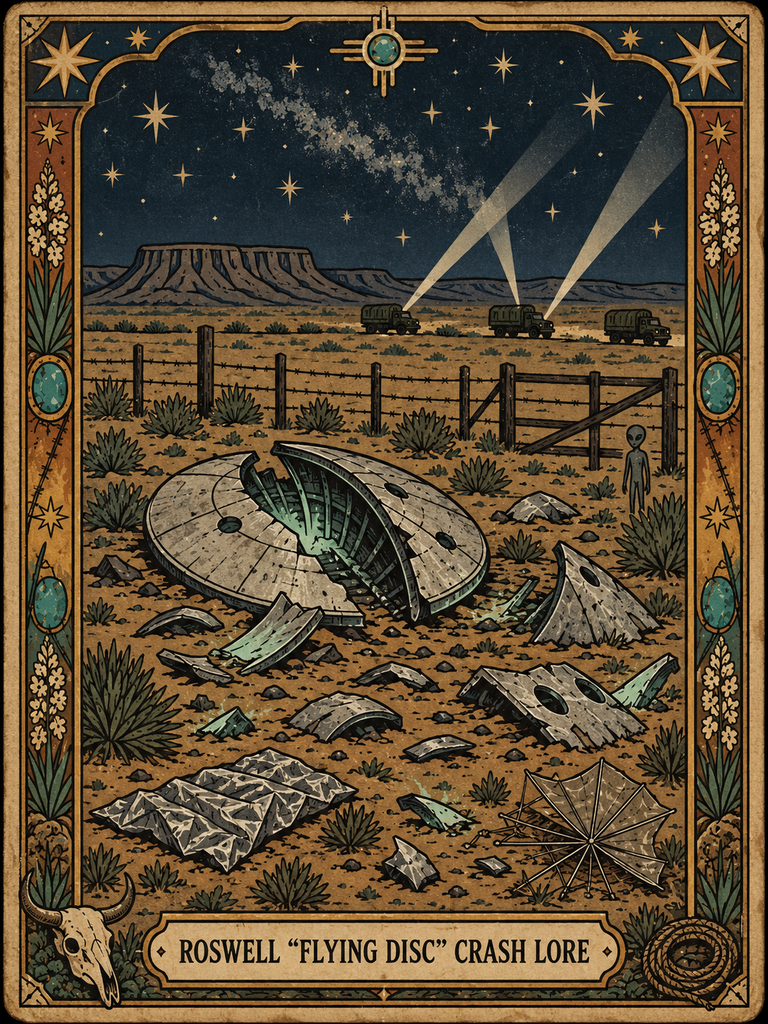
Roswell “Flying Disc” Crash Lore (Roswell and ranch country northwest of the city)
Roswell crash lore begins with the July 1947 debris story that local papers tied to Roswell. On July 8, the Roswell Daily Record reported that Roswell Army Air Field had recovered a “flying saucer” from a ranch near Roswell. The Army quickly replaced that claim with a balloon explanation, but the first headline fixed Roswell to flying-disc legend.
The story grew far beyond the first week of reporting. TIME says Stanton Friedman revived the case in 1978 after interviewing Jesse Marcel, pushing Roswell back into national UFO culture. Roswell’s UFO Museum hosts an annual UFOlogist Invasion, and New Mexico’s official tourism site promotes the annual Roswell UFO Festival.
The Taos Hum (Taos area)
The Taos Hum is a low-frequency sound reported by some residents around Taos beginning in the early 1990s. A 1993 Associated Press report described residents hearing throbbing, generator-like, or distant diesel sounds. In 1993, New Mexico’s congressional delegation requested an investigation after residents raised the issue. Joe Mullins and James Kelly later summarized the research in the Acoustical Society of America’s 1995 ECHOES newsletter.
The investigators surveyed 8,000 residents in Taos and surrounding communities, receiving 1,440 responses and identifying 161 hearers. About 80 percent of those hearers reported perceiving the hum at least weekly. The team found no known acoustic or seismic signal that explained the reports. Researchers then shifted attention toward low-frequency hearing and other possible human auditory mechanisms. The Taos County Historical Society revisited the Hum in its 2016 journal, Ayer y Hoy.

Dulce Base (Archuleta Mesa near Dulce)
Dulce Base is the modern legend of a hidden underground installation beneath Archuleta Mesa near Dulce. By 1988, the story had reached New Mexico newspapers, as shown by a Santa Fe New Mexican article headlined “ETs living in NM? Not likely investigators say.” New Mexico Magazine later summarized the legend as a claim that extraterrestrials inhabited caverns below Archuleta Mesa outside Dulce.
The legend kept growing in public life after that. New Mexico Magazine included “Aliens in Dulce” in its 2012 list of unsolved New Mexico mysteries. A 2026 feature described a Dulce Base Tipi stay as a blend of local hospitality, history, and high strangeness. New Mexico’s official tourism site now lists the Dulce Base Tipi.

Los Lunas Decalogue Stone (Hidden Mountain area near Los Lunas)
The Los Lunas Decalogue Stone, also called Mystery Stone and Commandment Rock, sits near Hidden Mountain west of Los Lunas. The New Mexico State Land Office says the stone is an 80-ton basalt boulder. It has an inscription that some people read as an abbreviated version of the Ten Commandments in Hebrew. The same state profile says University of New Mexico archaeologist Frank Hibben first documented the stone in 1933.
The stone later gained a full folklore life as a mystery site. New Mexico Magazine called it one of the most persistent mysteries in New Mexico, or one of its biggest hoaxes, while the State Land Office calls it one of the state’s most famous attractions. Visitors now hike in under a recreation permit to see the boulder for themselves, which keeps the debate attached to Los Lunas and Hidden Mountain.
