Maryland
Maryland folklore stretches from the Appalachian ridges in the west to the tidal marshes of the Chesapeake Bay in the east. Colonial settlement, fishing towns, and shipping routes all shaped the state’s legends, leaving behind a mix of ghost stories, cryptid sightings, and waterfront hauntings.
Each region adds its own mysteries. Forested hills echo with strange creatures, while coastal towns whisper of spirits tied to the water. From backroads to bay shores, Maryland cryptids and folklore continue to thrive in a landscape that balances rugged highlands with haunted waterways.
Chessie (Chesapeake Bay and Kent Island)
Chessie is a sea-serpent legend associated with the Chesapeake Bay in Maryland and Virginia. Witnesses usually describe a long, dark creature moving through the water with a serpentine or undulating motion. Reports became especially prominent during the late 1970s and early 1980s. A 1978 cluster placed a 25- to 30-foot creature in the lower Potomac River.
On May 31, 1982, Robert and Karen Frew saw a long creature from their Love Point home. Robert filmed the animal moving through Chesapeake Bay near Kent Island. The footage drew national attention and was later examined by Smithsonian zoologists. Chessie later became an environmental mascot in federal Chesapeake Bay education materials.

Snallygaster (Frederick County and South Mountain)
The Snallygaster is a winged monster legend from Frederick County, especially the Middletown Valley and South Mountain. Local tradition links its name to German-speaking settlers and the phrase schneller Geist, meaning “quick spirit.” Descriptions give it enormous wings, a pointed beak, hooked claws, one central eye, and sometimes tentacles.
The Valley Register launched a widely circulated Snallygaster series on February 12, 1909. Stories soon spread through western Maryland with increasingly elaborate descriptions and encounters. Newspapers revived the creature in 1932 with new reports around Frederick and Montgomery counties. Frederick County tourism and preservation groups continue featuring the Snallygaster as regional folklore.

Goatman of Prince George’s County (Bowie and Fletchertown Road)
The Goatman is a Prince George’s County legend centered on Bowie, Fletchertown Road, and nearby wooded backroads. Stories describe a hairy, upright creature that is part man and part goat. Some versions give it horns and an axe, while others describe a shaggy hermit or animal-like figure. Later retellings connect the creature to experiments at the Beltsville Agricultural Research Center.
University of Maryland folklore collections recorded Goatman stories by 1971. That October, the Prince George’s County News published an article drawing from those local traditions. After a Bowie family found their dog Ginger decapitated near Fletchertown Road, newspaper attention intensified. The legend then spread through teenage dares, backroad searches, local media, and later Maryland folklore collections.


The Dwayyo (Frederick County and the Catoctin Mountains)
The Dwayyo is a hairy, dog-like monster from Frederick County and the Catoctin Mountains. Contemporary newspaper coverage introduced the creature to a wide audience in November 1965. A man calling himself John Becker reported encountering it near his Frederick County home. He described a six-foot creature with black hair, dog-like feet, and a bushy tail.
Additional Dwayyo stories appeared around Frederick County during the following weeks. Reports described strange cries, large animals, and further supposed encounters in rural areas. The brief newspaper scare later developed into a lasting western Maryland monster legend. Modern retellings often connect the Dwayyo with the region’s older Snallygaster tradition.

Pig Woman of Cecil County (North East, Elkton, and Rising Sun)
The Pig Woman, also called the Pig Lady, is a Cecil County legend associated with rural roads and bridges. One common version begins with a nineteenth-century farmhouse fire near North East. The woman survives badly burned, flees into the woods, and later develops a pig-like face in retellings. Other versions place her beneath an old bridge or along secluded roads.
Drivers supposedly encounter her after their cars stall, sometimes hearing squeals, scraping, or pounding against the vehicle. Stories say those who remain inside find scratches or dents after escaping. Rising Sun versions circulated by the 1960s and often targeted teenagers parked on rural roads. The legend has remained part of Cecil County ghostlore through books, local reporting, and repeated retellings.

Black Aggie (Druid Ridge Cemetery, Pikesville, Maryland)
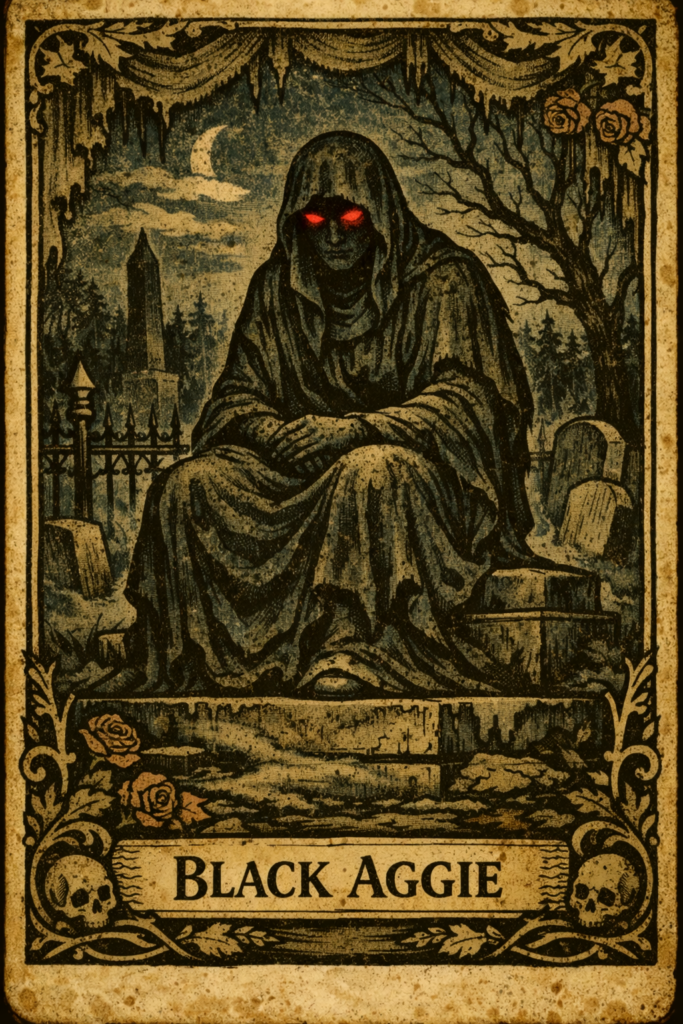
Black Aggie stood on the Agnus family plot in Druid Ridge Cemetery, Pikesville, Maryland. It was a shrouded seated statue, later tied to Baltimore dare stories. The legend grew after the statue reached the grave in the 1920s. Stories said its eyes glowed red at midnight. Other tales warned of blindness, miscarriage, and death in its lap.
Teenagers visited Black Aggie for dares, hazing, and slumber-party terror. Some children tried summoning her in mirrors long after the statue left Maryland. The family donated it to the Smithsonian in 1967. That removal did not kill the story in Baltimore.
Moll Dyer (Leonardtown, St. Mary’s County, Maryland)
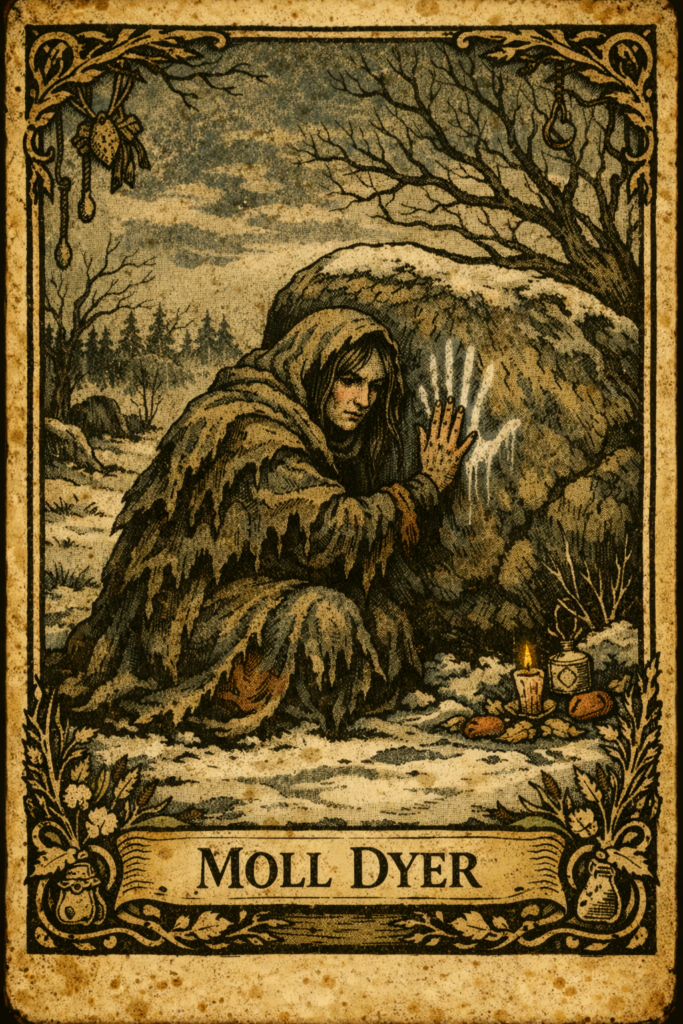
Moll Dyer belongs to Leonardtown witch lore in St. Mary’s County, Maryland. According to legend, villagers blamed her for influenza during the winter of 1697 and 1698. A mob burned her hut south of present-day Leonardtown. Days later, people found her frozen against a large rock.
Legend says her handprint remained on the stone as a curse. Touching the rock supposedly brings dizziness, illness, or bad luck. Phillip Love found the rock near Moll Dyer Road in 1972. It now stands at Tudor Hall in Leonardtown. Visitors often leave trinkets and small gifts for Moll.