Nevada
Nevada cryptids and folklore stretch across alpine lakes, desert basins, mining country, ghost towns, and long isolated highways. Lake Tahoe, the Great Basin, Black Rock Desert, and southern Mojave country each support different kinds of legends and strange reports.
The state’s stories include lake creatures, desert animals, haunted mining settlements, roadside apparitions, and Indigenous traditions tied to specific places. Later settler and mining-era folklore added tales of giants, mysterious lights, and creatures encountered far from towns and settlements.
Tahoe Tessie (Lake Tahoe, Nevada-California Border)
Tahoe Tessie is a lake-monster legend associated with Lake Tahoe on the Nevada-California border. Modern reports usually describe a large, dark animal or shape moving quickly beneath the water. During the 1980s, witnesses included two police officers, two nuns, an optician, and ten Tahoe City postal workers. Reno officer Kris Beebe described a dark creature at least ten feet long swimming beneath him while waterskiing.
The name Tahoe Tessie was coined by Kings Beach resident Bob McCormick during a 1975 kayaking trip. His 1984 children’s book helped turn Tessie into a friendly local mascot sold through tourism and community events. Later, tourism, merchandise, festivals, and repeated sightings kept the creature firmly attached to Lake Tahoe folklore

Washoe Water Babies of Cave Rock (Cave Rock, Lake Tahoe, Nevada shore)
Cave Rock stands on Lake Tahoe’s east shore in present-day Nevada. It holds deep importance in Washoe tradition. A Washoe tribal history published by the U.S. Forest Service says Water Babies inhabited bodies of water across Washoe territory, and that healers visited sacred Cave Rock to consult with them, bring offerings, and renew their powers. The same history describes Cave Rock as a sacred place that people avoided out of respect. However, Washoe healers went there to seek spiritual renewal.
Later public disputes over Cave Rock brought that tradition into wider view. The Washoe history says tunnel blasting disturbed Cave Rock in 1931 and 1951. It also records that people blamed later flooding in Carson Valley on angered Water Babies. Nevada State Parks says officials barred climbing equipment there in 1997 and banned climbing entirely in 2003, reflecting the site’s protected status and cultural importance.

Red-Haired Giants of Lovelock Cave (Lovelock, Nevada)
The Red-Haired Giants legend grew from a Northern Paiute tradition about enemy people living near the Humboldt River. Sarah Winnemucca recorded the story in 1883 in Life Among the Piutes. She described cannibal enemies with reddish hair who were eventually trapped inside a cave and killed by fire. Winnemucca’s account does not describe them as giants.
Lovelock Cave drew archaeological attention after guano miners uncovered artifacts there in 1911. Excavations beginning in 1912 recovered thousands of objects and human remains from centuries of Native use. BLM ethnographic records also preserve Northern Paiute versions involving red-haired cannibals and the cave’s destruction by fire. Later popular retellings transformed that tradition into stories of enormous red-haired giants.

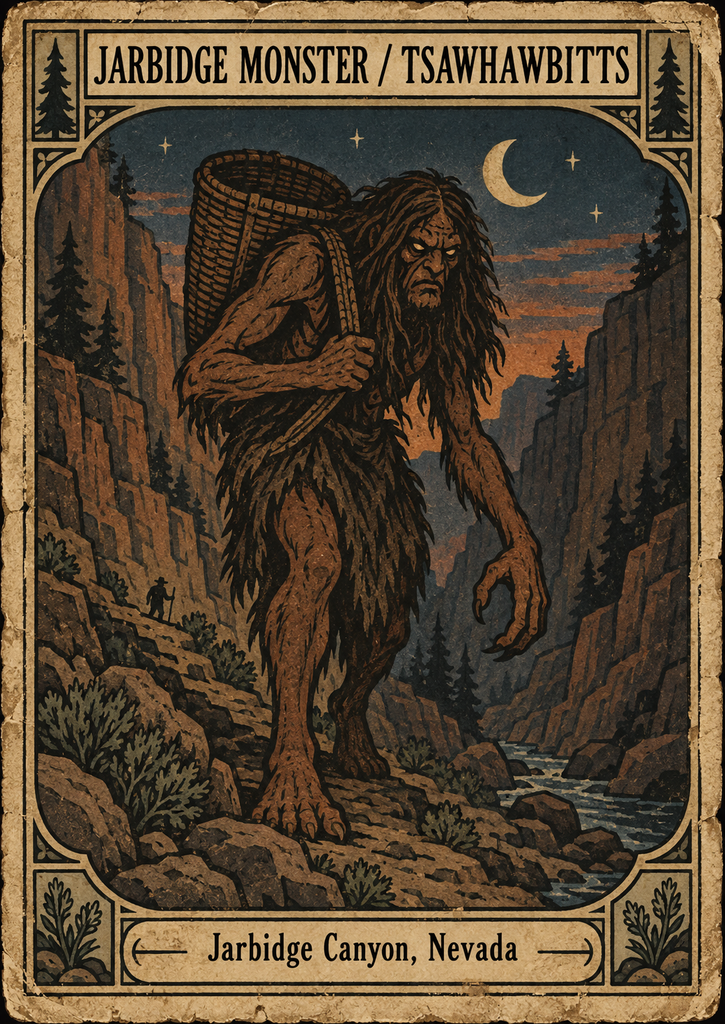
Jarbidge Monster / Tsawhawbitts (Jarbidge Canyon, Nevada)
The Jarbidge Monster is rooted in a Shoshone tradition about Tsawhawbitts, a dangerous being associated with Jarbidge Canyon. Travel Nevada describes Tsawhawbitts as a giant cannibal who captured travelers in a basket and carried them away. Other local versions describe an evil spirit or monster lurking in the canyon. The tradition gave the remote northeastern Nevada landscape a fearsome reputation before the twentieth-century mining boom.
Gold prospectors entered the canyon in 1909 and adapted the Shoshone name into Jarbidge. The Nevada State Historic Preservation Office still identifies the town’s name with this older tradition. Later Nevada histories continued retelling Tsawhawbitts alongside stories of the Jarbidge gold rush. The legend remains closely tied to the canyon and the town that inherited its name.
Area 51 Aliens and UFO Folklore (Groom Lake, Rachel, and the Extraterrestrial Highway)
Area 51 sits near Groom Lake in southern Nevada, north of Las Vegas and close to Rachel on State Route 375. Travel Nevada presents that road as the Extraterrestrial Highway, and National Geographic places the base off that highway near Groom Lake. In 1989, Bob Lazar told a Las Vegas television station that Area 51 housed alien spacecraft and that he worked there trying to recreate the technology. National Geographic and Travel Nevada both treat that claim as a key source of the site’s later alien lore.
That folklore moved from rumor into roadside culture along the highway. Travel Nevada describes Rachel as the closest community to Area 51 and the center of an alien-themed travel route filled with UFO stories, themed stops, and sighting lore.

The Nevada Triangle (Reno–Fresno–Las Vegas triangle)
The Nevada Triangle is a modern disappearance legend tied to a large zone over the Sierra Nevada and nearby desert skies. Nevada Public Radio described it in 2015 as a region where some 2,000 planes had been lost. Travel Nevada’s Nevada Magazine defined it as a triangle running from Reno to Fresno to Las Vegas.
Later retellings kept the name stable and the story active. In 2025, the Las Vegas Review-Journal still described the Nevada Triangle as a rumored hot spot for plane disappearances, and linked the legend to a 25,000-square-mile region spanning Reno, Las Vegas, and Fresno.
