South Carolina
South Carolina cryptids and folklore include swamp monsters, coastal ghosts, Gullah Geechee spirits, and sea-serpent reports. The Lowcountry carries traditions such as the Boo Hag and Plat-Eye alongside the Gray Man of Pawleys Island.
Inland, Bishopville has the Lizard Man of Scape Ore Swamp, while Columbia has the Third Eye Man. Charleston Harbor contributes nineteenth-century sea-serpent reports, and Summerville has its long-running ghost-light legend. These stories span coastal communities, university folklore, swamps, roads, and South Carolina’s Gullah Geechee cultural region.
The Lizard Man of Scape Ore Swamp (Bishopville and Lee County, South Carolina)
The Lizard Man is a reptilian cryptid from Scape Ore Swamp near Bishopville, South Carolina. Teenager Chris Davis reported the best-known encounter during the summer of 1988. According to a contemporary UPI report, Davis described a seven-foot creature with green scales, red eyes, and three fingers. He said it chased his car after he changed a flat tire near the swamp. The South Carolina Encyclopedia also records reports of damaged cars and other sightings around Browntown.
The story drew national attention within weeks, including CBS coverage and a Time magazine article in August 1988. WCOS offered a $1 million reward for the creature’s capture, while hunters searched the swamp. Local organizers revived the legend through the Lizard Man Stomp, first held in 2022. The 2023 Stomp drew hundreds to Bishopville for music, vendors, speakers, and Lizard Man events. Bishopville’s official site still gives the Lizard Man a dedicated page recounting the 1988 story.
From the Folk Bestiary shop

Products and checkout are handled by Redbubble.

The Third Eye Man (University of South Carolina, Columbia)
The Third Eye Man is a modern University of South Carolina campus legend associated with tunnels beneath Columbia. University archivist Elizabeth West says the story originated in a USC creative-writing class during the 1990s. A detailed version credited to USC graduate student Marc Minsker appeared online in 1998. That telling placed the creature near Longstreet Theatre and gave him silver clothing, a disfigured face, and three eyes.
Minsker’s version creates a chronology beginning with two students seeing a silver-clad man enter a manhole in 1949. It later adds mutilated chickens, a 1950 police encounter, and students chased through tunnels by a pipe-wielding figure. USC continues to include Mr. Third Eye among its campus ghost stories and tours. The legend remains closely associated with Longstreet Theatre and the university’s underground utility tunnels.

The Boo Hag (Gullah Geechee Lowcountry, South Carolina and Georgia)
The Boo Hag is a feared night-riding spirit in Gullah Geechee folklore from coastal South Carolina and Georgia. Folklore accounts describe Boo Hags shedding their skin before entering homes through cracks or openings. They ride sleeping victims, stealing breath or vitality and leaving them exhausted by morning. Some versions say repeated visits can cause illness or death. South Carolina-born Jacob Stroyer recorded related hag beliefs among enslaved people in his 1879 memoir.
Protective practices include salt, brooms, candles, and blue-painted doors or trim. Hags may be compelled to count broom straws until sunrise, preventing their escape. Lowcountry Gullah tradition also associates haint blue with protecting entrances from harmful spirits. The color could resemble water or sky, which spirits were believed unable to cross. Patricia McKissack and Onawumi Jean Moss brought the figure into children’s literature with 2005’s Precious and the Boo Hag.

The Gray Man of Pawleys Island (Pawleys Island, South Carolina)
The Gray Man is a protective ghost legend associated with Pawleys Island on South Carolina’s coast. Stories say he appears before hurricanes, warning residents who encounter him to leave the island. University of South Carolina connects the legend to the devastating 1822 hurricane that struck Georgetown and Horry Counties. One origin story says a young man drowned in marshy quicksand while traveling to his fiancée. He later appeared to warn her before the storm, and her family escaped the island.
Reported appearances continued before later storms, especially Hurricane Hugo in 1989. Jim and Clara Moore told Unsolved Mysteries that a gray figure vanished as they approached him before Hugo. They returned afterward to find their house standing while neighboring properties suffered severe damage. Garden & Gun also records another pre-Hugo sighting connected with the Love family’s surviving home. USC reported another claimed sighting shortly before Hurricane Ian reached Pawleys Island in September 2022.

Charleston Coast Sea Serpents (Sullivan’s Island and Charleston Coast, South Carolina)
Charleston-area sea-serpent reports are better documented from the late nineteenth century than from 1830. In June 1885, the Charleston Sunday News reported a huge serpent near Breach Inlet on Sullivan’s Island. A later local history quotes witness Smith estimating it near 100 feet long with a lizard-like head. The newspaper described a three-foot-wide neck and backward-pointing teeth.
In 2017, fisherman Michael Green reported another long, serpent-like animal in Charleston-area waters. Green estimated it at least thirty feet long and unlike familiar Atlantic animals. David Weatherly later included Green’s report in the Charleston City Paper survey of local monster stories. Charleston Living republished substantial portions of the 1885 newspaper account in 2019.

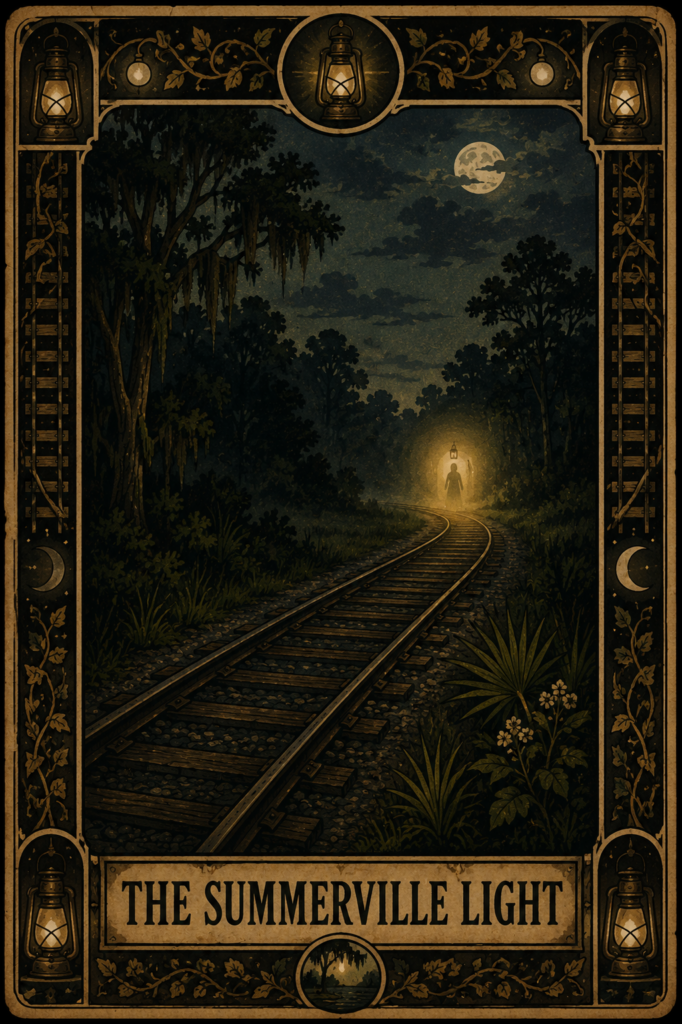
The Summerville Light (Old Light Road, Summerville, South Carolina)
The Summerville Light is a ghost-light legend associated with Sheep Island Road near Summerville, South Carolina. Local tradition describes a wandering light beside former railroad tracks, usually identified as a widow’s lantern. Her husband was supposedly decapitated in a train accident, leaving her to search nightly for his missing head. Azalea Magazine records blue, green, white, and red lights, plus stalled engines, shaking cars, whispers, and fingerprints. Summerville native Anne Jascomb recalled her father taking the family to Light Road during the 1960s.
USGS seismologist Susan Hough found the stories circulating by the 1950s and 1960s. She also documented the local Light Road name and today’s surviving Old Light Road. In 2013, Charleston City Paper reported former police officer Bruce Orr’s repeated mid-1980s encounters with the light. Hough later proposed earthquake lights as one possible explanation, noting nearby historic seismic activity. She emphasized that earthquake-light mechanisms remain uncertain and published the study in Seismological Research Letters in 2025.
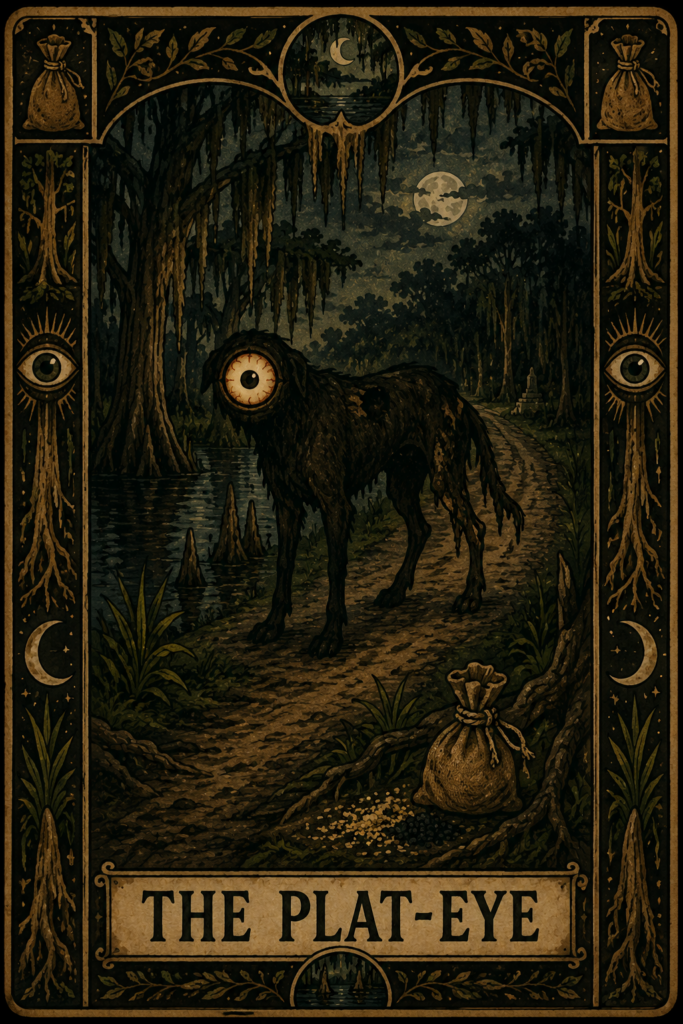
The Plat-Eye (Gullah Geechee Lowcountry, South Carolina and Georgia)
The Plat-Eye is a feared shapeshifting haint from Gullah Geechee folklore in the Carolina Lowcountry. Ambrose E. Gonzales’s 1922 collection The Black Border places the tradition specifically along the Georgetown coast. In those stories, Plat-Eyes appear as animals, drifting wraiths, or low clouds with fiery eyes. National Park Service research also records Plat-Eye among Sea Islands Gullah supernatural traditions. Another tradition connects the spirit with murdered people guarding buried treasure.
Genevieve Chandler recorded especially vivid Plat-Eye accounts during Federal Writers’ Project interviews in the 1930s. In May 1936, Addie Knox described a creature changing from frog to turtle, cat, and larger forms. Knox struck it with a stick and escaped after refusing to show fear. Thelma Knox told Chandler in 1937 that a hant was a Plat-Eye. She then recounted her sister Mattie’s encounter with one. USC Press published Chandler’s Waccamaw Neck interviews in 2008 as Coming Through.