Indiana
Indiana folklore stretches from the Ohio River to the forested hills and wetlands of the interior, mixing ghost stories, cryptid sightings, and river legends. Farmers, hunters, and travelers have reported strange creatures in rural landscapes, while industrial towns carry their own haunted reputations.
Many of these stories draw from Native traditions and gained new life through 19th- and 20th-century accounts. Today, small-town communities still share the tales of Indiana cryptids, keeping the state’s mix of water spirits, backroad monsters, and haunted places alive.
Beast of Busco (Churubusco / Fulk Lake)
The Beast of Busco is a giant snapping turtle said to inhabit Fulk Lake near Churubusco. Farmer Oscar Fulk reported seeing an enormous turtle there in 1898. In 1948, fishermen Ora Blue and Charley Wilson reported another giant turtle in the same lake. Landowner Gale Harris soon joined the search, estimating the animal at several hundred pounds. News coverage in 1949 drew thousands of visitors and turned “Oscar” into a national curiosity.
Harris tried traps, divers, a female turtle, and even draining much of the lake to catch Oscar. None of the efforts succeeded, and the turtle became more famous with every failed attempt. Churubusco began celebrating Turtle Days in 1950, keeping Oscar at the center of local folklore. The town still embraces the Beast of Busco through festivals, statues, signs, and its “Turtle Town USA” identity.

Meshekenabek / Lake Manitou Monster (Lake Manitou / Rochester)
Meshekenabek is the name commonly given to the monster serpent associated with Lake Manitou near Rochester. Potawatomi tradition placed a dangerous supernatural serpent in the lake long before modern resort development. An 1899 folklore article recorded fears that damming the lake could disturb the being beneath its waters. Local tradition also connected the lake’s name with the powerful spirit inhabiting it.
Settler reports soon became another layer of the Lake Manitou legend. In 1838, the Logansport Telegraph reported a sixty-foot creature resembling an enormous snake. Other witnesses described a long-necked animal with a broad head and dark body. Lake Manitou residents still preserve the monster through local history and stories surrounding the lake.

Crosley Monster (Crosley Fish and Wildlife Area / Jennings County)
The Crosley Monster is a large, hairy creature associated with the wooded Crosley Fish and Wildlife Area. In July 2006, four teenagers encountered something unusual while fishing at Harsin Pond. They described a seven-foot figure with dark hair and glowing yellow-orange eyes standing near the tree line. The creature reportedly followed them through the woods and into a nearby cornfield.
Weeks later, Corey Mullikin reported another encounter while squirrel hunting nearby. He described a black-haired creature running on all fours and circling him through the woods. Local officials told reporters they had heard Crosley Monster stories for years, including numerous reports from visitors. The legend remains closely tied to Jennings County’s heavily wooded Crosley landscape.

Pukwudgies / Pa-i-sa-ki (Mounds State Park / Anderson)
Pukwudgie stories in Indiana center strongly on Mounds State Park and the White River near Anderson. The Indiana Historical Society connects the tradition with Lenape stories of small forest beings. They are described as two to three feet tall and capable of transforming into animals. Miami tradition preserves a related little-person figure called Pa-i-sa-ki.
Paul Startzman claimed his first encounter occurred in 1927 while hiking near the park. He later collected other Indiana accounts in The Puk-Wud-Jies of Indiana. One woman recalled groups of little people approaching her and speaking in high-pitched voices. Startzman’s book helped make Mounds State Park the center of Indiana’s modern Pukwudgie tradition.

Green-Clawed Beast (Dogtown / Evansville)
The Green-Clawed Beast comes from an August 1955 incident near Dogtown, west of Evansville. Naomi Johnson was swimming in the Ohio River when something seized her left leg beneath the surface. She said the grip felt like a large, hairy hand with claws. The unseen attacker pulled her underwater twice before releasing her near a floating inner tube. Johnson never saw the creature itself. Later accounts described scratches, bruising, and a green palm-shaped stain on her leg.
United Press carried Johnson’s story nationally within days of the incident. After reading about Kelly-Hopkinsville, Johnson wondered whether her attacker was connected to the reported “little green men.” That association helped move the story into later UFO, Fortean, and cryptid writing. The Evansville Courier & Press revisited the case in 2024, nearly seventy years after Johnson’s encounter.

Crawfordsville Monster (Crawfordsville, Montgomery County)
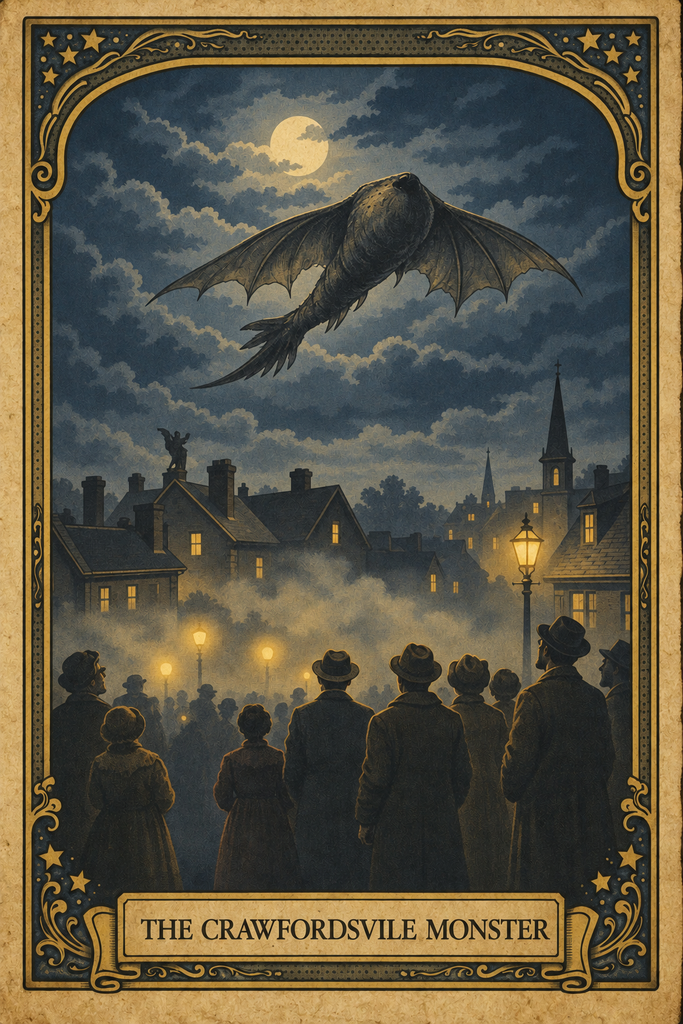
The Crawfordsville Monster appeared over Crawfordsville during a short burst of reports in September 1891. On September 4, icemen Marshall McIntyre and Bill Gray saw a pale aerial shape while hitching a wagon. The Crawfordsville Daily Journal reported their encounter the following day. It described an eighteen-foot, headless form with side fins, one flaming eye, and a wheezing cry. Methodist minister George W. Switzer also reported seeing the apparition above town.
Reports continued over following nights, and later accounts claimed large crowds watched the creature hover and squirm. The story spread through Indiana newspapers and reached the Brooklyn Daily Eagle by September 10. The Daily Journal continued publishing follow-ups, including “The Spook Explained” on September 8. Charles Fort later included the Crawfordsville incident in his 1931 book Lo!. Hoosier State Chronicles now preserves the original Crawfordsville newspaper run.
Mill Race Monster (Mill Race Park, Columbus, Indiana)
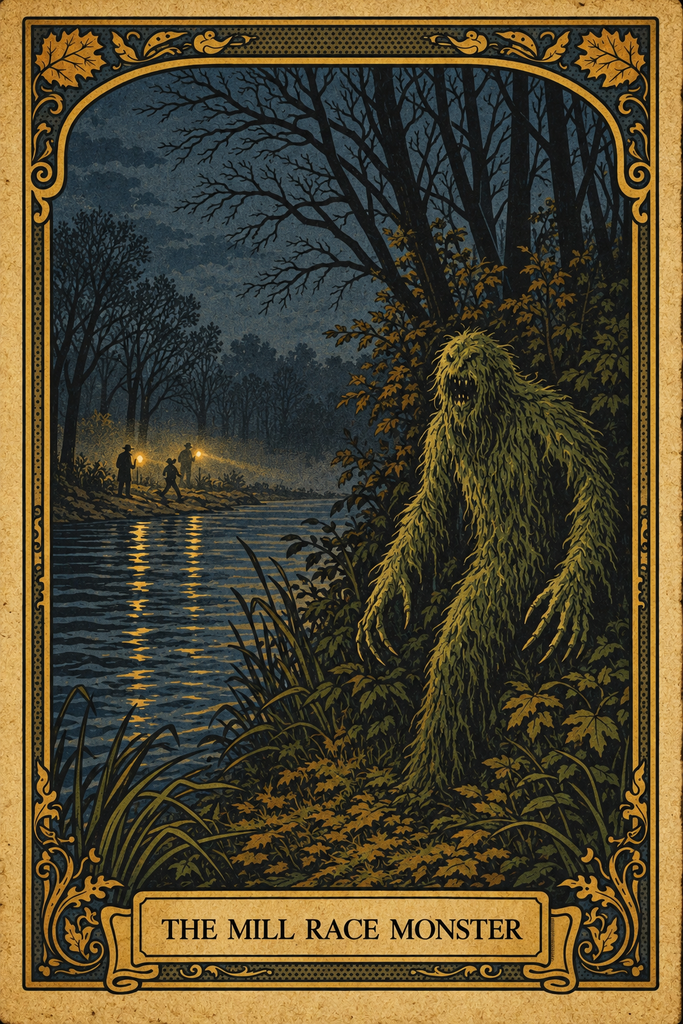
The Mill Race Monster emerged around Columbus, Indiana’s Mill Race Park in November 1974. On November 1, six young women made two separate reports to local police. They described a roughly six-foot, upright creature that was hairy, green-faced, and clawed. One group said the creature jumped onto their car and left scratches on its hood. Police searched the park but found nothing matching their descriptions.
On November 5, two men reported seeing a hairy figure near the park’s covered bridge. City dogcatchers reported another encounter on November 8 while rescuing cats. Crowds of armed monster hunters soon filled the park, prompting officials to close it after dark. Columbus newspapers continued covering sightings, searches, and public reactions throughout November. The Mill Race Monster Festival debuts October 23–25, 2026, using original 1974 newspaper reports in its programming.