Massachusetts
Massachusetts cryptids and folklore range from colonial-era sea-serpent reports to modern humanoid sightings and southeastern Massachusetts paranormal legends. The Atlantic coast produced famous monster reports, while inland woods and swamps carry stories of strange creatures, ghosts, and UFOs.
The 1817 Gloucester Sea Serpent became one of New England’s best-documented early monster reports. Dover added its brief 1977 humanoid sighting cluster. Farther south, the Bridgewater Triangle gathers unusual sightings around Hockomock Swamp and Freetown-Fall River State Forest. Pukwudgie stories also appear in the region’s traditional and modern folklore.
Dover Demon (Dover, Norfolk County)
The Dover Demon was reported during three encounters in Dover on April 21 and 22, 1977. Seventeen-year-old Bill Bartlett first saw it beside Farm Street while driving that evening. He described a four-foot, hairless figure with a large head, shining orange eyes, and long fingers. Bartlett said he could see no nose, mouth, or ears. The Boston Globe account
About two hours later, 15-year-old John Baxter reported a similar figure near Miller Hill Road. The following evening, Abby Brabham, 15, and Will Taintor, 18, saw one on Springdale Avenue. Brabham described bright green eyes, differing from Bartlett’s orange description. Bartlett and Baxter produced drawings that shaped later depictions of the creature. Investigator Loren Coleman coined the name “Dover Demon” during his investigation. Coleman’s account In 2025, the Dover Historical Society opened a Sawin Museum exhibit devoted to the case. Dover Historical Society

Gloucester Sea Serpent (Gloucester Harbor / Cape Ann)
The Gloucester Sea Serpent was reported repeatedly around Gloucester Harbor and Cape Ann during August 1817. Mariner Amos Story reported seeing a serpent-like animal near Ten Pound Island on August 10. Other witnesses estimated lengths from roughly fifty to ninety feet. Some described a dark body, large head, and visible sections resembling humps or joints. The Linnaean Society of New England collected sworn testimony and published its report that same year.
Reports continued in 1818, including sightings around Cape Ann and Marblehead. Massachusetts coastal historians later documented the creature among the state’s best-known maritime legends. An 1817 engraving also preserved the serpent’s contemporary appearance in Gloucester Harbor. Cape Ann Museum marked the sightings’ bicentennial in 2017 with programs and a harbor cruise. Its collections preserve artwork and archival material connected with the 1817 reports.

Pukwudgie (Wampanoag Tradition / Bridgewater Triangle)
The Pukwudgie is a small supernatural being in Wampanoag tradition. In southern New England tellings, Pukwudgies can be mischievous, dangerous, and closely connected with Maushop stories. Descriptions often make them child-sized, humanlike, and capable of vanishing, using magic, or harming people who offend them. Later summaries also note kidnapping stories, poison arrows, and attacks with fire or spears.
In modern Massachusetts folklore, Pukwudgies became strongly tied to the Bridgewater Triangle. Stories place them around Freetown-Fall River State Forest and nearby ledges, roads, and swampland. Recent witnesses describe small figures in the trees, stones thrown from cover, and sudden disappearances. A Boston Globe overview later listed them among the Triangle’s best-known creature traditions.

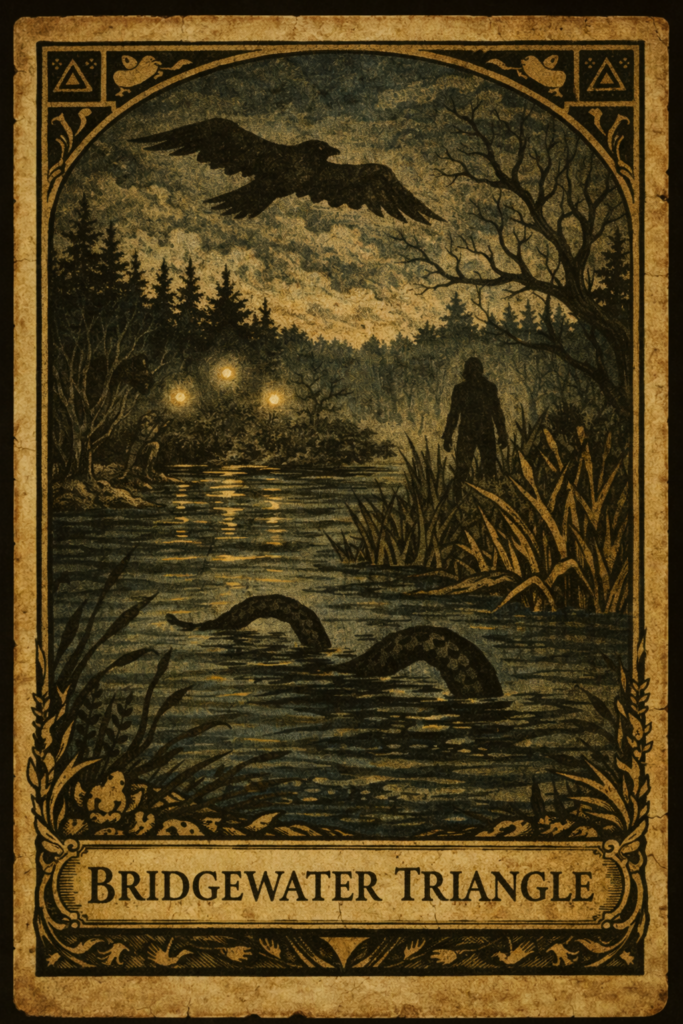
Bridgewater Triangle (Hockomock Swamp and surrounding towns, Southeastern Massachusetts)
The Bridgewater Triangle covers roughly 200 square miles of southeastern Massachusetts. Cryptozoologist Loren Coleman coined the name in the 1970s while mapping unusual regional reports. He later used it in his 1983 book Mysterious America. Its traditional points are Abington, Freetown, and Rehoboth, with Hockomock Swamp near the center. The Bridgewater Public Library catalogs reports involving UFOs, poltergeists, Bigfoot-like creatures, giant snakes, and thunderbirds.
The 16,950-acre Hockomock Swamp became one of the Triangle’s best-known settings. Freetown-Fall River State Forest is another major location in later accounts. Stories from surrounding towns describe strange lights, apparitions, large animals, and other unexplained encounters. The 2013 documentary The Bridgewater Triangle collected resident testimony and explored decades of regional reports. The Boston Globe covered the documentary and its local eyewitness accounts in 2014.