Colorado
Colorado cryptids and folklore vary from Rocky Mountain fearsome critters to mining legends, ghost stories, and UFO sightings. Old mining districts produced stories of Tommyknockers, while the San Juan Mountains gave the Slide-Rock Bolter its Colorado home.
The San Luis Valley has decades of UFO reports and now hosts the roadside UFO Watchtower. Elsewhere, abandoned mines, historic hotels, mountain towns, and ghost towns carry numerous haunting traditions. Colorado’s folklore stretches from deliberately absurd fearsome critters to modern paranormal reports tied to specific communities.
Slide-Rock Bolter (San Juan Mountains)
The Slide-Rock Bolter appears in William T. Cox’s 1910 collection of lumberjack folklore. Cox places the enormous creature on Colorado mountain slopes exceeding 45 degrees. Its divided tail has hooks that grip a ridge while it watches the gulch below. Spotting tourists, it releases itself and slides downhill, swallowing victims before momentum carries it up another slope.
Cox’s account says the Bolter flattened trees and sometimes swallowed entire tourist parties. A forest ranger between Ophir Peaks and Lizard Head supposedly baited one with an explosive-filled dummy tourist. The legend is that the resulting blast killed the Bolter and reportedly damaged buildings in nearby Rico.

The Tommyknockers (Colorado Mining Districts)
Tommyknockers are supernatural miners carried from Cornish folklore into the American West by emigrating miners. In Colorado, they became associated with gold and silver mines throughout the Rockies. Their underground knocking could warn miners of danger, while other stories blamed them for missing tools and troublesome noises. Western traditions sometimes described Tommyknockers as spirits of miners killed underground.
Folklorist Caroline Bancroft found belief still active around Central City during the 1930s. In 1931, two miners reportedly quit after hearing a cow-like noise inside the Chain-O-Mines workings. Their foreman investigated and discovered dripping water reverberating across sheet metal. Colorado’s official tourism site still features Tommyknockers among the state’s legendary creatures.

The Augerino (Eastern Middle Park, Colorado)
The Augerino is a subterranean fearsome critter recorded in eastern Middle Park, Colorado. Ronald L. Ives documented the creature in a 1941 Journal of American Folklore article. Stories described an enormous, corkscrew-shaped worm that bored through dams and irrigation ditches. Its tunnels were supposedly reinforced with silica-like material, making them difficult to collapse. Ives noted that some residents spoke about the Augerino as though it genuinely existed.
Ives also mentioned spiral fossils called “fossil augerinos” and suggested they influenced the legend. In 2008, paleontologists named the trace fossil Augerinoichnus helicoidalis after the mythical Augerino. The paper cites Ives’s 1941 study and describes the creature as an enormous, malevolent corkscrew-shaped worm. Augerinoichnus fossils occur at several Permian sites across New Mexico.

The Vampire of Lafayette (Lafayette Cemetery)
Teodor Glava was a Romanian coal miner born in Transylvania and buried in Lafayette Cemetery in 1918. His concrete marker also names fellow Romanian miner John Trandafir, who died two days after Glava. By the 1950s, local children heard warnings that a Transylvanian vampire lay buried in the cemetery. Later versions claimed townspeople had driven a wooden stake through Glava’s heart.
The legend expanded as generations of Lafayette residents repeated it. A juniper near Glava’s grave became the tree supposedly grown from the stake. Later stories added roses growing from his fingernails and a tall, thin man appearing near the grave. By 2010, the legend had inspired the student film Glava.

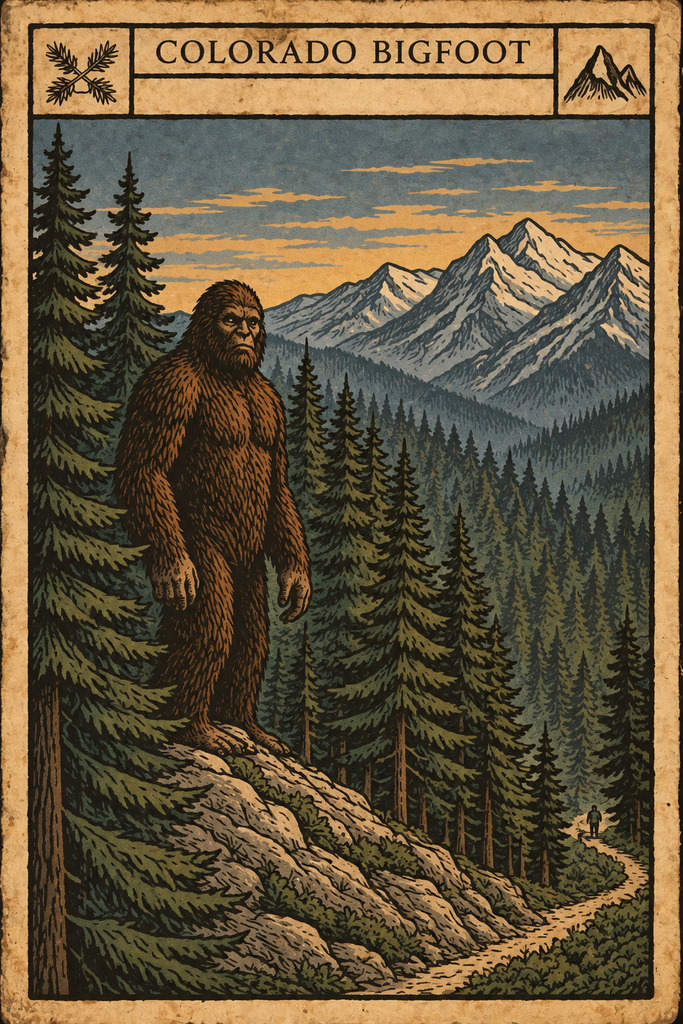
Colorado Bigfoot (Rocky Mountains and Southern Colorado)
Colorado has a substantial modern record of reported Bigfoot encounters across its mountainous counties. The BFRO database currently lists more than 130 reports statewide. Reports commonly describe large, hairy bipeds seen crossing roads, moving through forests, or appearing near campsites. Southwestern Colorado has produced repeated reports around the San Juan Mountains and Conejos County.
A miner reported a biped crossing a road near Silverton before dawn in 1989. In 2000, a backpacker reported an eight-foot hairy figure standing behind a tent in Hinsdale County. A motorist reported another daylight sighting near Lake City in July 2026. Estes Park now hosts Bigfoot Days, featuring Colorado stories, speakers, films, and a Bigfoot calling contest.
Riverdale Road Jogger (Riverdale Road, Thornton and Brighton)
The Ghost Jogger is one of several haunting legends associated with Riverdale Road. The eleven-mile road runs between Thornton and Brighton in Adams County. Stories describe a jogger supposedly killed by a driver and now haunting the roadside. Drivers who stop on Jogger’s Hill may hear running footsteps followed by unexplained banging against their vehicles.
Some versions say handprints appear on fogged windows after the footsteps approach. The Denver Public Library specifically records stories of the jogger tapping passing cars. The Adams County Museum lists the “jogger of Jogger’s Hill” among Riverdale Road’s recurring haunts. The road’s other legends include a phantom Camaro, a woman in white, and the supposed Gates of Hell.
