Illinois
Illinois cryptids and folklore stretch from Chicago’s haunted neighborhoods to strange sightings along the Mississippi River and the farmlands of the south. Reports of ghostly figures on bridges, eerie lights in the woods, and creatures said to stalk rural backroads have circulated for generations. These stories draw on both Native traditions and early settler accounts, mixing history with mystery.
The state’s legends also reflect its varied landscapes and communities. In the north, Chicago has its own haunted landmarks and urban ghost tales, while central Illinois preserves stories of phantom riders and lost spirits. Along the rivers and bluffs of the south, sightings of unusual animals and spectral figures continue. Together, they make Illinois a crossroads of folklore where old traditions and modern encounters keep the strange alive.
The Enfield Horror (Enfield)
The Enfield Horror entered Illinois folklore in April 1973 after strange encounters in the small town of Enfield. On April 25, Henry McDaniel reported scratching at his door before seeing a grayish creature near his rosebushes. He described three legs, two short arms, and enormous pink eyes, with a body standing about four-and-a-half feet tall. McDaniel fired at it, and the creature reportedly hissed before covering fifty feet in three enormous jumps.
Police responding to McDaniel’s home found unusual six-toed, dog-like tracks in the soft ground near the house. McDaniel reported another sighting on May 6, when he saw the creature moving along nearby railroad tracks. News coverage drew reporters, investigators, and monster hunters to Enfield, turning the brief episode into lasting folklore. The creature’s three-legged form and bizarre leaping gait remain the defining features of the Enfield Horror.

Piasa Bird (Alton and Mississippi River Bluffs)
The Piasa Bird legend grew from Indigenous cliff paintings recorded near present-day Alton in 1673. Marquette described two painted beings with antlers, humanlike faces, scales, and long fishlike tails. Early French drawings show similarly composite creatures without the familiar birdlike form. Quarrying later destroyed the original bluff paintings.
In 1836, writer John Russell transformed the older image into the winged, man-eating Piasa Bird of modern legend. His story introduced Chief Ouatoga, who offered himself as bait while hidden warriors fired poisoned arrows. The Illinois State Museum traces much of this familiar story to Russell. A 48-foot-wide mural completed in 1998 now overlooks the Mississippi north of Alton.

Big Muddy Monster (Murphysboro)
Big Muddy Monster reports erupted around Murphysboro in June 1973, especially near Riverside Park and the Big Muddy River. Witnesses described a towering, light-haired creature caked with mud, accompanied by a powerful odor and piercing screams. Police investigated the area after multiple reports and documented large tracks in soft ground near the sightings.
Additional reports followed in later years, including sightings around Murphysboro in 1975 and 1976. Local newspapers and national coverage turned the creature into one of southern Illinois’s best-known monster legends. Murphysboro now preserves the original case files and celebrates the Big Muddy Monster through local events and storytelling.

Cole Hollow Road Monster (East Peoria / Pekin)
The Cole Hollow Road Monster swept through central Illinois folklore during the summer of 1972. Witnesses described a towering, whitish-haired creature with a terrible smell and an eerie, whistle-like scream. Reports clustered around Cole Hollow Road, nearby woods, riverbanks, and abandoned mine country. East Peoria police received more than 200 calls during the height of the sightings. A large volunteer search eventually combed the area, helping turn “Cohomo” into a regional sensation.
In 1991, original witness Randy Emert said his first report began as a prank. Other reported encounters nevertheless became part of the broader Cohomo legend. That same year, a woman told police an eight-foot hairy creature grabbed the back of her moving pickup. Cohomo remains part of East Peoria folklore, where the local Historical Society still celebrates the monster today.

Mad Gasser of Mattoon (Mattoon)
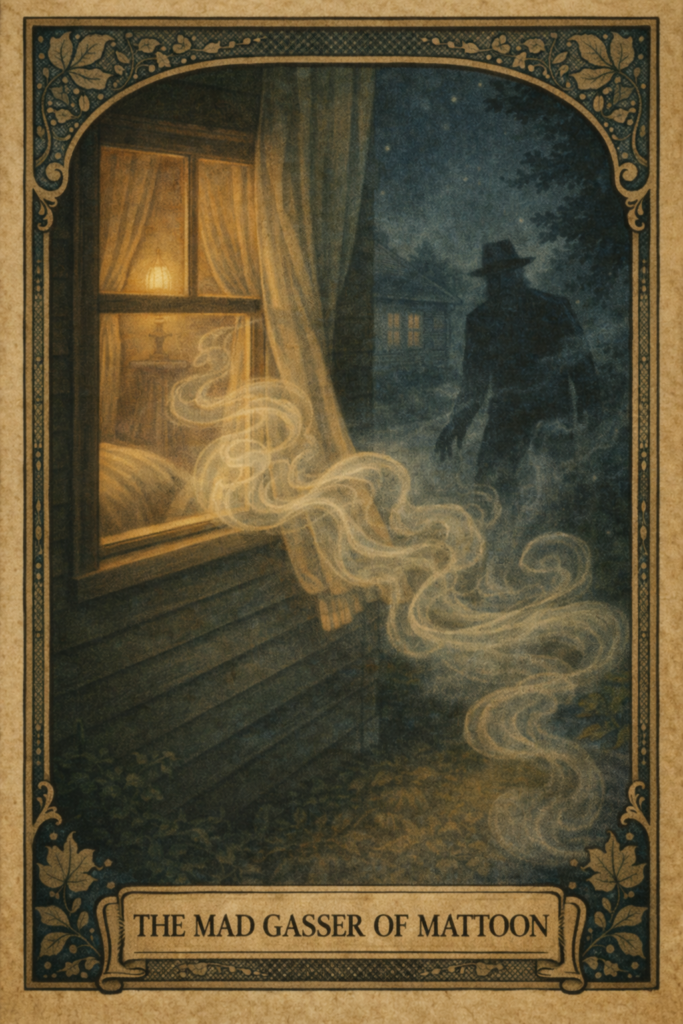
During September 1944, Mattoon residents reported a prowler releasing strange gas into homes after dark. Victims described sweet odors, nausea, weakness, and temporary numbness or paralysis in their legs. On September 1, Aline Kearney said fumes entered her bedroom and left her unable to walk. Her husband later reported seeing a tall man in dark clothing near the window.
As reports multiplied, police increased patrols while armed citizens organized their own night watches. Eastern Illinois University records that state and federal authorities joined the search, but no attacker was caught. By September 12, police blamed many later alarms on fear, ordinary odors, and mistaken observations. EIU now preserves maps, victim lists, and contemporary newspaper references from the 1944 panic.
Chicago Mothman (Chicago and Chicagoland)
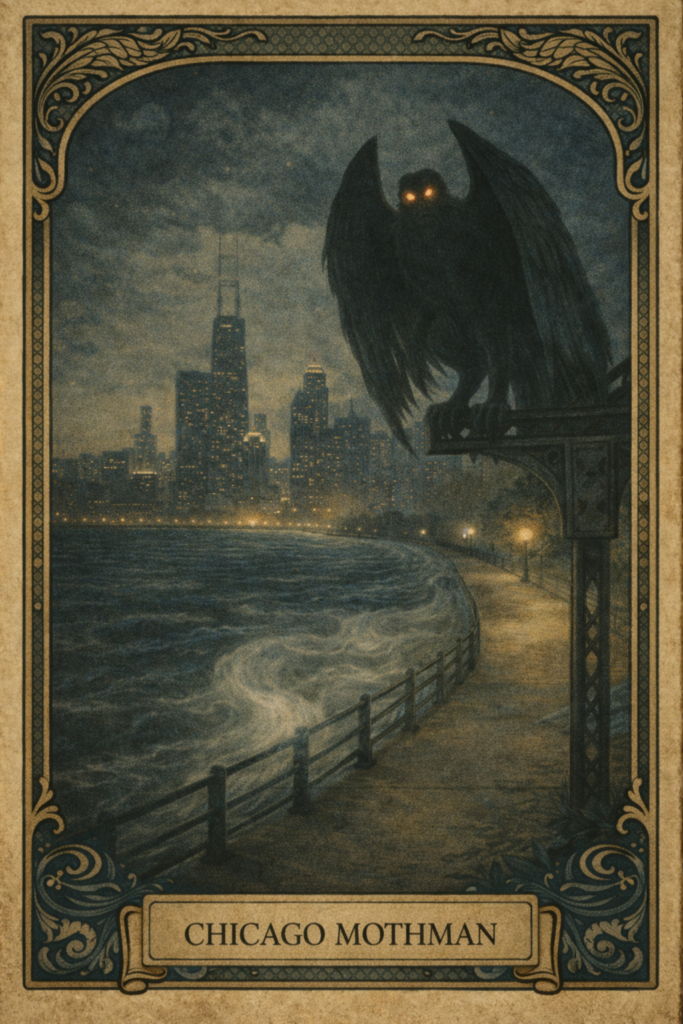
Chicago Mothman describes winged humanoids reported across Chicago and surrounding suburbs. The modern wave accelerated in 2017, with reports near Oz Park, Lake Shore Drive, and other lakefront neighborhoods. Witnesses described large, dark figures with broad wings, sometimes adding glowing red eyes or bat-like features.
Reports continued after 2017, increasingly concentrating around O’Hare International Airport and nearby suburbs. A 2021 airport report described a seven-to-eight-foot black winged figure with glowing red eyes. Other accounts through 2022 came from Rosemont, Park Ridge, Bensenville, and other Chicagoland communities. By 2023, investigators had collected more than a dozen reported sightings from O’Hare itself.
Cuba Road Phantoms (Cuba Road and White Cemetery / Lake County)
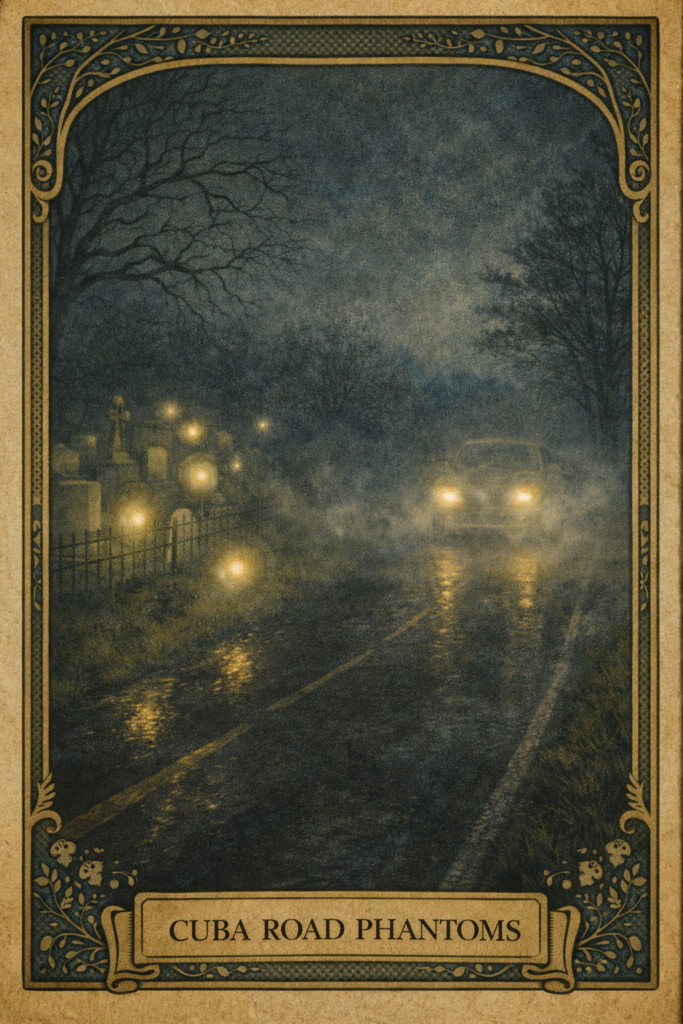
Cuba Road between Barrington and Lake Zurich has accumulated one of northern Illinois’s richest collections of roadside ghost stories. White Cemetery, dating to 1820, anchors the tradition with reports of floating lights and hazy human figures. Witnesses describe white globes drifting above graves, crossing the fence, and sometimes moving toward the roadway.
The road carries other legends, including phantom cars, spectral lovers, a vanishing woman, and an occasionally disappearing house. Some versions place the ghost car entering or leaving White Cemetery before vanishing from sight. Decades of local retellings and ghost hunting have made Cuba Road a lasting Chicagoland supernatural landmark.