Arizona
Arizona folklore moves through desert, canyon, forest, river, and sky. The state’s legends range from the Mogollon Monster of the central highlands to the Red Ghost of frontier Arizona. They also include lost treasure stories in the Superstition Mountains, La Llorona along the Santa Cruz River, and the Phoenix Lights over the Valley.
Some traditions on this page come from living Native cultures, including Navajo and Hopi stories with deep ceremonial meaning. Others belong to mining camps, military history, UFO witnesses, roadside retellings, and local ghost lore. Together, they make Arizona one of the Southwest’s richest landscapes for cryptids, spirits, monsters, and mystery stories.
Mogollon Monster (Mogollon Rim, Central and Eastern Arizona)
The Mogollon Monster is Arizona’s Bigfoot-like creature of the Mogollon Rim. Reports place it in pine forests across north-central and eastern Arizona. Descriptions include a tall, hairy humanoid with a hairless face, colored eyes, large footprints, and a foul odor. EBSCO places sightings near Prescott, Williams, Winslow, and Payson.
Arizona Highways traces an early wild-man story to The Williams News in 1903. I.W. Stevens described a gray-haired figure near the Grand Canyon with claws and a club. Later accounts include Don Davis’s 1940s Boy Scout sighting near Tonto Creek outside Payson. The name also circulates through the Mogollon Monster 100 endurance race.

Skinwalker (Navajo Nation and the Four Corners)
Skinwalkers are harmful witches in Diné tradition, rather than a separate species of supernatural creature. The term yee naaldlooshii means roughly “with it, he goes on all fours.” Accounts describe witches who change into, possess, or disguise themselves as animals. These traditions belong to Diné cultural worlds across Arizona, New Mexico, and Utah.
Traditional narratives include witches wearing coyote, wolf, bear, owl, fox, or crow skins. They also describe skinwalkers troubling livestock, approaching homes, robbing graves, and causing illness. Peggy Alford’s 1992 folklore study found major differences between Diné narratives and neighboring Anglo-American versions. Her Flagstaff-area fieldwork found Anglo retellings increasingly portraying skinwalkers as wolf-like creatures encountered along roads.

The Red Ghost (Eagle Creek and Southeastern Arizona)
The Red Ghost is an Arizona frontier legend about a feral red camel reportedly carrying human remains. Later accounts traced the story to Eagle Creek around 1883. An 1893 Mohave County Miner account described the woman’s death and later sightings across Arizona Territory. Cyrus Hamblin later identified the strange animal as a camel carrying what appeared to be a man.
Prospectors near the Verde River reportedly shot at the camel, dislodging a human skull from its burden. In 1893, rancher Mizoo Hastings reportedly killed the scarred camel near the San Francisco River. Arizona Highways says its body carried knotted rawhide that had cut deeply into its flesh. The story fits the documented U.S. Army camel experiment that brought camels into the Southwest before the Civil War.

Lost Dutchman’s Mine (Superstition Mountains)
The Lost Dutchman’s Mine is Arizona’s best-known lost-treasure legend, centered on the Superstition Mountains east of Phoenix. Jacob Waltz was a German immigrant who prospected in Arizona and died in Phoenix in 1891. Arizona State Parks says legend placed his rich mine near Weaver’s Needle. Waltz supposedly gave clues to Julia Thomas, who searched for the mine the following year.
Treasure hunters continued entering the mountains, and some later disappeared or died during their searches. The Apache Junction Public Library traces widespread publication of the legend to an 1895 San Francisco Chronicle story. Arizona Highways reported dozens of books, films, and television programs devoted to the mine by 1993. Lost Dutchman State Park now bears the legend’s name at the western foot of the Superstitions.

Tombstone Thunderbird (Huachuca Desert near Tombstone)
The Tombstone Thunderbird is Arizona’s famous giant-winged creature story from the territorial press. On April 26, 1890, the Tombstone Epitaph printed “Found in the Desert.” The article placed the creature between the Whetstone and Huachuca mountains. It described a winged monster resembling an alligator, with a long tail and enormous wings.
Later retellings turned the report into a lost-photograph legend. KGUN 9 says the Library of Congress issue contains no photograph. The supposed image features cowboys posing with a pterodactyl-like body and stretched wings. Researcher Joshua Hawley tied the story to Tombstone’s fading mining economy and tourist lore.

La Llorona (Santa Cruz River and Tucson)
La Llorona is a Tucson ghost legend tied to the Santa Cruz River and other local waterways. The Arizona Daily Star says Tucson traditions place her from South Stone Avenue to the Santa Cruz River. One version says she drowned her children after an unfaithful husband betrayed her. Another says her children drowned when the Santa Cruz flooded after she left them in Nogales, Sonora.
Arizona folklorist Jim Griffith told KJZZ that La Llorona stories change with each teller, audience, and community. Arizona accounts also place her along the Rio de Flag and San Pedro River. Tucson versions warn that anyone who tries to touch her may suffer a burn. The University of Arizona preserves La Llorona materials in its Southwest Folklore collection.

The Phoenix Lights (Phoenix and Central Arizona)
The Phoenix Lights were two separate aerial events reported across Arizona on March 13, 1997. The first involved a V-shaped formation moving southeast from Nevada through Prescott, Phoenix, and toward Tucson. Witnesses described several lights moving silently together, while some reported a dark structure connecting them. A second group of lights appeared later near the Sierra Estrella southwest of Phoenix.
Investigators later linked the second display to flares dropped during a Maryland Air National Guard training exercise. Contemporary reporting also recorded amateur astronomer Mitch Stanley identifying the earlier moving lights as aircraft through his telescope. Other witnesses maintained that they had seen a single enormous craft. Phoenix police received numerous calls that night from residents reporting the formations.

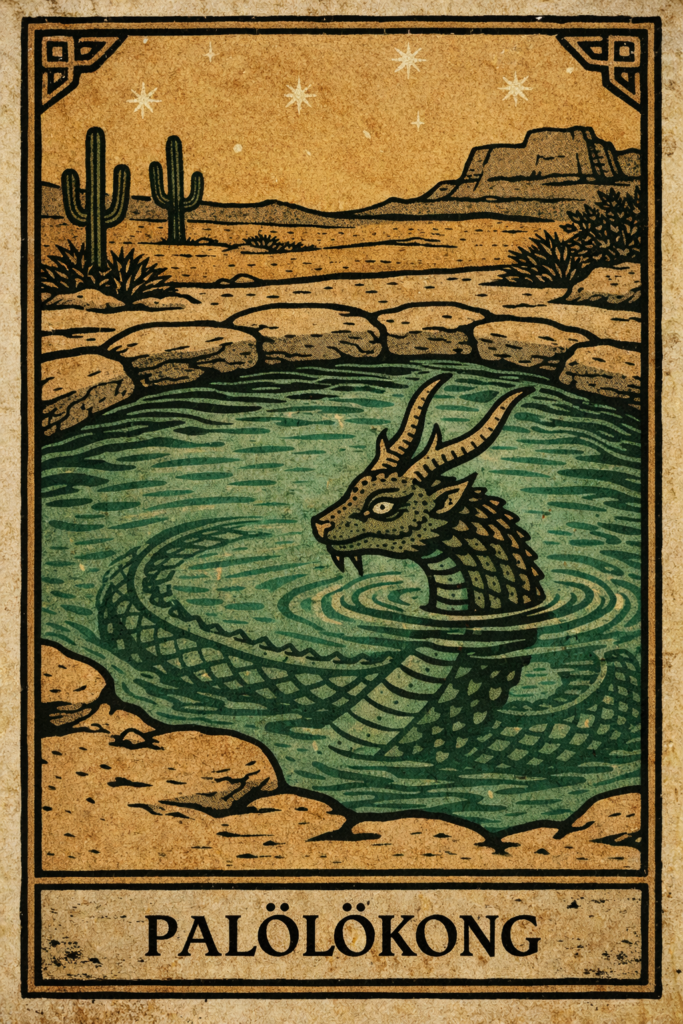
Paalölöqangw (Hopi Water Serpent)
Paalölöqangw is a Hopi water-serpent deity associated with springs and other water sources in northeastern Arizona. Anthropologist Peter Whiteley describes Paalölöqangw as living in springs and receiving appeals during Snake and Flute ceremonies. Winter religious performances also portray the being through ceremonial puppetry. The Flute ceremony includes offerings placed in sacred springs.
An early published Hopi narrative collected by H. R. Voth places a Water Serpent at Lânva, the Flute Spring. In that story, the serpent visits Coyote and grows until its body nearly fills his kiva. Whiteley also records prayer-sticks planted for Paalölöqangw at springs during ceremonial observances. Winter solstice ceremonies place feathered prayer-sticks over major springs around Hopi villages.