Alabama
Alabama cryptids stem from Appalachian folklore, roadside ghost stories, river legends, strange-animal reports, and modern paranormal encounters. The state’s wooded mountains, river valleys, coastal wetlands, rural roads, and older towns give these stories distinct local settings.
Alabama folklore includes the White Thang, Huggin’ Molly, the Alabama Metal Man, and Mobile’s Wolf Woman. Other legends involve hairy wildmen, mysterious predators, haunted roads, unusual lights, and creatures reported around rivers and isolated communities.
White Thang (Northern Alabama)
The White Thang is a North Alabama monster legend reported across wooded communities from Winston County eastward. Local Etowah County accounts place the tradition there by the 1930s and 1940s. Witness descriptions vary between a tall white-haired humanoid and a large pale animal resembling a cat or dog. Some accounts also mention red eyes and unusually rapid movement.
Modern reports cluster around places including Walnut Grove, Moody’s Chapel, Happy Hollow, and Wheeler National Wildlife Refuge. Descriptions often include a piercing scream compared with a woman, panther, or crying child. 256 Today notes that the White Thang has inspired books, documentaries, songs, and artwork. The Gadsden Messenger revisited Etowah County White Thang stories in August 2026.

Wolf Woman of Mobile (Mobile, Alabama)
The Wolf Woman of Mobile erupted into local news during the first week of April 1971. Mobile Bay Magazine says calls began April 1 from Davis Avenue and Plateau residents. On April 8, the Press-Register published “But Would You Believe?” after receiving more than 50 calls. Witnesses described a creature with a woman’s head and wolf’s body; one called it “pretty and hairy.”
Reports included nighttime chases and sightings around homes before fading within days. Mobile Bay Magazine interviewed residents who remembered the Wolf Woman as a serious childhood fear. Antoinette Roberts Stewart recalled sprinting past wooded lots after believing the creature was following her. Libye Sawyer remembered watching from her back door and asking her stepbrother to teach her to shoot.

Falkville Metal Man (Falkville, Morgan County)
The Falkville Metal Man began with police chief Jeff Greenhaw’s reported encounter on October 17, 1973. An anonymous caller told him a UFO had landed outside town, but Greenhaw found no craft. He instead encountered a human-shaped figure covered in intensely reflective material. Greenhaw compared its surface to mercury on nickel and said it moved with a stiff, mechanical gait.
Greenhaw took four Polaroid photographs before the figure fled across the field. He pursued it by patrol car, reaching about 35 mph before crashing and losing sight of it. NICAP later investigated whether the figure might have been someone wearing reflective clothing. Greenhaw said the original photographs were stolen during a 1983 burglary, along with his service revolver and shotgun.

Huggin’ Molly (Abbeville, Henry County)
Huggin’ Molly is an Abbeville ghost legend about a towering woman who roams town after dark. Alabama Travel describes her as dressed in black, sometimes with a wide-brimmed hat. Stories say she chases children, squeezes them in a crushing hug, then screams directly into their ears. Some versions make her about seven feet tall and as broad as a bale of cotton.
Parents in Abbeville used the story for generations to keep children from staying outside after dark. Abbeville native Jimmy Rane recalled hearing the warning throughout his childhood. Alabama Travel says the tradition has circulated locally for more than a century. Rane later opened Huggin’ Molly’s restaurant at 129 Kirkland Street in downtown Abbeville.

The Downey Booger (Winston County)
The Downey Booger is a Winston County legend preserved in family oral history from the late nineteenth century. Vera Whitehead’s account names cousins John and Joe Downey as early witnesses. They encountered a strange creature resembling both a human and an animal while returning from a dance. Their horses reared, bolted, and later refused to cross the sandy stretch where it appeared. Months later, another family reportedly saw the figure dart from bushes near the same road.
Moonshiner Jim Jackson later encountered the creature following his wagon while walking upright on two feet. Jackson fired twice, and the creature screamed like a woman before limping into the woods on three feet. A posse reportedly followed blood from the sandy road toward a distant cliff but found nothing else. Alan Brown retold the Downey family accounts in his 2019 book Eerie Alabama.

The Sipsey Creature (Sipsey and Walker County)
The Sipsey Creature is a Walker County legend about a large unidentified animal near the community of Sipsey. In a published oral-history account, Martha Parnell Salomaa records family stories dating to the 1940s and 1967. Both witnesses initially compared the animal to a bear before describing more cat-like features. They said it moved on four legs, rose upright, and produced a terrifying scream.
The creature later appeared in broader Walker County cryptid stories under both Sipsey Creature and Wampus Cat names. A 2015 Animal Planet special described local rumors of large cats and Bigfoot-like creatures near Jasper. The program followed a man who claimed an unidentified creature attacked him in the woods. Animal Planet aired I Was Bitten: The Walker County Incident in May 2015.

The Coosa Monster (Coosa River near Gadsden)
The Coosa Monster is a river-serpent legend documented around Gadsden during a major 1877 sighting wave. On June 8, the Gadsden Times reported Marcus L. Foster’s encounter near Ball Play Creek. Foster described a horse-like head, glaring eyes, red tongue, and neck rising several feet above the river. Other 1877 reports described a serpent-like animal between fifteen and twenty feet long with large fins.
Later that June, raftsmen reported the creature approaching their raft near Gadsden. Green Rasbury and John Burgess also reported strange animals near the mouth of Wills Creek. Gadsden newspapers warned parents to keep children away from the river during the excitement. In 2016, Gadsden’s A Walk Through Time included a portrayal of Foster and his sea-monster encounter.

The Witch of Hinds Road (Gadsden, Etowah County)
The Witch of Hinds Road is a Gadsden haunting legend tied to a wooded road in Etowah County. Modern accounts say a witch lived in a shack near a pond and sold her soul to the Devil. Some versions give her a huge black dog with glowing or fiery eyes. Visitors also report stalled cars, strange lights, voices, and apparitions along the road.
Later retellings say townspeople burned the witch inside her cabin after blaming her for missing children. No reliable historical source confirms that killing or identifies a real woman behind the legend. A 2021 folklore podcast recorded the Hinds Road story as a Gadsden urban legend. Southern Gothic featured the Witch of Hinds Road again in an October 2024 episode.

The Crichton Leprechaun (Crichton / Mobile)
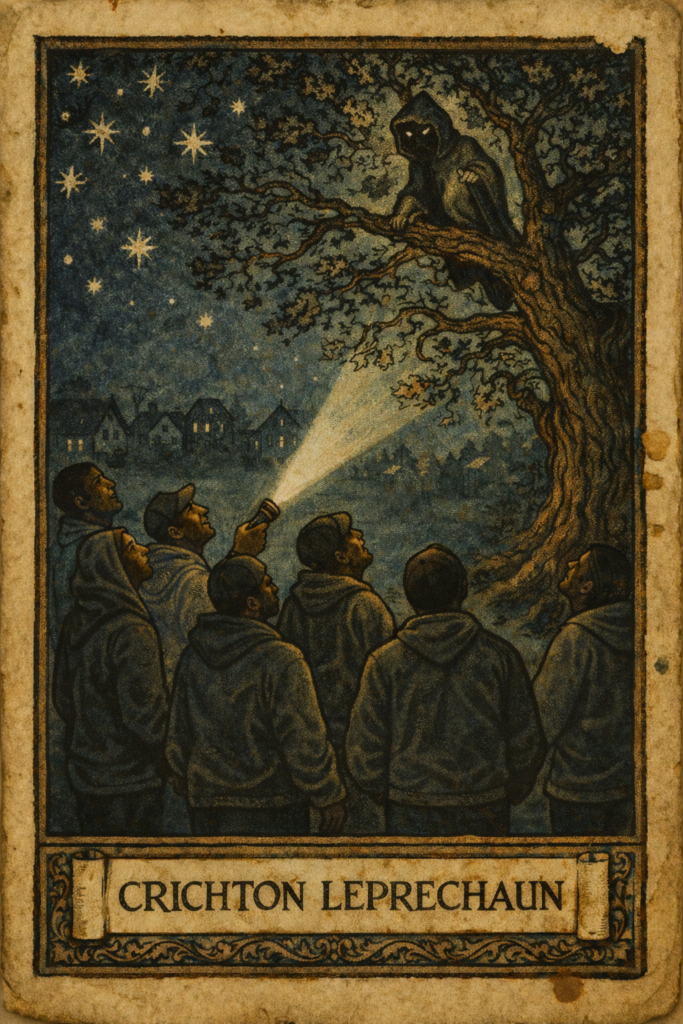
In March 2006, residents crowded beneath a tree in Mobile’s Crichton neighborhood after reports of a leprechaun. WPMI-TV sent reporter Brian Johnson to investigate the gathering on March 14. Witnesses pointed toward the branches and offered competing explanations while one resident supplied an amateur sketch. The broadcast mixed apparent belief, obvious joking, neighborhood spectacle, and wonderfully improvised testimony. One man even displayed a metal pipe as an ancient leprechaun flute.
WPMI aired the segment twice, and the morning version quickly became an early viral internet hit. The station later auctioned the original sketch for charity, raising about $1,000. Mobile coverage says the clip returns to local attention around St. Patrick’s Day each year. By 2023, a Mobile sign shop was selling cardboard versions of the famous sketch. An eight-foot Crichton Leprechaun cutout stood outside the business.