Minnesota
Minnesota cryptids draw from northern forest folklore, lake-monster legends, Indigenous traditions, roadside encounters, and strange historical mysteries. The state’s thousands of lakes, wooded north country, river systems, and remote rural areas give many stories a strong local setting.
Ojibwe and Dakota traditions form part of Minnesota’s older folklore, alongside later settler legends and modern cryptid reports. Lake monsters, hairy humanoids, mysterious animals, and unusual historical figures appear across northern forests, farming communities, and the state’s waterways.
Wiindigoo / Wendigo (Ojibwe Tradition / Northern Minnesota)
The Wiindigoo is an Ojibwe winter cannibal being associated with hunger, danger, and extreme cold. The Ojibwe People’s Dictionary defines wiindigoo as “a winter cannibal monster.” Traditional stories describe giants, ice-bodied beings, or people transformed through cannibalism. These traditions extend across Ojibwe communities throughout the Great Lakes region.
Minnesota has a direct Windigo tradition through Ojibwe communities in the northern part of the state. During the 1960s, Leech Lake elder Paul Buffalo’s Windigo story was recorded by anthropologist Tim Roufs. Buffalo explained that the story warned children about dangerous winter ice. Bois Forte Ojibwe scholar Linda LeGarde Grover later documented the account in her study of Windigo traditions.

Lake Pepin Serpent (“Pepie”) (Lake Pepin, Minnesota)
The Lake Pepin Serpent, commonly called Pepie, is a monster legend from Lake Pepin on the Minnesota-Wisconsin border. Newspaper reports of unusual creatures in the lake appeared by 1867. A better-known 1871 account described a marine monster moving rapidly through the water. Descriptions vary, with later witnesses reporting eel-like bodies, humps, long necks, or large wakes.
Lake City businessman Larry Nielson helped revive the legend publicly in 2008. He offered a $50,000 reward for convincing photographic or physical evidence of Pepie. The publicity encouraged researchers Chad Lewis and Noah Voss to investigate earlier reports. Lake City tourism still promotes Pepie as part of the community’s folklore.

Hairy Man of Vergas (Vergas Trails / Otter Tail County)
The Hairy Man of Vergas is a shaggy humanoid legend from the backroads west of Vergas, Minnesota. Reports clustered around the Klondike area and roads near County Highways 130 and 17. Local accounts describe a large, heavily haired figure with a beard, broad shoulders, and bare feet. Stories became especially common during the 1970s, when residents drove the trails hoping to see him.
Sherri Hanson later recalled seeing the Hairy Man emerge from an abandoned shack while she was snowmobiling. She remembered that the figure was barefoot despite the snow. Reports declined as the area became more developed, with Hanson placing the last notable sightings in the 1990s. Vergas now celebrates the legend through its annual Hairyman Festival, including a trail ride and community events.

Minnesota Iceman (Minnesota)
The Minnesota Iceman was a hairy humanoid displayed frozen in ice by showman Frank Hansen during the late 1960s. Hansen toured it through fairs and exhibitions, offering changing stories about where the body originated. In December 1968, zoologists Ivan Sanderson and Bernard Heuvelmans examined the specimen in Hansen’s Minnesota trailer. They considered it possibly genuine, and Heuvelmans later proposed the name Homo pongoides.
Smithsonian primatologist John Napier investigated after Hansen refused further access to the supposed body. In 1969, the Smithsonian traced the display to a Hollywood prop maker and concluded it was manufactured. Hansen later published another story claiming he had displayed both a model and a real specimen. The surviving Minnesota Iceman exhibit resurfaced in 2013 and entered Austin, Texas’s Museum of the Weird.

Mishipeshu (Ojibwe Tradition / Lake Superior)
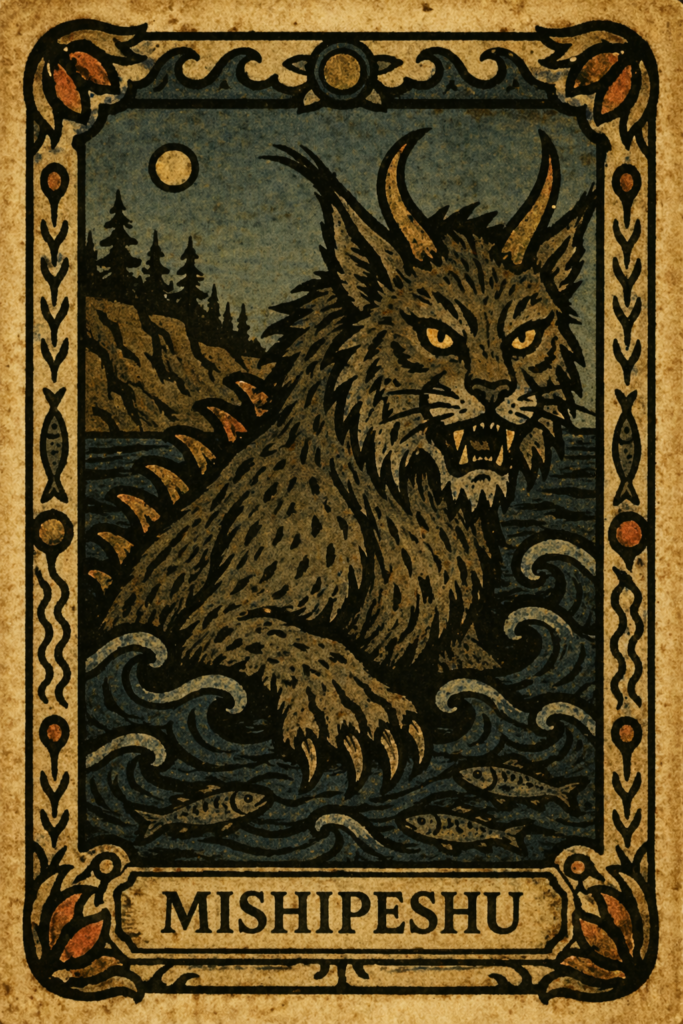
Mishipeshu is a powerful underwater being in Ojibwe tradition, especially associated with Lake Superior. National Park Service (NPS) describes Mishipeshu as the Great Lynx or Water Panther, with feline features, horns, scales, and dorsal spikes. Its horns and tail may be copper, and stories connect the being with storms, drowning, and dangerous water. Offerings could be made before traveling Lake Superior or seeking copper.
The Grand Portage Band of Lake Superior Chippewa has a specific documented tradition involving Mishepeshu. NPS records say waters around Minong, or Isle Royale, are considered a home of the underwater lynx. Minong is a traditional cultural property connected to Grand Portage Ojibwe fishing, gathering, and spiritual practice. Grand Portage National Monument also records older Ojibwe testimony about the underwater lynx along Minnesota’s North Shore.
Paul Bunyan and Babe the Blue Ox (Northern Minnesota, especially Bemidji)
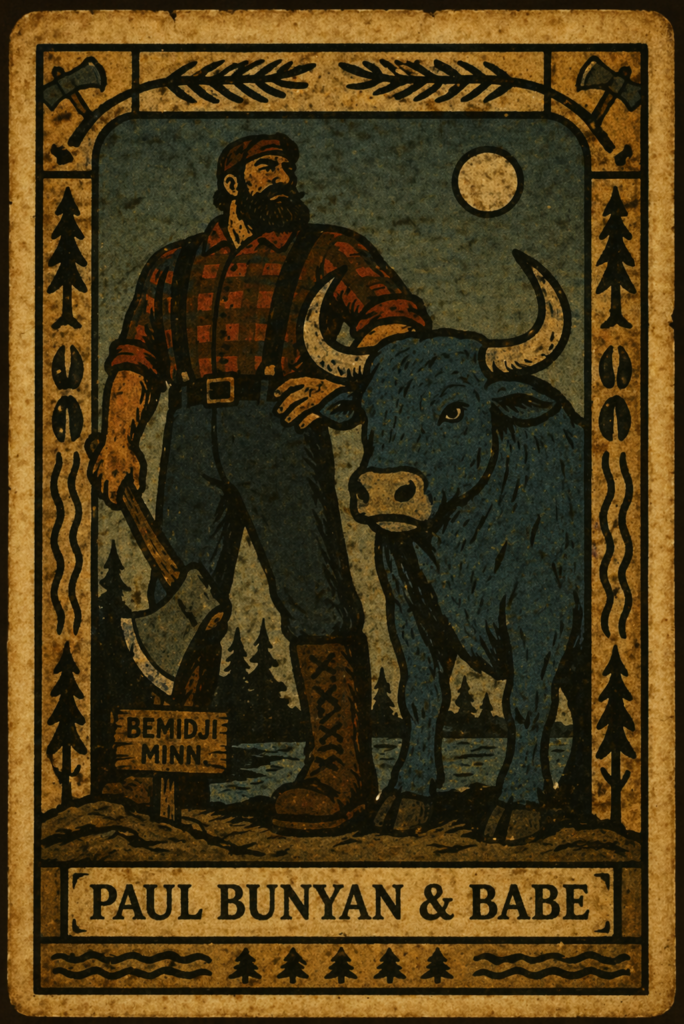
Paul Bunyan is the giant lumberjack of North American logging folklore, accompanied by Babe the Blue Ox. The first known published Bunyan account appeared in the Duluth News Tribune in 1904. William B. Laughead expanded the legend through a 1914 Red River Lumber Company advertising booklet. Revised editions followed in 1916 and 1922, helping spread Bunyan and Babe far beyond logging camps.
Bemidji transformed the pair into Minnesota tourism landmarks during its 1937 Winter Carnival. Residents built an eighteen-foot Paul beside Lake Bemidji and a mobile Babe for carnival parades. Life magazine featured the statues nationally on February 1, 1937. Carnival attendance reached about 100,000 in 1938, and the statues later entered the National Register of Historic Places.