Wisconsin Cryptids and Folklore
Wisconsin cryptids and folklore range from the Beast of Bray Road and Rhinelander’s Hodag to Water Panthers and lake-monster legends. Across the state, Northwoods forests, rural highways, deep lakes, and small towns have produced generations of strange sightings, supernatural stories, Indigenous traditions, and local legends.
Wisconsin folklore includes mysterious creatures, lumber-camp tales, roadside encounters, haunted places, and stories preserved through newspapers and oral tradition. Some legends have become regional icons, while others remain closely tied to particular lakes, forests, towns, and communities.
Beast of Bray Road (Elkhorn)
Reports of an upright, wolf-like creature circulated around rural Elkhorn during the late 1980s and early 1990s. Local witnesses described a hairy, canine animal that sometimes walked or ran on two legs near Bray Road. Reporter Linda S. Godfrey investigated the stories for The Week and interviewed several witnesses. Her December 29, 1991 article, “Tracking Down the ‘Beast of Bray Road,’” gave the legend its enduring name. Walworth County Humane Officer Jon Fredrickson had already collected several reports in a folder labeled “Werewolf.”
Godfrey’s article quickly drew wider attention, bringing reporters and curious visitors to Elkhorn. Additional sightings and similar stories later reached Godfrey from Wisconsin and beyond. The Beast became one of Wisconsin’s best-known cryptids and a lasting part of the state’s modern folklore. Bray Road remains closely associated with the creature more than three decades after Godfrey’s original investigation.
Sources: Linda Godfrey’s original 1991 report; Walworth County Community News retrospective.

Red Cedar Lake Monster (Jefferson County / near Cambridge)
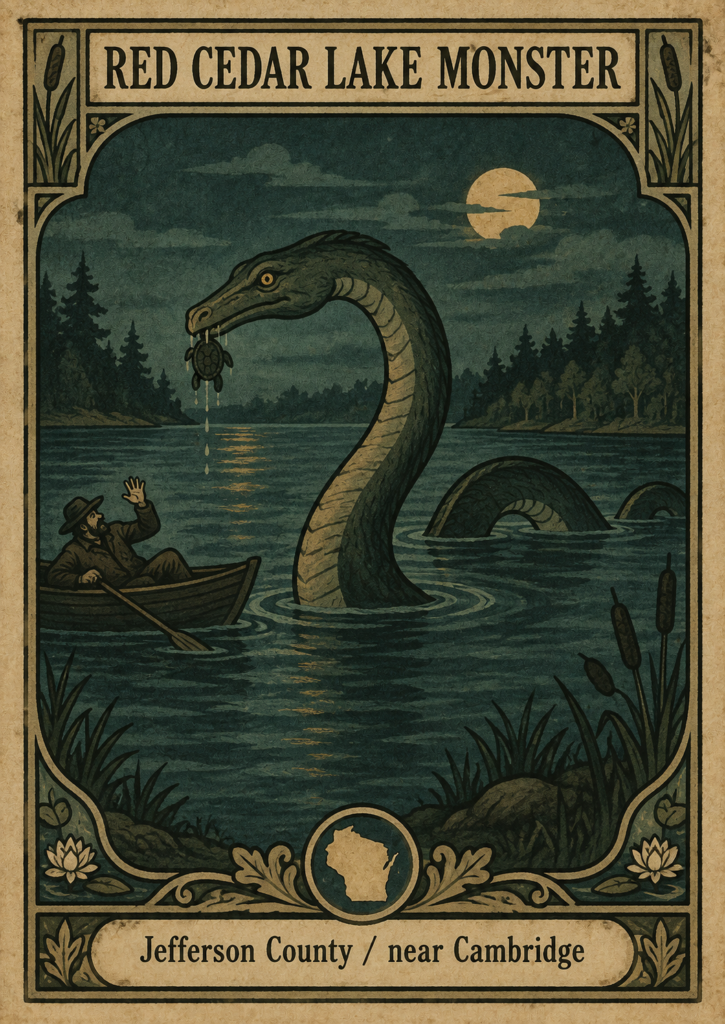
Red Cedar Lake in Jefferson County acquired its own monster stories during Wisconsin’s late nineteenth-century lake-serpent craze. Charles E. Brown recorded an 1891 account of a fisherman seeing an enormous undulating form cross the water. Nearby residents reportedly told him they had seen the creature before and estimated its length near fifty feet.
By 1892, newspaper reports described the monster as active again after winter. One report claimed witnesses saw it swallow a mud turtle, while several sheep disappeared near the lake. Later retellings connected Red Cedar’s creature with nearby Lake Ripley through a supposed underground passage. Those linked stories helped create a small cluster of monster lore across southern Jefferson County.
Hodag (Rhinelander)
The Hodag is Rhinelander’s signature monster, popularized by timber cruiser Eugene S. Shepard during the 1890s. A 1893 Rhinelander newspaper account depicted Shepard’s beast as bear-sized, fanged, and armed with spikes along its back. In 1896, Shepard displayed a constructed Hodag at the Oneida County Fair. The wooden, ox-hide creature moved by wires and supposedly ate white bulldogs only on Sundays.
The stunt spread beyond Rhinelander, while the Hodag became part of the city’s public identity. The Rhinelander Chamber of Commerce calls it the city’s official symbol and identifies it as the local high school mascot. Hodag statues, plaques, schools, parks, and businesses now carry the creature’s image or name. Each May, the Hodag Heritage Festival includes a calling contest, historical city bus tours, speakers, and vendors.

Devil’s Lake Monster Legends (Baraboo)
Devil’s Lake near Baraboo has inspired monster stories alongside its deep cultural and geological history. Ho-Chunk people know the lake as Tee Wakacak, often translated as Sacred Lake. Ancient effigy mounds surround the water, and towering quartzite bluffs give the landscape a striking enclosed character. Local legends describe strange beings living beneath the lake’s dark surface.
One story tells of a drought lowering the water and revealing an amphibious or tentacled creature. Other accounts describe large serpent-like forms moving through the lake, adding to its enduring monster lore. These tales became part of the folklore surrounding one of Wisconsin’s most dramatic natural landmarks. The lake’s old stories, unusual landscape, and sacred associations have kept its mysteries alive for generations.
Sources: Wisconsin DNR: Devil’s Lake State Park History; Devil’s Lake area guide: Monsters of the Lake.

Water Panther (Wisconsin / Ho-Chunk and Ojibwe Traditions)
Water Panthers and related water spirits appear throughout Indigenous traditions of Wisconsin and the western Great Lakes. Ojibwe stories describe powerful panther-like beings dwelling beneath lakes, rivers, and other deep waters. They are associated with copper, supernatural power, dangerous waters, and conflicts with thunder beings. Ho-Chunk traditions likewise tell of powerful horned water spirits inhabiting the world beneath the water.
One Ojibwe story tells of women encountering an underwater panther while crossing a lake. A cedar paddle severs its tail, revealing the tail to be solid copper with supernatural powers. Stories of these water beings have circulated across generations and remain part of Wisconsin’s rich Indigenous folklore. Their presence also echoes through Great Lakes imagery, oral traditions, and stories connected with the region’s waterways.
Sources: Milwaukee Public Museum: Great Lakes Oral Tradition; Milwaukee Public Museum: Ojibwe Oral Tradition.

Geneva Lake Water Spirit (Lake Geneva / Walworth County)
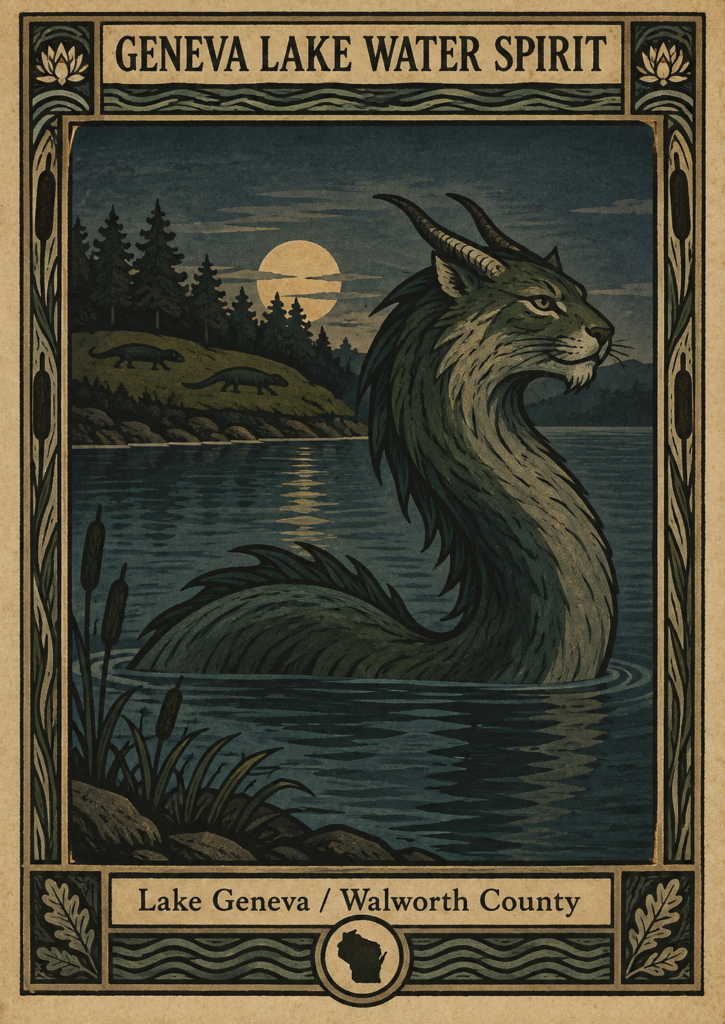
Geneva Lake has long been associated with Indigenous water-spirit traditions in southeastern Wisconsin. Local histories record Potawatomi stories of powerful beings inhabiting the lake, including serpents, giant fish, and water panthers. Near today’s Library Park, early surveys also recorded two large water-spirit effigy mounds beside the shore. Historian Albert Beckwith described these lizard-shaped earthworks in 1912, before later development destroyed them.
Regional tradition placed a dangerous water spirit beneath Geneva Lake and connected such beings with the surrounding landscape. Later writers preserved stories of horned serpents, water panthers, and other enormous creatures associated with the lake. These traditions form an older layer of Geneva Lake folklore beneath the better-known nineteenth-century lake-monster reports.
Rock Lake Pyramids and Rocky the Lake Monster (Lake Mills)
Rock Lake beside Lake Mills is famous for mysterious submerged formations often called the Rock Lake pyramids. Divers, sonar surveys, and local researchers have reported geometric rock piles and mound-like structures beneath the water. Stories about the formations have circulated for decades and are sometimes connected with nearby Aztalan and theories about an ancient settlement beneath the lake.
Rock Lake also has its own monster legend, usually called Rocky or the Rock Lake Terror. Accounts describe a large, serpent-like creature seen moving through the water, with some stories dating to the nineteenth century. Together, Rocky and the submerged formations have made Rock Lake one of Wisconsin’s richest centers of lake mystery and local folklore.
Sources: Travel Wisconsin: Sunken Structures; Discover Wisconsin: Rocky of Rock Lake.

Bozho (Lake Mendota / Madison)
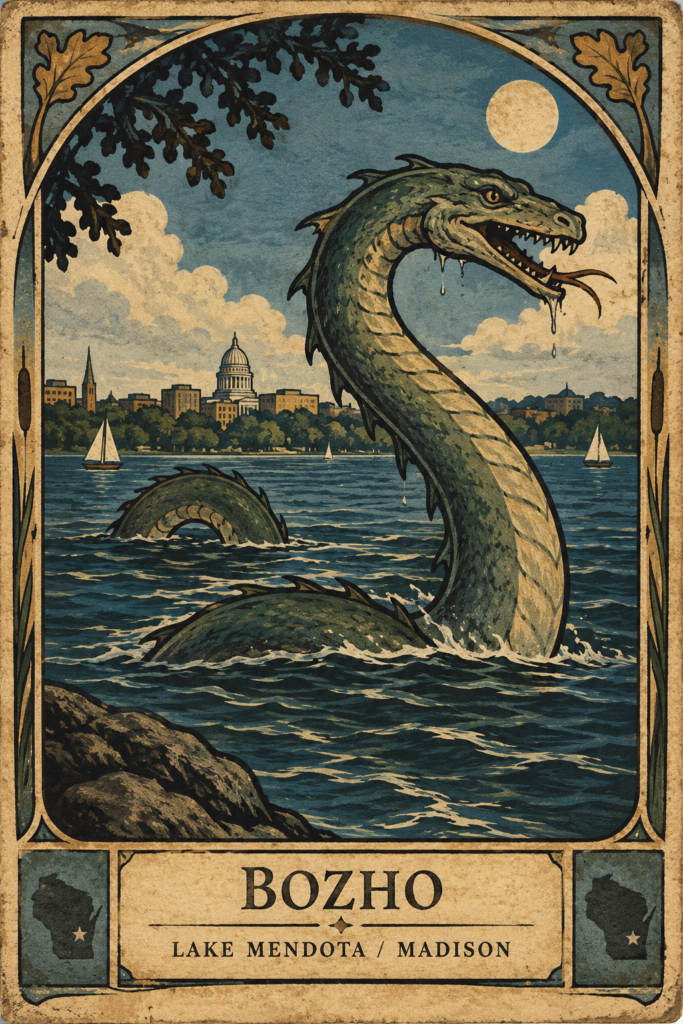
Lake Mendota has hosted sea-serpent stories since the nineteenth century. Madison newspapers reported large snake-like creatures in the lake during the 1880s and 1890s. Charles E. Brown later collected the stories in his 1942 Wisconsin Folklore Society pamphlet on sea serpents. Brown placed several Bozho stories in 1917, beginning with a university student finding an enormous scale at Picnic Point.
One tale describes a huge snake or dragon tickling a sunbathing student’s feet from the water. Other stories credit Bozho with overturning canoes, chasing boats, uprooting piers, and creating waterspouts. Modern Madison writing still retells the legend, and Bozho remains closely associated with Lake Mendota and university folklore.
Explore more regional legends in the Midwest section of Folk Bestiary.