Mississippi
Mississippi cryptids draw from swamp folklore, river legends, ghost stories, strange animal reports, and Indigenous traditions. Cypress wetlands, pine forests, Delta farmland, and the Mississippi River give many of these stories a strong regional setting.
The state’s folklore includes swamp creatures, haunted roads, river monsters, mysterious lights, and legends attached to old towns and rural communities. Gulf Coast stories add maritime encounters and coastal mysteries, while inland traditions reflect the forests, bayous, farms, and waterways of Mississippi.
Pascagoula River Aliens (Pascagoula River, Jackson County)
The Pascagoula River Aliens are tied to an October 11, 1973 encounter reported by Charles Hickson and Calvin Parker. While fishing on the river’s west bank, they heard a whirring sound and saw blue lights. They said three gray, wrinkled beings with claw-like hands floated from an oval craft. Hickson said the creatures carried both men aboard, where an eye-like device examined him.
They reported the encounter that night to the Jackson County Sheriff’s Department. Deputies secretly recorded them after leaving them alone, hoping their private conversation would expose a hoax. The recording instead captured both men continuing to speak fearfully about what they said had happened. Pascagoula dedicated a historical marker to the incident in 2019, preserving it as part of local history.

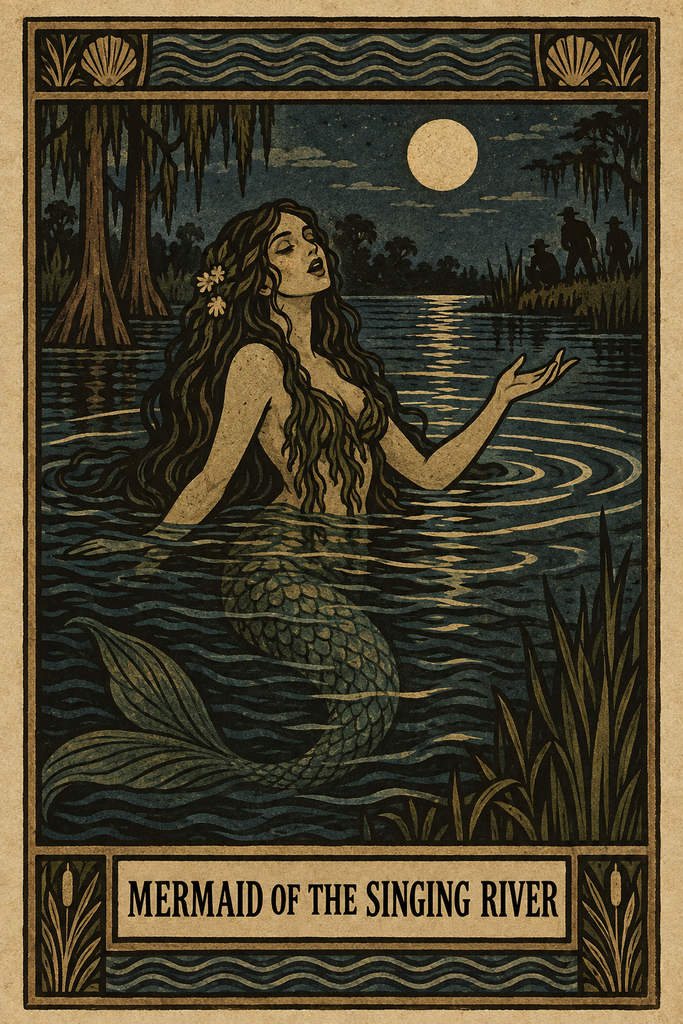
Mermaid of the Pascagoula “Singing River” (Pascagoula River, Mississippi Gulf Coast)
The Pascagoula River on Mississippi’s Gulf Coast is known as the Singing River. Charles Gayarré’s 1867 History of Louisiana records one of its strangest legends. His account describes a riverside people who worshipped a carved mermaid and gathered nightly for music. One midnight, the mermaid rose above the river and sang, drawing the entire community into the water. Gayarré wrote that nearby tribes believed their drowned neighbors still sang from a palace beneath the river.
The river’s mysterious sound also appeared outside the legend. Gayarré wrote that Governor Étienne Périer heard its music near Pascagoula in 1727. Catherine Cole described it as flute-like in the Daily Picayune on July 24, 1892. On August 25, 1925, the Biloxi Daily Herald reported three record companies preparing to capture the sound. Recording equipment was planned along the riverbanks and aboard the yacht Flapper Girl under sportsman Hermes Gautier.
Chatawa Monster (Chatawa, Pike County, Mississippi)
The Chatawa Monster belongs to Chatawa in Pike County, Mississippi. Local stories place it in woods and swamps near the Tangipahoa River. Retellings describe a Bigfoot-like creature and link it to a circus wreck. Some locals say older students used the monster to scare homesick children.
Another explanation pointed to monkeys once seen near St. Mary’s. A highway patrolman later claimed he saw an upright hairy figure. People around Chatawa still repeated that sighting near the artesian well.

Chupacabra (Simpson County and Picayune, Mississippi)
The chupacabra reached Mississippi through modern scare stories, not older local folklore. In 2011, Truitt Barnard shot a strange hairless animal in Simpson County. He compared it to Texas chupacabra photographs.
In 2013, families in Picayune filmed another hairless animal near their homes. Neighbors called it El Chupacabra after sharing video online. Wildlife officers claimed the animal was a coyote with mange.

Sea Serpents of the Gulf (Ship Island and Mississippi Gulf waters)
Mississippi Gulf sea-serpent stories include one famous report from Ship Island. During 1864, Union soldiers there claimed eight monster fish entered the harbor. One account said a harpooned beast dragged their boat ten miles seaward.
Later Gulf reports kept similar creatures in nearby waters. In 1889, a lightship captain near the Mississippi’s mouth described another monster. He said it crushed a boat after the crew approached and attacked it.

The Three-Legged Lady on Nash Road (Columbus, Lowndes County, Mississippi)
The Three-Legged Lady is a roadside ghost legend attached to Nash Road outside Columbus. Locals have long called the route Three-Legged Lady Road, especially around the former church site and nearby lock-and-dam area. Retellings disagree about her origin, but most describe a woman somehow associated with an extra human leg. Some stories say she sewed a dead lover’s leg onto her body; others involve a murdered child.
The legend is best known for a ritual challenge performed by drivers at night. Visitors stop near the old church site, kill their headlights, and honk three times to summon her. She then supposedly knocks or slams against the car and races it down Nash Road. Local recollections show teenagers making nighttime trips there decades ago, helping preserve the legend through repeated dares.
