Arkansas
Arkansas cryptids range from Ozark folklore and river monster traditions to swamp legends, Bigfoot reports, and supernatural animal stories. The state’s mountains, forests, rivers, wetlands, and rural backroads give many legends a clear regional setting.
Arkansas folklore includes the Fouke Monster, White River Monster, Ozark Howler, and the supernatural Snawfus. Other stories developed around remote waterways, isolated communities, and the wooded landscapes of the Ozarks and southern Arkansas.
Fouke Monster
The Fouke Monster, also called the Boggy Creek Monster, is a hairy humanoid reported around Fouke in southwestern Arkansas. Reports predate its famous 1971 outbreak; one resident reported a strange creature to Sheriff Leslie Greer in 1946. In May 1971, Bobby Ford reported that a red-eyed, seven-foot creature attacked him outside his home near Fouke. Ford received hospital treatment for scratches and shock after the reported encounter. Investigators found unusual tracks and porch scratches, but no blood from the creature.
Reporter Jim Powell’s follow-up story introduced the name “Fouke Monster,” and wire services carried the story nationally. Charles B. Pierce transformed the reports into the 1972 docudrama The Legend of Boggy Creek. Filmed around Fouke with local residents, the movie became a major drive-in success and spread the legend widely. Fouke began hosting the Boggy Creek Festival in 2013, celebrating local stories surrounding the creature. Restored in 2019, Pierce’s film continues connecting the Fouke Monster with the town that made it famous.


White River Monster (“Whitey”) (White River near Newport)
The White River Monster, often called Whitey, is a lake-monster legend from the White River near Newport. The Encyclopedia of Arkansas traces reported sightings to 1915. On July 1, 1937, plantation owner Bramlett Bateman reported an enormous gray creature in the river. Bateman described it as roughly as wide as a car and three cars long. Locals later attempted to trap it with a huge rope net and brought in a diver.
Sightings resumed in 1971 with reports of a gray creature bearing a horn and long, spiny back. Witnesses also reported three-toed tracks measuring fourteen inches long near the river. In 1973, the Arkansas General Assembly passed Senate Resolution 23, creating the White River Monster Refuge. The resolution prohibited molesting, killing, trampling, or harming Whitey within its designated stretch of river.

Ozark Howler (Ozark Mountains of Northern Arkansas)
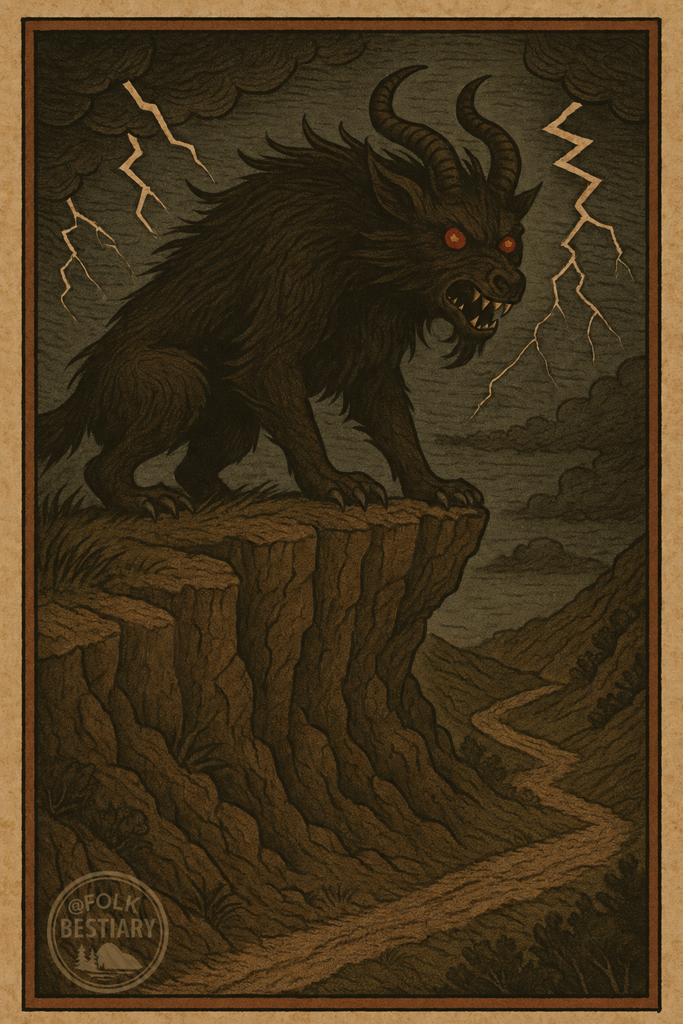
The Ozark Howler is a modern monster legend associated with the Ozark Mountains of northern Arkansas and southern Missouri. It is usually described as a dark, shaggy, cat-like animal with horns and a frightening howl. Cryptozoologist Loren Coleman traced its early internet spread to a deliberate 1998 hoax. Those planted stories gave the Howler an invented historical pedigree, including supposed older sightings.
Later reports continued under the Ozark Howler name despite that origin. In 2015, a viewer sent 40/29 News photographs said to show the creature at Devil’s Den State Park. Arkansas Game and Fish officials knew of no documented Howler sightings there. In October 2024, Garden & Gun published a feature on the legend.
From the Folk Bestiary shop

Products and checkout are handled by Redbubble.
Gowrow
The Gowrow entered Arkansas print through an Arkansas Gazette story published January 31, 1897. The account placed the creature near Blanco in Searcy County, where William Miller organized a posse. It described a twenty-foot beast with tusks, webbed claws, back horns, and a blade-like tail. The story said the posse killed the Gowrow after tracking it to a cave near a lake. Editor Fred Allsopp later identified Elbert Smithee as the writer and Elmer Burrus as the illustrator.
Folklorist Vance Randolph later recorded additional Gowrow stories in his 1950 article about fabulous Ozark monsters. Randolph said his sources placed Gowrow reports as early as the 1880s and treated the creature as a species. His material included a Devil’s Hole encounter in Boone County and claims that Gowrows laid huge soft-shelled eggs. Randolph also repeated a Mena tale about a captive Gowrow fattened with dried apples until it became trapped. He later included the Gowrow in We Always Lie to Strangers, his 1951 collection of Ozark tall tales.

The Snawfus (Arkansas Ozarks)
The Snawfus is a supernatural white deer from Ozark folklore in Arkansas and Missouri. Stories describe an enormous albino stag with flowering plum or dogwood branches growing from its head. Some versions say it leaps into treetops or flies silently through the forest. Its breath produces spirals of blue smoke said to create the Ozarks’ seasonal blue haze.
Folklorist Vance Randolph recorded several Snawfus traditions in his studies of Ozark tall tales. One story says a hunter shot an albino deer with plum pits, producing its flowering antlers. Another describes an orchardist grafting Arkansas Black apple branches onto a captured Snawfus. Ozark belief also treated albino deer as ominous, with a Snawfus sighting sometimes regarded as a warning of death.

The Heber Springs Water Panther
The Heber Springs Water Panther is a reported creature associated with Greers Ferry Lake near Heber Springs, Arkansas. George Eberhart’s 2002 guide cites a 1995 Fate article about the Greers Ferry Lake creature. That article reportedly described yellow eyes and loud groans heard during summer. W. C. Jameson’s 2007 account later described a furred, manlike creature around Greers Ferry Lake and the Little Red River.
Jameson attributed several incidents to the creature, including an early-1970s scuba-diver encounter near an underwater cave. University of Central Arkansas professor Mark Spitzer later investigated the legend while researching Arkansas cryptid stories. His search found no 1970s newspaper accounts, and several local residents said they had never heard the story. A 2011 newspaper appeal nevertheless produced a report of a black panther near Tumbling Shoals. Spitzer later included the Water Panther among the Arkansas legends examined in his book Crypto-Arkansas.
