California
California cryptids range from Northern California Bigfoot reports and Tahoe Tessie to the Dark Watchers of Big Sur and the Fresno Nightcrawler. Other legends grew around Gold Rush country, desert highways, mountain lakes, isolated canyons, and the strange backroads of Southern California.
The state’s folklore also includes modern UFO events, lost-treasure stories, regional ghosts, internet-born monsters, and Indigenous supernatural traditions tied to specific communities. California’s size and cultural variety have produced legends that differ sharply between the redwoods, Sierra Nevada, Central Valley, deserts, and Pacific coast.
Tahoe Tessie (Lake Tahoe, California-Nevada Border)
Tahoe Tessie is a lake-monster legend associated with Lake Tahoe on the California-Nevada border. An 1897 newspaper account recalled I.C. Coggin’s supposed 1865 encounter near Tahoe. Coggin described an enormous black-scaled serpent with a fourteen-foot-wide head and body exceeding six hundred feet. The modern Tessie name appeared much later, during the 1970s and 1980s.
In 1982 and 1984, witnesses reported large, dark animals moving through the lake. A 1984 newspaper account described creatures estimated at twelve and seventeen feet long. Bob McCormick coined the Tahoe Tessie name in 1975. He later published the children’s book The Story of Tahoe Tessie in 1984.

The Dark Watchers (Santa Lucia Mountains and Big Sur)
The Dark Watchers are shadowy human-like figures associated with the Santa Lucia Mountains and Big Sur. Descriptions place them on distant ridges, often watching travelers around dawn or dusk. Robinson Jeffers mentioned mysterious “watchers” in his 1937 collection Such Counsels You Gave to Me. John Steinbeck used similar figures in his 1938 short story “Flight.”
Later lore describes them as unusually tall, faceless silhouettes, sometimes wearing hats or carrying staffs. Claims of a Chumash origin or the name Los Vigilantes Oscuros remain difficult to document. Thomas Steinbeck and Benjamin Brode collected local accounts in their 2014 book In Search of the Dark Watchers. Their work helped preserve modern Big Sur stories about figures seen along the Santa Lucia ridgelines.

Batsquatch (Mount Shasta, Northern California)
Batsquatch is primarily a Washington cryptid, but a 2009 report placed a similar winged creature near Mount Shasta. Paranormal investigator Paul Dale Roberts published the hikers’ account after one witness contacted him. They described a man-height, stocky creature with leathery wings and a bat-like head. One witness estimated the wingspan at roughly fifty feet.
The name comes from the better-known Washington Batsquatch tradition associated with the Pacific Northwest. Later cryptid sources grouped the Mount Shasta sighting under the same name. The California account remains a single reported encounter rather than a recurring local tradition. Roberts published the Mount Shasta account in April 2009.

Fresno Nightcrawler (Fresno and Central California)
The Fresno Nightcrawler emerged from security footage recorded in Fresno in 2007. The video shows two small, pale figures crossing a residential lawn at night. Their bodies appear dominated by long legs, with tiny upper bodies and no visible arms. The homeowner later brought the footage to Univision while seeking an explanation.
A second video circulated in 2011, reportedly filmed at Yosemite Lakes Park near Coarsegold. Similar white figures walk across the frame with the same unusual proportions. Fact or Faked: Paranormal Files investigated the original footage in 2010. PBS’s Monstrum devoted a 2025 episode to the Nightcrawler and its internet following.

The Napa Rebobs (Partrick Road, Napa)
The Napa Rebobs are winged monkey-like creatures associated with Partrick Road in the hills west of Napa. The San Francisco Chronicle describes searching for them as a local teenage rite of passage. Stories usually portray flying primates, while some versions add robotic or mechanical features. Drivers traditionally ventured up Partrick Road at night hoping to glimpse them among the trees.
Origin stories range from mad-scientist experiments to escaped hybrids and secret government projects. The Chronicle suggests the Halloween-loving Partrick family may have influenced the road’s reputation. In 2018, locals campaigned to make a Rebob Napa High School’s new mascot. Lucky Penny Productions staged The Revenge of the Rebobs in Napa in 2025.

The Lone Pine Mountain Devil (Lone Pine and the Eastern Sierra)
The Lone Pine Mountain Devil is a modern cryptid legend attached to Lone Pine and California’s Eastern Sierra. The USC Digital Folklore Archives traces the creature to a 2010 horror-comedy video by Chad, Matt & Rob. Their Mountain Devil Prank Fails Horribly featured a bat-like predator supposedly inhabiting the mountains near Lone Pine. Later websites added older sightings, historical attacks, and elaborate origin stories.
By 2013, a Sierra Wave letter was asking Eastern Sierra residents about supposed local Mountain Devil traditions. USC recorded another account in 2017 describing a carnivorous, pterosaur-like creature circulating through cryptid communities. PBS SoCal featured the Lone Pine Mountain Devil in a 2022 survey of Southern California monster folklore.

Penelope (Sierra Nevada Mountains)
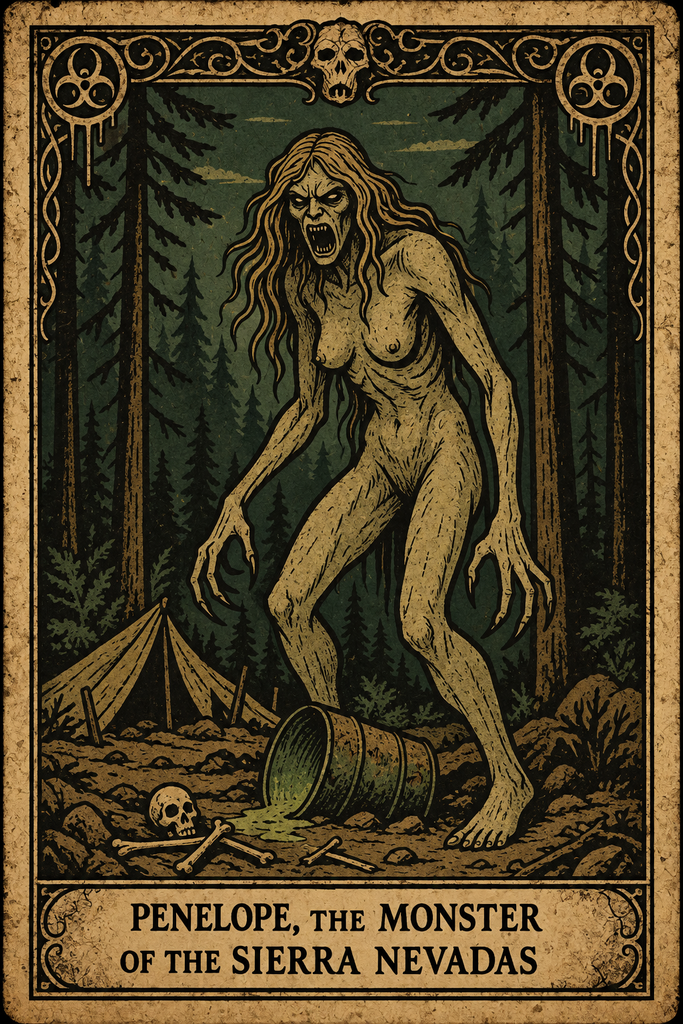
Penelope is a Sierra Nevada legend about a tall, pale female humanoid with long limbs and light hair. In a 2012 account, a father and teenage son camped in an RV near Tioga Lake. They heard repeated woman-like screams after midnight, then woke again around 2:40 a.m. Through the windshield, they saw a nearly seven-foot figure with a deformed face and long, pale hair. The figure walked toward the lake before they drove away. A ranger later told them similar creatures had been called Penelope.
Other versions describe Penelope as a woman who became lost in the Sierra Nevada and turned cannibalistic. A more elaborate legend says a crash killed her husband and stranded her during a winter storm. She supposedly sheltered inside a discarded toxic-waste drum and emerged transformed, violent, and hungry for human flesh. Weird California records stories of attacks on hikers, campers, rangers, and even a train. PBS SoCal later placed Penelope around Tioga Lake, Convict Lake, and Mono Lake in 2022.
The Proctor Valley Monster
In the dry hills between Chula Vista and Jamul, travelers whisper about the Proctor Valley Monster, a towering, part-human, part-bovine creature said to stalk the dirt road after dark. Witnesses describe it as seven feet tall, covered in matted hair, with a distorted cow-like head and clawed hands. The creature leaves behind enormous 18-inch footprints, and locals claim it mutilates livestock and ambushes cars that wander too far into the valley. Some say its guttural bellows echo through the brush, half roar and half scream, warning intruders to turn back before it charges.
The monster’s legend may date back to the 1960s, when isolated ranches first reported strange attacks on cattle. Since then, countless stories have tied the creature to the haunted stretch of Proctor Valley Road, already home to phantom headlights and ghostly hitchhikers. Some believe the monster is a modern minotaur—an ancient curse reborn in the Californian desert. Others think it’s simply a feral beast mutated by isolation and violence. Whatever it is, the Proctor Valley Monster stands as one of Southern California’s most enduring cryptids, a creature that turns every midnight drive into a test of courage.

Bigfoot (Bluff Creek and Northern California)
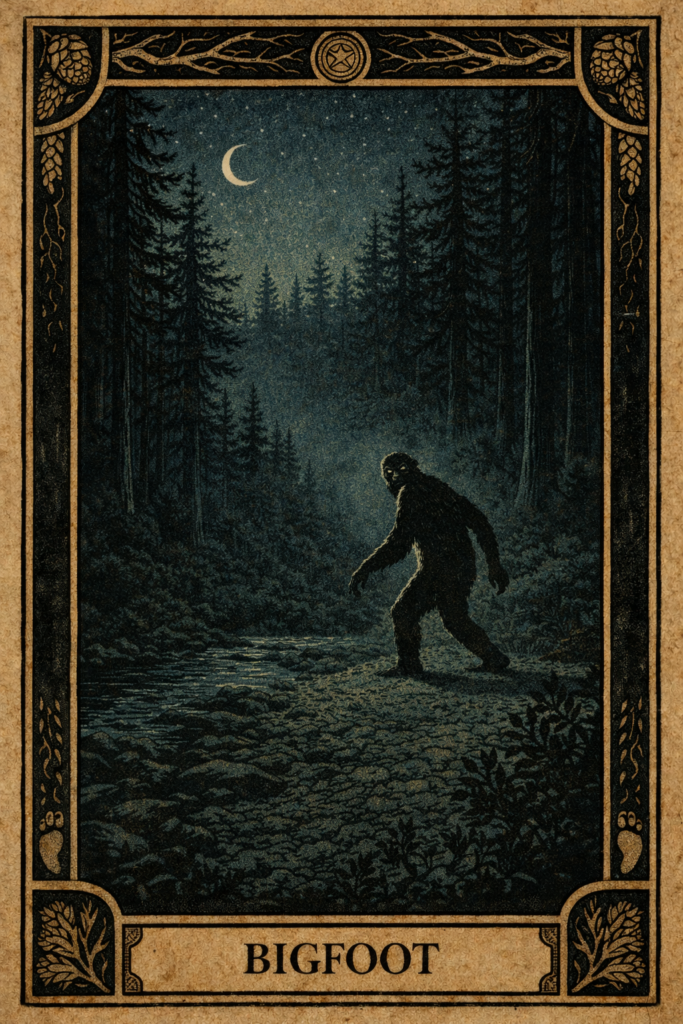
Bigfoot is a large, hairy biped reported across North America, with modern lore strongly rooted in Northern California. In 1958, road worker Jerry Crew found sixteen-inch footprints near Bluff Creek and made a plaster cast. He brought the cast to Eureka’s Humboldt Times, where editor Andrew Genzoli helped popularize the name Bigfoot. Associated Press coverage spread the Bluff Creek story nationally.
On October 20, 1967, Roger Patterson and Bob Gimlin encountered a hairy figure in Six Rivers National Forest. Patterson filmed it crossing a Bluff Creek sandbar before it disappeared into the forest. The Patterson–Gimlin film became the best-known footage associated with the creature; its subject is commonly nicknamed Patty. Willow Creek now houses the China Flat Museum’s Bigfoot collection and hosts the annual Bigfoot Daze.
Char Man (Ojai Valley, Ventura County)
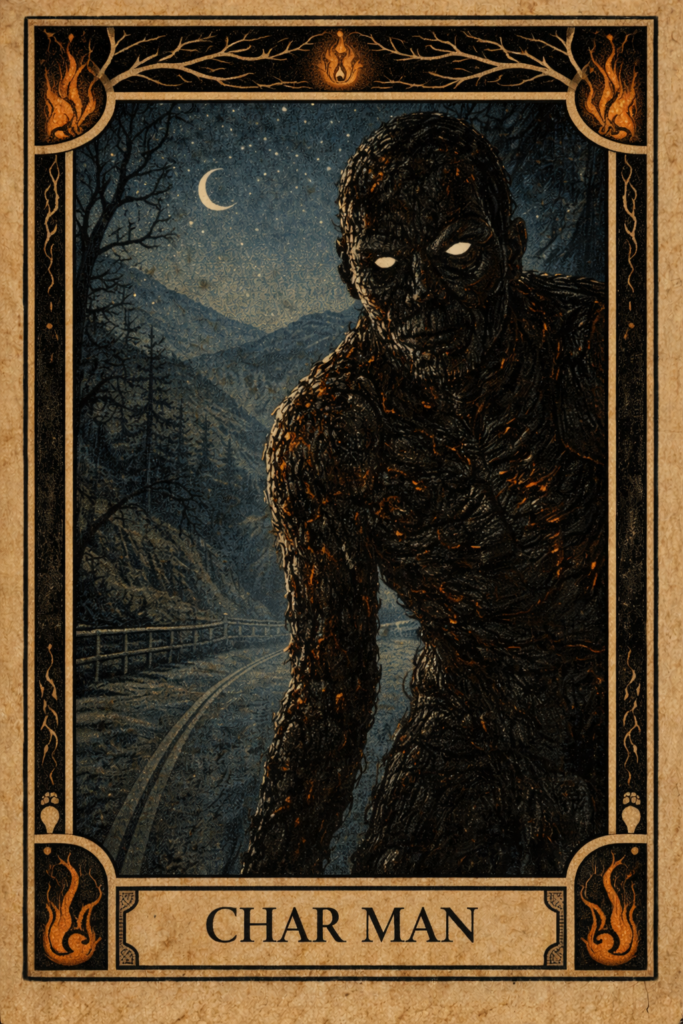
Char Man is an Ojai legend about a badly burned man haunting roads outside town. Folklorist Charlie Seemann traced the earliest reports to Shelf Road around 1961 or 1962. Ojai police Sergeant Bill Klamser recalled teenagers reporting a badly deformed man approaching parked cars there. Police later identified a reclusive elderly resident with severe facial and arm disfigurement who walked Shelf Road at night.
Teenagers soon connected the figure with the 1948 Wheeler Springs Fire and ruins of the Sanderson home. As development reached Shelf Road, stories shifted south to Old Creek Road and Camp Comfort. Later versions describe Char Man attacking motorists or emerging when visitors call for help from a bridge. USC’s folklore archive recorded Ojai students still trading Char Man stories as schoolyard folklore in 2021.