Delaware
Delaware cryptids and folklore are closely tied to water, old settlements, and the state’s unusually dense local history. Shipwrecks, lighthouses, tidal marshes, cypress swamps, and abandoned military sites have all produced their own legends. Some involve ghosts connected to real disasters or historic buildings. Others, like the Selbyville Swamp Monster, began as distinctly local stories.
Along Delaware Bay, haunted lighthouses and maritime tales sit beside the long ghost tradition of Fort Delaware. Farther south, swamp roads and small towns produced stranger creatures, practical jokes, and stories passed between generations. Delaware’s folklore is compact but varied, with monsters, hauntings, shipwreck legends, and roadside stories packed into a very small state.
Selbyville Swamp Monster (Great Cypress Swamp, Sussex County)
The Selbyville Swamp Monster is a hairy creature from folklore surrounding the Great Cypress Swamp in Sussex County. WHYY reports that residents told stories of screams and pursuing monsters near the swamp by the early 1900s. The legend surged in 1964 after Selbyville resident Fred Stevens began appearing beside Cypress Road in costume. His disguise used his aunt’s raccoon coat, a mask, and a spiked club.
Stevens acted at the urging of Ralph Grapperhaus, who published encounters in the local newspaper. The stunt attracted visitors from Delaware and Maryland, some bringing chickens as offerings for the monster. Stevens stopped after armed searchers made the prank dangerous, then publicly revealed his role in 1987. His oral history is preserved by the Selbyville Public Library’s Delaware Room.

Zwaanendael Merman (Lewes)
The Zwaanendael Merman is a fabricated mermaid displayed at the Zwaanendael Museum in Lewes. Museum sources identify it as a nineteenth-century East Asian curiosity made for Western buyers. Figures of this type were often called Fiji Mermaids and combined animal parts with manufactured materials. A visiting sea captain gave this example to the Martin family of Lewes in the early twentieth century.
The Merman first appeared at the museum in 1941 after a Martin relative set it aside for display. When the family later planned to sell it, Lewes residents raised money to keep it in town. The Lewes Historical Society purchased the figure for $250 and presented it to the museum. It remains on display today as one of the museum’s best-known pieces of folk or sailor’s art.

Fort Delaware Ghosts (Pea Patch Island, Delaware City)
Fort Delaware stands on Pea Patch Island in the Delaware River near Delaware City. During the Civil War, it held roughly 33,000 Confederate and political prisoners. About 2,400 Confederate prisoners died there, according to the Delaware Public Archives. Ghost stories now include apparitions, footsteps, voices, and unexplained movement throughout the fort.
DNREC records stories of a photographed “blue man” and children haunting the officers’ quarters. Visitors and investigators also report opening doors, footsteps, distant shadows, and whispers. Fort Delaware appeared on Ghost Hunters, where investigators reported cannon fire and a thermal image of a man. The state’s paranormal tours completed their seventeenth season in 2025.

Ghost Ship of Cape Henlopen (Cape Henlopen and Delaware Bay)
A Delaware Heritage Commission history of Cape Henlopen preserves a ghost-ship legend from the cape. On calm moonlit nights, the vessel appears offshore and turns into Delaware Bay. A skull-and-crossbones flag flies from its mast as it moves past the cape. Stories of the ship circulated around Henlopen campfires and became part of the coast’s maritime folklore.
Cape Henlopen’s real shipwreck history gives the legend a fitting setting. HMS DeBraak capsized nearby in 1798, killing many aboard. The ghost ship survives in C. W. Warrington’s published history of Fort Miles.

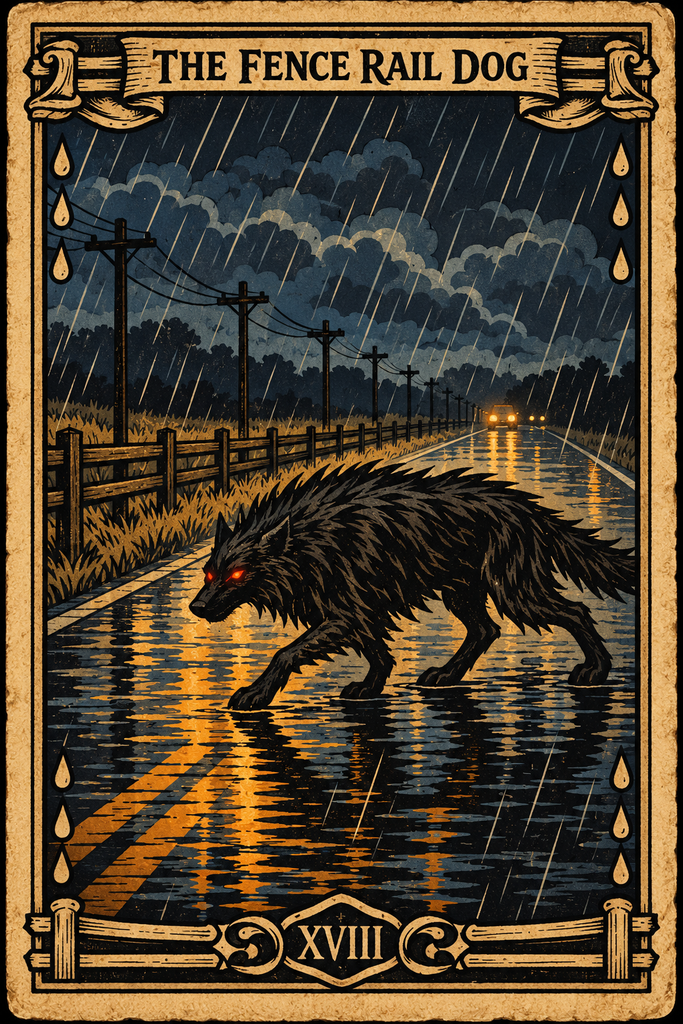
Fence Rail Dog (Frederica and Midstate Road, Kent County)
The Fence Rail Dog is a black spectral hound associated with the Bonwell House west of Frederica. A 1972 National Register nomination records it as a local legend with flaming red eyes. Reports describe it as being as long as a fence rail, giving the apparition its name. The same legend says Michael Bonwell killed a young Black worker at his tannery before his own death. After neighbors refused burial, local Black residents supposedly buried Bonwell, whose spirit returned as the dog.
Later versions moved the haunting onto Route 12, or Midstate Road, between Frederica and Felton. These stories describe the dog racing cars along the rural highway. A local history of Andrews Lake also gives it a bushy tail arched over its back. That version keeps the glowing red eyes and places the haunting west of Frederica. The Bonwell House entered the National Register of Historic Places in 1973.