Georgia
Georgia cryptids sit inside a much broader folklore shaped by mountains, river country, coastal marshes, and the Okefenokee. North Georgia carries mountain legends and ghost stories, while the Okefenokee preserves a distinctive tradition of tall tales. Along the coast, the Altamaha River has its own monster tradition centered on Altamaha-ha, or Altie.
Georgia folklore also includes haunted historic sites, strange animals, roadside legends, and creatures inherited from older storytelling traditions. The state’s storytelling history ranges from exaggerated frontier tales to ghosts and supernatural encounters. Modern sightings sit beside much older local stories, giving different parts of Georgia noticeably different folklore traditions.
Altamaha-ha (Altamaha River and Darien, McIntosh County)
The Altamaha-ha, or Altie, is Georgia’s best-known river monster, centered on the Altamaha estuary near Darien. An 1830 newspaper account described Captain Delano seeing a huge animal off nearby St. Simons Island. He estimated it at seventy feet long, with an alligator-shaped head raised several feet above the water. Five crewmen reportedly saw it, while island residents described similar creatures offshore.
Former Darien mayor Scotty Rogers described another encounter on December 23, 1973, while crossing the Champney River Bridge. In a Georgia Public Broadcasting interview, Rogers described a thick neck, horselike head, and automobile-sized body rising from the river. Darien later adopted Altie as a local tourism symbol. A twenty-foot replica by artist Rick Spears was unveiled at the visitor center in 2009. Explore Georgia still invites visitors to photograph the replica and learn about the legend.

Hogzilla (Alapaha, Berrien County)
On June 17, 2004, hunting guide Chris Griffin shot an enormous hog near Alapaha in Berrien County. Plantation owner Ken Holyoak claimed it measured twelve feet and weighed 1,000 pounds. Photographs spread quickly, turning the animal into a local legend before anyone independently measured the carcass. In 2005, a National Geographic investigation exhumed the remains and confirmed that Hogzilla had existed. Researchers estimated about 800 pounds and roughly seven-and-a-half to eight feet long. DNA testing found both wild boar and domestic pig ancestry.
Alapaha embraced the story almost immediately. In November 2004, the town’s annual festival featured a Hogzilla float, merchandise, and a hog-calling contest. The New Georgia Encyclopedia later noted the inaugural festival and Hogzilla’s national attention. Georgia planning documents even list the “Legend of Hogzilla” among Alapaha’s distinctive local activities.

Lake Lanier Ghosts (Lake Lanier, North Georgia)
Lake Lanier formed behind Buford Dam after the U.S. Army Corps of Engineers completed the project in 1956. The Corps acquired about 58,000 acres, removed shoreline buildings, relocated some graves, and left other structures underwater. Submerged roads, trees, and foundations later became part of the lake’s haunted reputation.
The best-known ghost is the Lady of the Lake, tied to a real 1958 disappearance. Delia Mae Parker Young and Susie Roberts vanished after their car left Lanier Bridge and entered the water. A woman’s body surfaced in 1959, but Roberts and the car remained missing until workers recovered them in 1990. Later folklore describes a handless woman in blue walking near the bridge where the women vanished.

The Wog (Winder and the Jackson-Barrow County Area)
The Wog appears in G.J.N. Wilson’s 1914 history of Jackson County, based on stories he said locals told him. Wilson said early settlers around old Jug Tavern, now Winder, claimed the creature visited homes before about 1809. He described a jet-black, long-haired animal about a small horse’s size, with front legs longer than its hind legs. Its bear-like head had red eyes, exposed white teeth, and a long forked tongue.
Wilson’s narrative also linked the Wog with Nodoroc through dialogue assigned to a Creek character. His account said animals panicked nearby, while the creature’s white-tipped tail made a distinctive whizzing sound. A 1923 Winder newspaper revived the legend with stories of later Wog appearances around northeast Georgia. In 2009, the Barrow County Historical Society featured the Wog at its New Year’s Eve Jug Drop.

Old Green Eyes (Chickamauga Battlefield, Georgia)
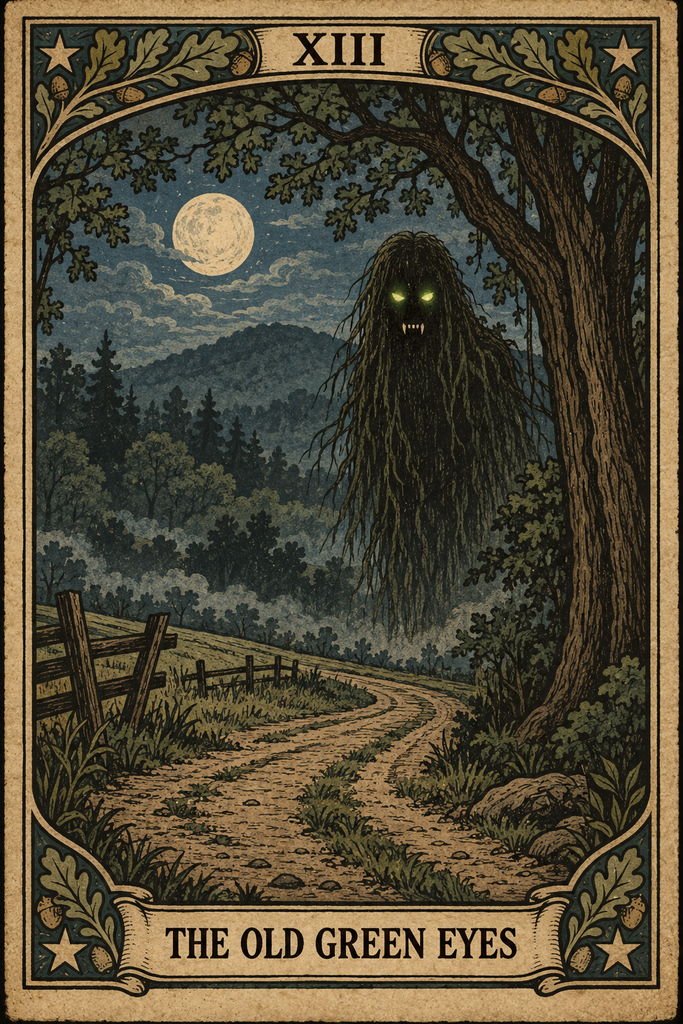
Old Green Eyes is a battlefield apparition associated with Chickamauga, especially the wooded areas around Snodgrass Hill. Stories describe glowing eyes, a shadowy figure, a headless soldier, or a long-haired creature with sharp teeth. Many versions connect the figure to soldiers killed during the September 1863 Battle of Chickamauga. The familiar legend is documented through twentieth-century local storytelling and folklore collections.
The James T. Callow Folklore Archive preserves several Green Eyes stories from the region. One describes lights descending through battlefield trees while frightened teenagers watched from their cars. Another makes Green Eyes a decapitated soldier searching nightly for his missing head. Since 2024, downtown Chickamauga has celebrated the legend through the annual Green Eyes Festival.