New Hampshire
New Hampshire cryptids and folklore range from White Mountain creatures and lake monsters to colonial legends, hauntings, and unexplained phenomena. The northern forests contribute strange-animal reports, while Lake Winnipesaukee carries one of the state’s best-known monster traditions.
Southern New Hampshire adds the Deerfield Booms, Mystery Hill, and the modern Devil Monkey story from Danville. Hampton preserves Goody Cole folklore, while the Isles of Shoals carry ghost stories rooted in the state’s Atlantic coast.
Wood Devils (Coös County, New Hampshire)
Wood Devils are tall, thin humanoids said to inhabit the deep forests of Coös County. The earliest traceable account appears in a 1996 post recalling older local stories. The writer said local men associated the creatures especially with the 1930s. He described gray-haired figures that moved quickly and hid by circling tree trunks.
Later retellings emphasize their extreme thinness, pale or gray coloring, and ability to vanish behind trees. Some versions also mention screams or other strange sounds in the woods. The legend now circulates through New Hampshire cryptid writing and regional folklore retellings. Its tree-hiding behavior remains the Wood Devil’s most distinctive feature.

Devil Monkey (Danville, Rockingham County)
The Devil Monkey is a modern legend from Danville, where unusual primate sightings began in 2001. Fire Chief David Kimball reported seeing a monkey-like animal leap from roadside trees near Kingston Road. Other residents reported sightings or strange screeching and howling sounds around town.
Search parties tried to capture the animal, which many residents believed was an escaped exotic pet. A Today Show segment was scheduled for September 11, 2001, but never aired. A possible 2012 sighting involved Michelle Andino, who saw a dark animal climbing a tree. The story later inspired a local Devil Monkey scavenger hunt.

The Witch of Hampton (Eunice “Goody” Cole, Hampton)
Eunice “Goody” Cole became New Hampshire’s only woman convicted of witchcraft. A Boston court convicted her in 1656, and she spent years imprisoned. She faced another witchcraft trial in 1673, but that jury acquitted her. Cole died in 1680 after another accusation and confinement in Hampton.
By the nineteenth century, local historians were recording legends about Cole and her reputed grave. Hampton restored her citizenship in 1938 and later placed a memorial stone at the Tuck Museum. In the early 1960s, Hampton lore included reported sightings of Goody Cole’s ghost. Her story remains central to local folklore, museum exhibits, commemorations, and the “Witch of Hampton” tradition.

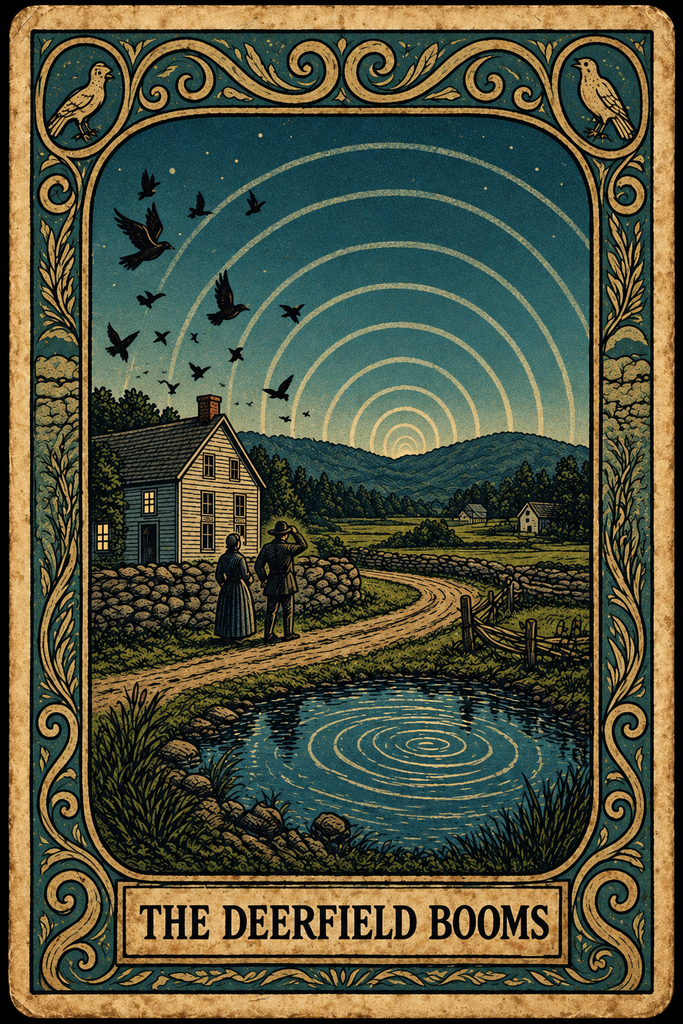
The Deerfield Booms (Deerfield, New Hampshire)
The Deerfield Booms were unexplained explosive sounds reported around southern Deerfield during the 1830s and 1840s. In September 1846, Scientific American reprinted a Portsmouth Journal letter describing twelve years of recurring blasts. The writer said reports centered near South Road and sometimes shook buildings, windows, stoves, and stone walls. Former congressman and judge Josiah Butler also documented the disturbances from his Deerfield home.
The 1846 account said sounds occurred day and night, in every season, and sometimes repeatedly during one night. Reports extended into nearby Candia but were strongest between South Road, Lamprey River, and the Pawtuckaway area. The booms appear to have stopped later in 1846 after roughly twelve years of reports. New England Legends revisited the case in 2021 with retired UNH geologist Wally Bothner, who found no certain explanation.
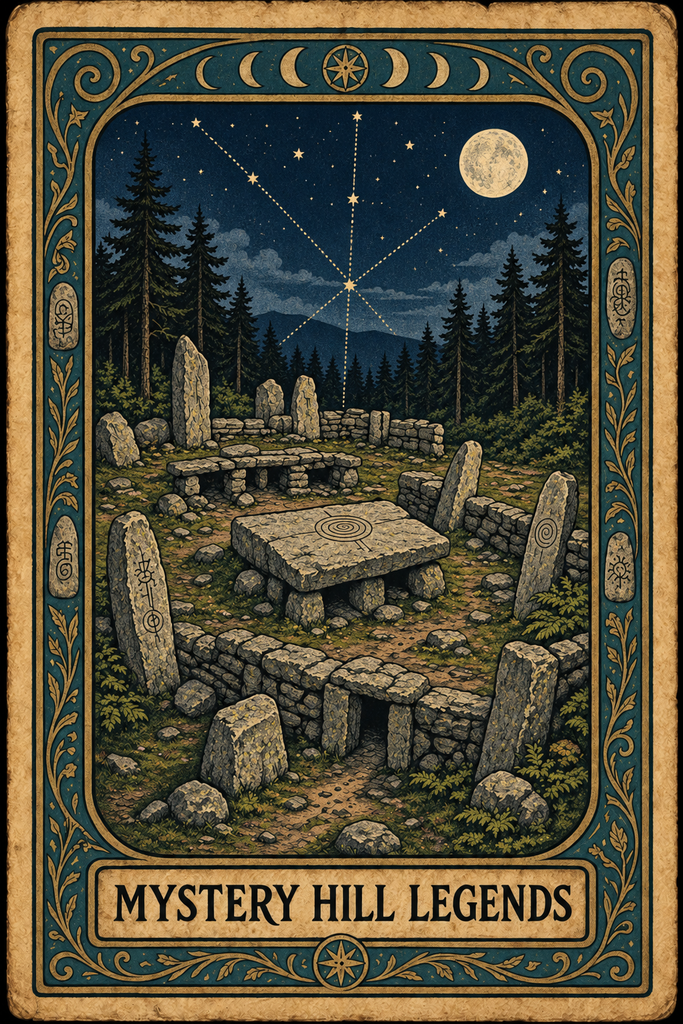
Mystery Hill (America’s Stonehenge) Legends (Salem, New Hampshire)
Mystery Hill is a complex of stone walls, chambers, and standing stones in Salem, New Hampshire. The attraction presents the site as preserving more than 4,000 years of human history. Claims have linked its structures with ancient Europeans, astronomy, ritual activity, and pre-Columbian settlement. Boston University archaeologist Curtis Runnels rejected Bronze Age European builders, citing the absence of supporting artifacts.
William Goodwin bought Mystery Hill in 1936 and promoted theories involving Irish monks and other pre-Columbian Europeans. Discover reports that Goodwin rearranged stones while trying to fit the site to his preferred interpretation. Later promoters added astronomical alignments and other ancient-builder claims. Renamed America’s Stonehenge in 1982, the property remains an active museum and archaeological attraction.
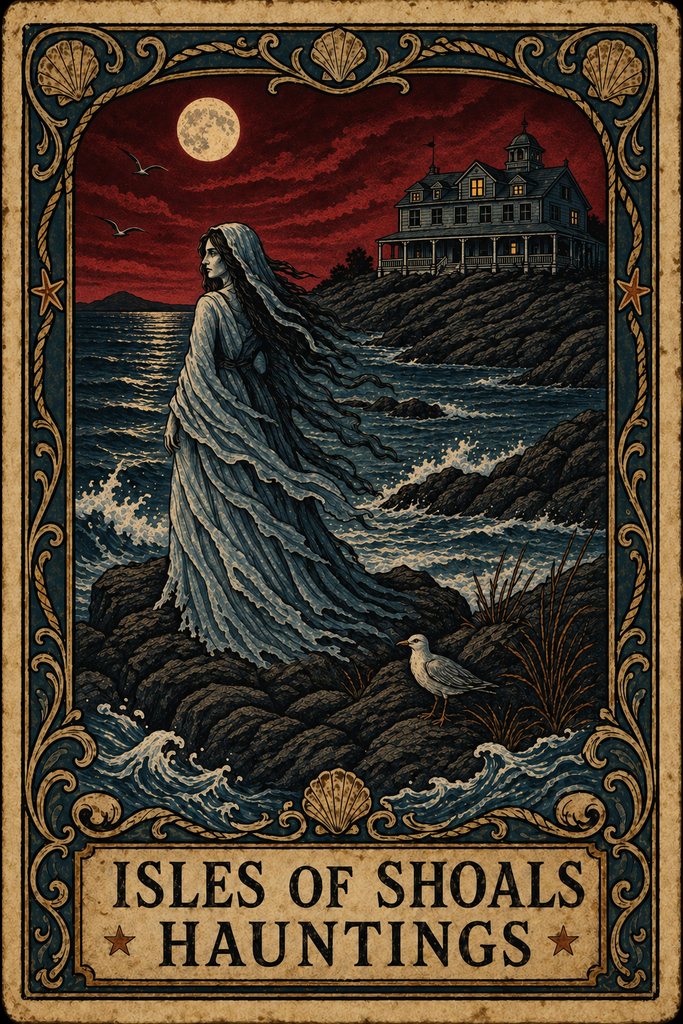
Isles of Shoals Hauntings (Isles of Shoals, New Hampshire and Maine)
The Isles of Shoals carry several ghost traditions across Appledore and Star islands. Celia Thaxter’s 1873 Among the Isles of Shoals describes Philip Babb’s ghost near Babb’s Cove on Appledore. Witnesses saw a hollow-faced man in a striped frock, sometimes brandishing a knife. Babb had served as constable for most of the islands in the seventeenth century.
Thaxter also recorded a separate Appledore ghost, a pale woman who repeatedly said, “He will come again.” Her story involved Captain Scot, a pirate who supposedly left her guarding buried treasure. Vaughn Cottage also preserves later Star Island stories involving unexplained sounds inside the Oceanic Hotel.