Wyoming
Wyoming cryptids and folklore draw from mountain wilderness, open plains, frontier settlements, and the state’s long Indigenous history. Strange creatures, ghost stories, cowboy legends, river apparitions, and unexplained encounters have circulated across Wyoming for generations.
The state’s folklore includes Native traditions, frontier mysteries, haunted places, tall tales, and stories tied to isolated roads and remote landscapes. Many remain connected to particular rivers, mountains, towns, ranches, and historic sites across Wyoming.
The Platte River Ship of Death (North Platte River)
Wyoming folklore tells of a frost-covered sailing ship appearing from sudden mist along the North Platte River. The legend places three encounters in 1862, 1887, and 1903, stretching from Guernsey toward the Casper area. Witnesses described a ghostly crew gathered around a shrouded body on the deck. As the ship approached, the corpse was revealed as someone personally known to the observer.
Each appearance served as an omen that the person shown aboard the ship had died that same day. The best-known stories involve Leon Webber, cattleman Gene Wilson, and Victor Heibe, who reportedly saw Tom Horn hanging aboard. The legend later gained wider attention through Vincent Gaddis’s 1948 Fate magazine story. The icy vessel remains one of Wyoming’s strangest and most memorable ghost legends.

Jackalope (Douglas)
The Jackalope is Wyoming’s famous horned rabbit and the signature folklore creature of Douglas. Local taxidermists Douglas and Ralph Herrick popularized it during the 1930s by mounting deer antlers on a jackrabbit. The first mount was sold to Roy Ball, who displayed it at Douglas’s LaBonte Hotel. Stories soon gave jackalopes a talent for mimicking human voices and other improbable habits.
The creature quickly grew beyond the original mount into tall tales, postcards, hunting licenses, souvenirs, and roadside humor. Douglas even issued novelty licenses allowing jackalope hunting only on June 31. The city calls itself the Jackalope Capital of the World and celebrates the creature throughout town. Jackalope statues, signs, and Jackalope Days keep the legend firmly embedded in Wyoming identity.

Shoshone Water Babies (Wind River Region)
Shoshone traditions describe Water Babies as supernatural beings associated with springs, ponds, rivers, and other waters. Ethnographer Robert H. Lowie recorded the Pa’ona as a water being heard crying at night. People reportedly recognized the being by its cries rather than by seeing it directly. Related Wind River Shoshone traditions describe powerful small spirits connected with water, mountains, and sacred rock art.
Wind River Shoshone traditions also connect Water Babies and related little spirits with the Dinwoody rock-art landscape. Ethnographic accounts describe these beings as powerful spirit helpers associated with shamans, visions, and places of supernatural power. Historic Wind River Shoshone attributed some Dinwoody figures to Water Babies or mountain spirits, giving the tradition a specifically Wyoming setting.

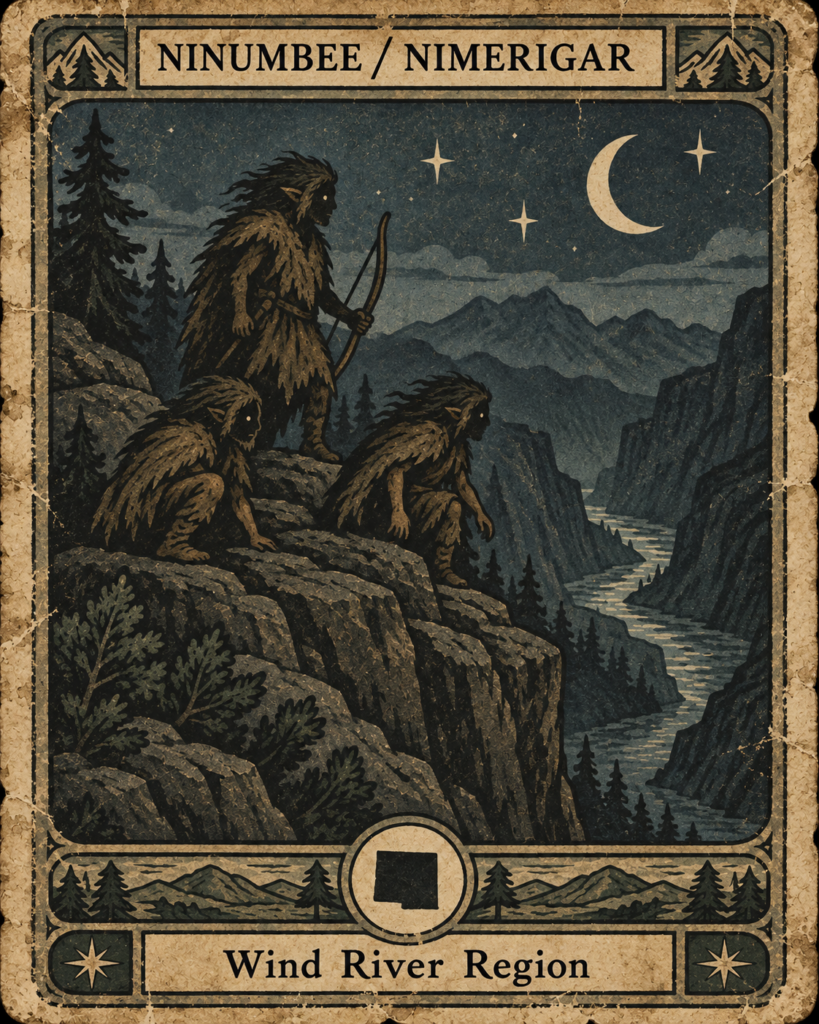
Ninumbee (Wind River Region)
The Ninumbee are mountain-dwelling Little People important in Eastern Shoshone tradition around the Wind River region. Eastern Shoshone elder Reba Teran describes them as powerful beings about three feet tall living in the mountains. She says Wind River Canyon was remembered in Shoshone as “Little People’s River.” A 2024 scientific paper likewise identifies Ninumbee as the Shoshone name for mountain-dwelling Little People.
In 2024, researchers and Fort Washakie students named a newly described Wyoming fossil amphibian Ninumbeehan dookoodukah. The name honors the Ninumbee and translates roughly as “Little People’s flesh eater.” Its second element refers to the fossil animal’s sharp teeth. Teran contributed the Shoshone name and recorded its cultural context for the study.
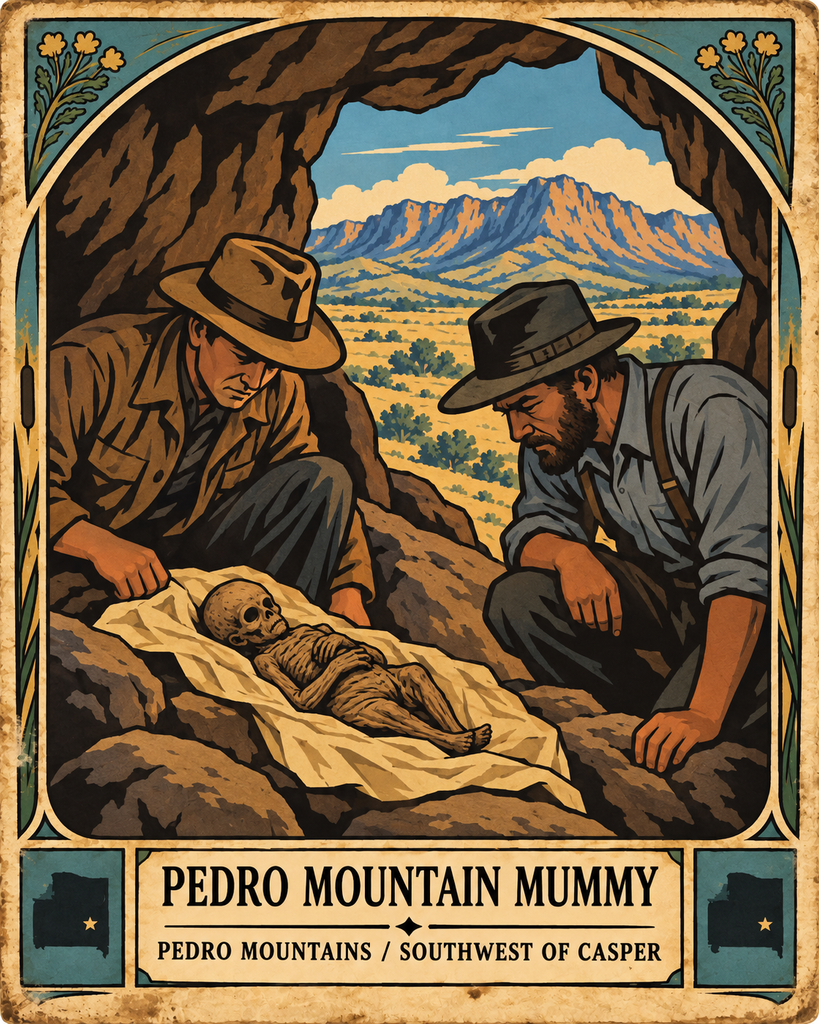
Pedro Mountain Mummy (Pedro Mountains / Southwest of Casper)
The Pedro Mountain Mummy was discovered in 1934 by prospectors Cecil Main and Frank Carr southwest of Casper. WyoHistory says photographs and Main’s signed affidavit document its discovery inside a sealed cave. The mummy later passed through local displays and sideshows before Casper businessman Ivan Goodman acquired it. Goodman took it to anthropologist Harry Shapiro, who examined the body and made X-rays. The mummy disappeared after Goodman took it to New York again in 1950.
Shapiro sent the X-rays to University of Wyoming anthropologist George Gill for review. Gill later said both men regarded Pedro as probably a human infant with anencephaly. Earlier newspaper and mystery accounts had promoted the mummy as an unusually tiny adult. The original body has not been seen since 1950, preventing further direct examination. In the 1990s, Gill examined a different mummy found in the same region. Tests on that separate specimen supported his earlier interpretation of Pedro.