United Kingdom
United Kingdom cryptids, monsters, and ghost stories come from distinct folklore traditions across England, Scotland, Wales, and Northern Ireland. Coastal villages, moorlands, mountain lakes, and ancient settlements feature in stories of spectral animals, giants, dragons, fairy beings, and restless spirits. These legends draw on centuries of English, Scottish, Welsh, and Irish storytelling, alongside more recent reports of strange creatures and unexplained sightings.
In England, phantom black dogs haunt lonely roads and churchyards, while Scottish water horses inhabit rivers and lochs. Welsh folklore includes monstrous lake dwellers and supernatural figures preserved in medieval literature and local oral traditions. Northern Ireland shares the wider Irish traditions of banshees, fairy encounters, and supernatural warnings. Historical manuscripts, regional folklore collections, and later newspaper reports document these stories across different periods.
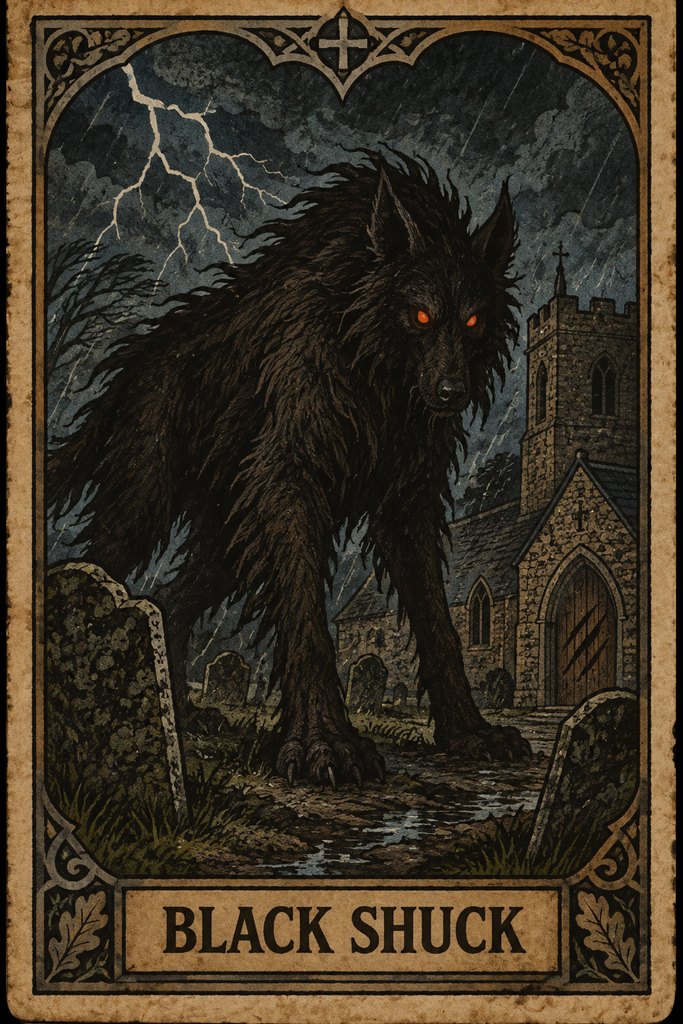
Black Shuck (East Anglia / England)
Black Shuck is a spectral black hound said to haunt East Anglia’s roads, coastline, and churchyards. On 4 August 1577, a violent storm struck the Suffolk towns of Bungay and Blythburgh. Abraham Fleming’s contemporary account described a black dog killing two kneeling worshippers inside Bungay’s St Mary’s Church. Another man reportedly survived an attack that left his body twisted and injured. Fleming also described a similar creature killing two men and a boy inside Blythburgh’s Holy Trinity Church.
An 1850 folklore account described Shuck as an enormous, shaggy black dog with fiery eyes. Witnesses reportedly encountered the creature around Norfolk churchyards at midnight, with sightings extending into Cambridgeshire. At Blythburgh, scorch marks on a church door are traditionally attributed to the hound’s claws. Bungay now celebrates the legend through its Black Shuck Festival, featuring parades, performances, music, and art.
Lambton Worm (County Durham / England)
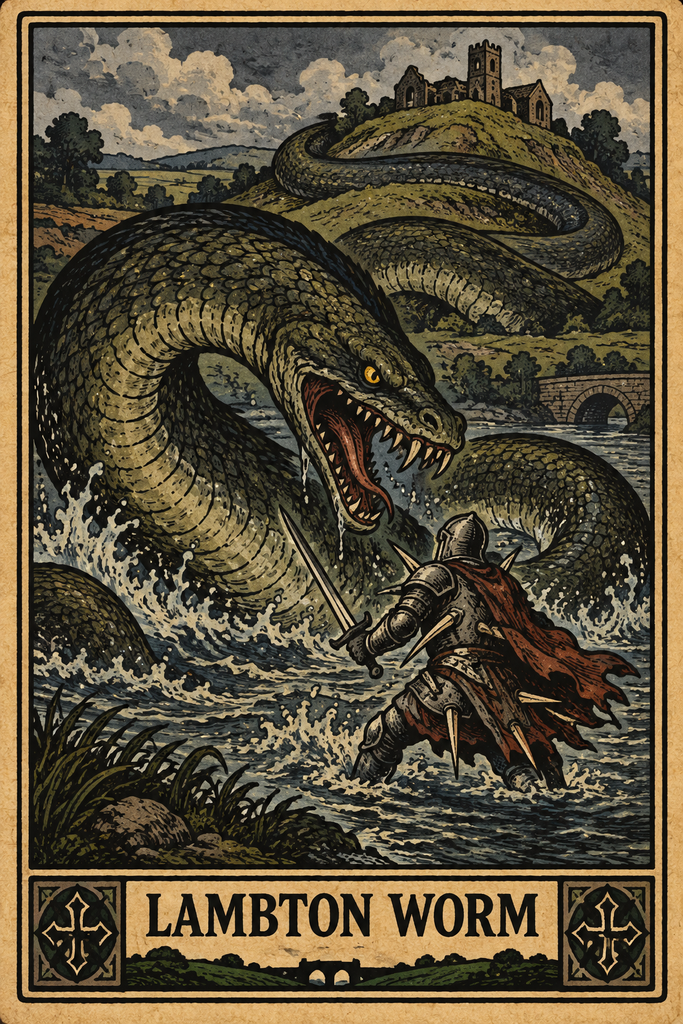
The Lambton Worm is a giant serpentine monster from County Durham folklore, associated with the River Wear. According to nineteenth-century folklore collections, young John Lambton caught a hideous, eel-like creature while fishing on Sunday. He threw it into a nearby well, where it grew into an enormous serpent. The worm wrapped its body around Worm Hill, attacked livestock, and uprooted trees. It demanded a daily offering of milk from nine cows, threatening destruction when the villagers failed to provide it. Attempts to kill the monster failed because severed pieces of its body reportedly rejoined.
Returning from the Holy Land, Lambton sought advice from a wise woman. She instructed him to wear armor covered in sharp blades and fight the creature in the river. The worm’s coils pressed against the blades, while the current carried away its severed flesh before it could rejoin. The woman also demanded that Lambton kill the first living creature he encountered afterward. Otherwise, nine generations of his family would suffer unnatural deaths. Lambton arranged to sacrifice his hound, but his delighted father rushed forward first. Unable to kill his father, Lambton broke the vow, bringing the curse upon his descendants. The legend gained popularity through nineteenth-century chapbooks and inspired C. M. Leumane’s famous 1867 song.
Beast of Bodmin Moor (Bodmin Moor / Cornwall, England)
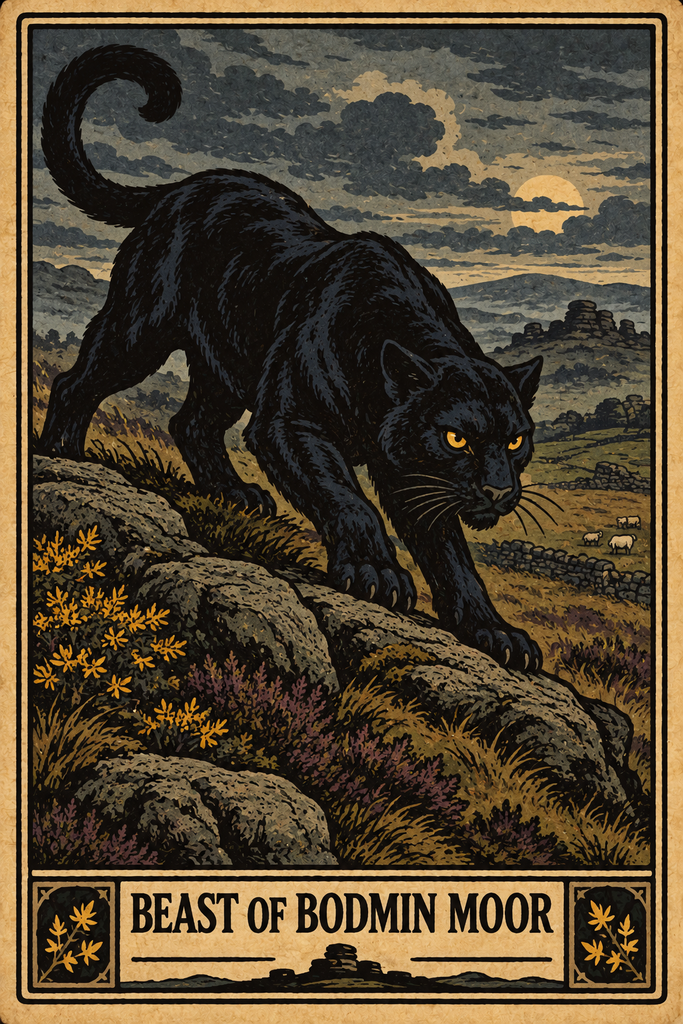
The Beast of Bodmin Moor is a large, panther-like cat reportedly roaming Cornwall’s moorland since the late twentieth century. Witnesses describe a dark animal with a long tail, glaring eyes, and an unsettling, almost human scream. In 1995, Ninestones Farm owner Rosemary Rhodes described enormous yellow eyes and a cry resembling a woman’s scream. She attributed several sheep deaths to the creature, including an ewe found with a broken neck and deep scratches. Nearby farmer John Goodenough also reported livestock losses, while builder Steve Parkyn described a reddish-brown animal near Jamaica Inn.
In 1995, the Ministry of Agriculture investigated photographs, tracks, and livestock deaths, finding no verified big-cat attacks. That August, a leopard skull discovered near the River Fowey briefly attracted national attention. The Natural History Museum identified it as an imported hunting trophy. More recently, police records released in 2025 documented a July 2024 sighting along the Camel Trail near Bodmin. The caller described a black animal approximately two feet tall and three feet long, with a long tail.
Spring-Heeled Jack (London / England)
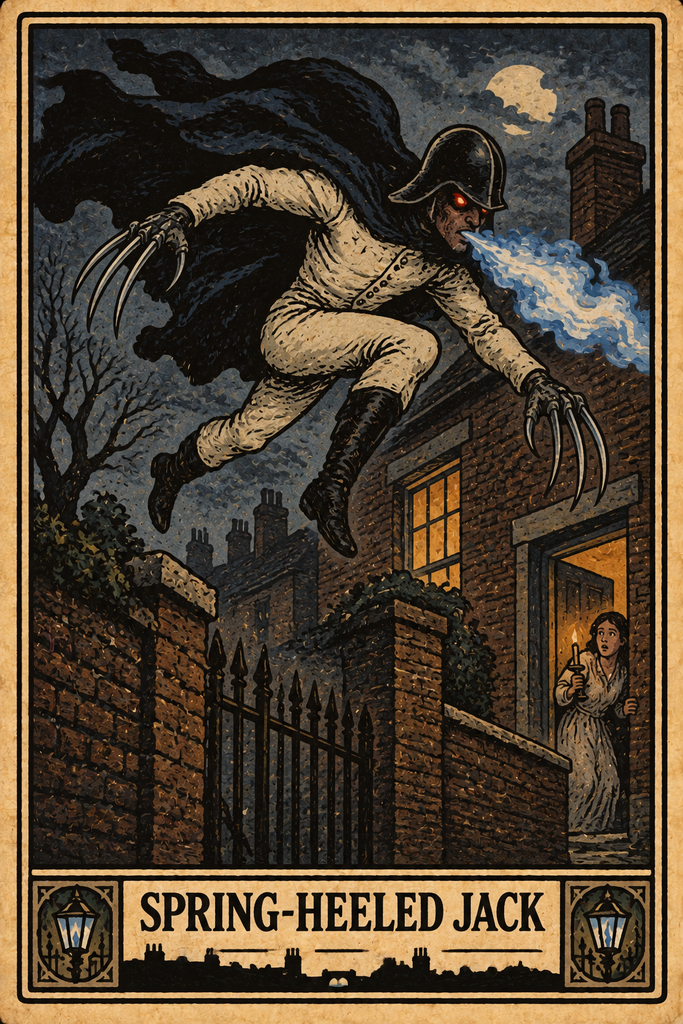
Spring-Heeled Jack was a mysterious attacker reported around London from 1837, notorious for his supposedly extraordinary leaps. Accounts described a cloaked figure with fiery eyes, clawed hands, and the ability to breathe blue flames. In February 1838, eighteen-year-old Jane Alsop answered a knock at her family’s home near Old Ford. The visitor claimed to be a policeman and asked her to fetch a candle. According to The Times, he discarded his cloak, revealing a helmet and tight white clothing. Alsop said he breathed blue and white flames, tore her dress with metallic claws, and scratched her neck. Her sisters helped her escape into the house.
On 28 February, Lucy Scales reportedly encountered a cloaked stranger in Limehouse’s Green Dragon Alley. She said he blew blue flame into her face, temporarily blinding her and causing violent fits. Later accounts spread the creature’s reported appearances beyond London into other parts of England and Wales. Jack also became a character in Victorian stage dramas and inexpensive serialized fiction. The British Library records an 1840 stage adaptation and numerous penny-dreadful stories. Its collections include the script of an 1863 drama, Spring heeled Jack; or, The felon’s wrongs.
Loch Ness Monster (Loch Ness / Scottish Highlands)
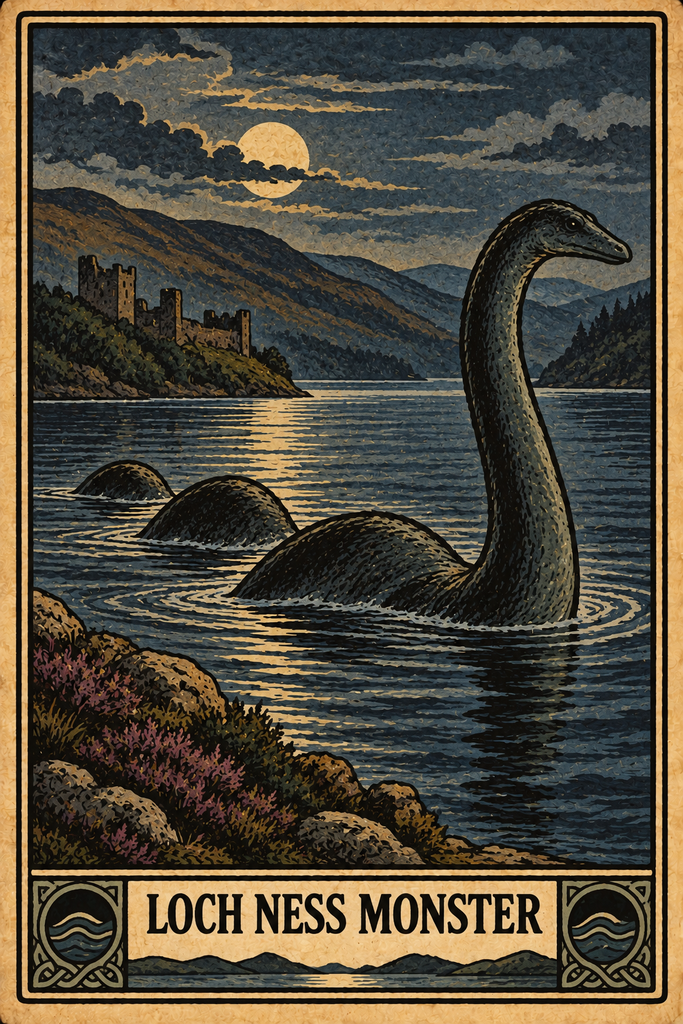
The Loch Ness Monster, commonly called Nessie, is a mysterious aquatic creature reportedly inhabiting Scotland’s Loch Ness. Witnesses describe a long neck, small head, rounded humps, and a dark body breaking the water’s surface. Older Highland folklore also placed dangerous water horses around the loch. On 2 May 1933, the Inverness Courier published Aldie Mackay’s account of a huge, whale-like creature rolling through the water. That July, George Spicer reported a long-necked animal crossing the lakeside road before disappearing toward the loch.
The famous 1934 “surgeon’s photograph” helped establish Nessie’s familiar long-necked appearance, although its staged origins emerged decades later. In 1987, Operation Deepscan deployed sonar-equipped boats across the loch and reported unusual underwater contacts. An organized search in August 2023 brought volunteers, infrared drones, and sonar equipment to the Highlands. The Loch Ness sightings register continues documenting encounters. In August 2026, German visitor Felix Tiekemeier reported a dark, six-metre form surfacing for approximately twenty seconds.
Gorbals Vampire (Glasgow / Scotland)
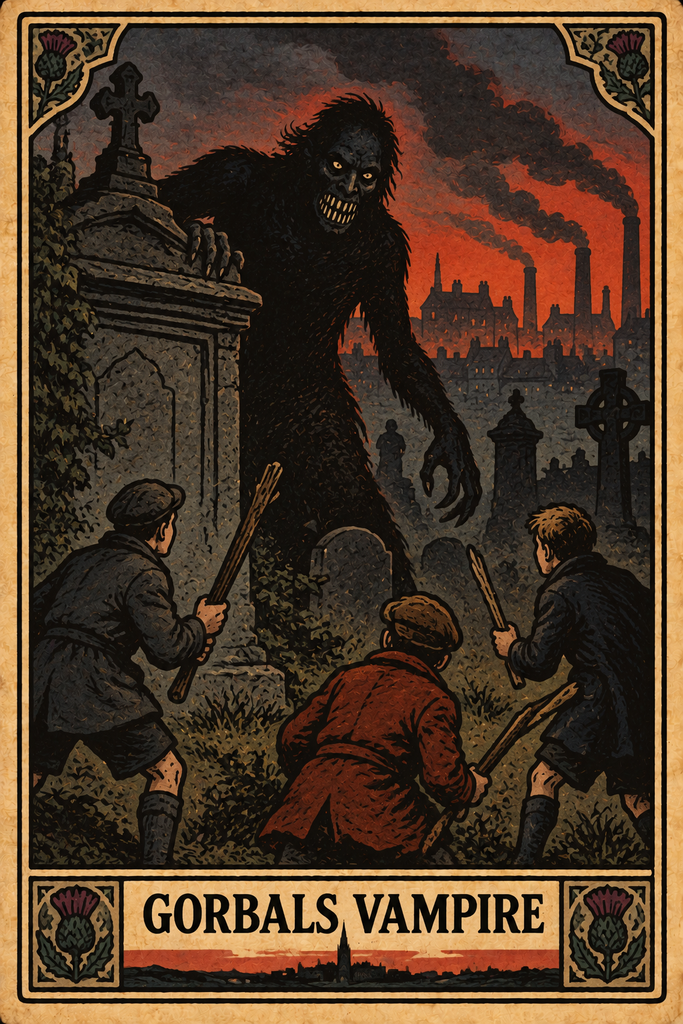
On 23 September 1954, hundreds of children gathered at Glasgow’s Southern Necropolis to hunt the Gorbals Vampire. Rumours described a seven-foot monster with iron teeth that had killed and eaten two local boys. Armed with sticks, stones, and improvised weapons, the children climbed cemetery walls and searched among the graves. Smoke and flames from nearby steelworks illuminated the cemetery as darkness fell. Residents complained about the commotion, bringing police constable Alex Deeprose to the scene. Rain eventually scattered the young hunters, although some returned the following evening.
The Bulletin reported the hunt on 24 September 1954, and subsequent newspaper coverage blamed American horror comics. Older Scottish folklore also featured Jenny with the Iron Teeth, a frightening figure invoked to scare disobedient children. Folklorists Sandy Hobbs and David Cornwell later documented these traditions while researching the incident. In February 1955, MP John Rankin cited the hunt during parliamentary debates over restricting children’s comics. Parliament passed the Children and Young Persons (Harmful Publications) Act on 6 May 1955.
Am Fear Liath Mòr (Ben Macdui / Cairngorms, Scotland)
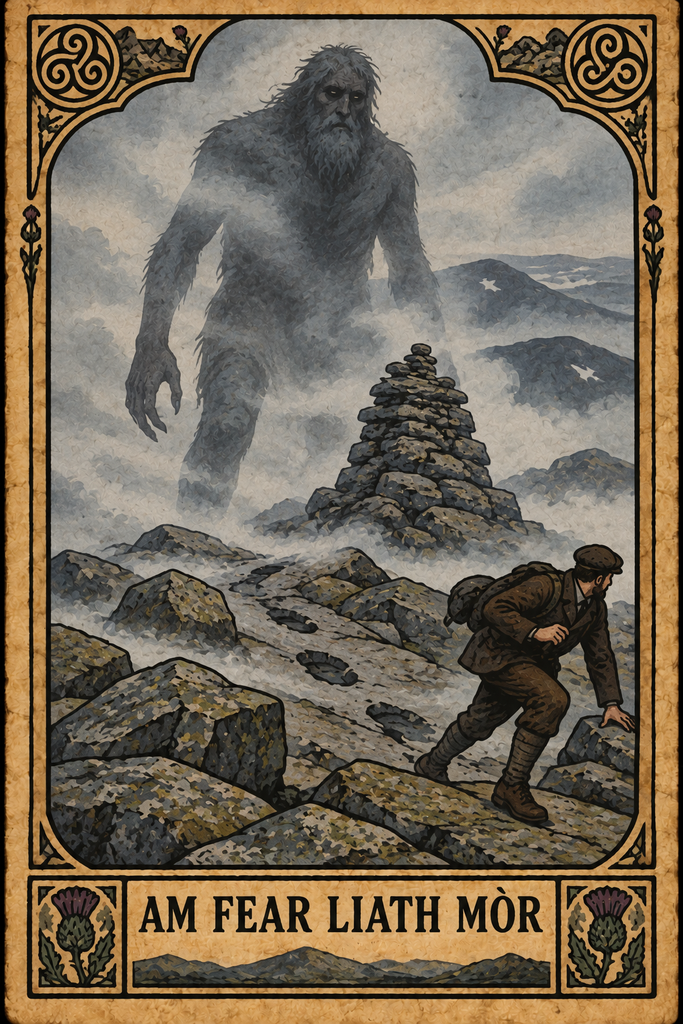
Am Fear Liath Mòr, the “Big Grey Man,” is a mountain presence associated with Scotland’s Ben Macdui. Some accounts describe a huge grey figure, while others report only heavy footsteps and sudden dread. At a 1925 Cairngorm Club gathering, mountaineer Norman Collie recalled a terrifying climb around 1891. He heard footsteps in the mist, each stride seemingly three or four times longer than his own. Unable to see anyone, Collie fled across the boulders and ran nearly to Rothiemurchus Forest.
Collie also recounted mountaineer Alexander Kellas seeing a figure nearly ten feet tall beside the summit cairn. Kellas’s brother, sitting nearby, insisted he had seen nobody. In another account, climber Tom Crowley described a grey giant with pointed ears and long, clawed feet. During a 1945 climb, Peter Densham reported cold, pressure around his neck, and frightening sounds near the summit. Local tradition also identified the presence as William of Rynuie, a hunter and poet wounded at Corunna in 1809. He died in Portsmouth while returning home.
Afanc (Conwy Valley / Wales)
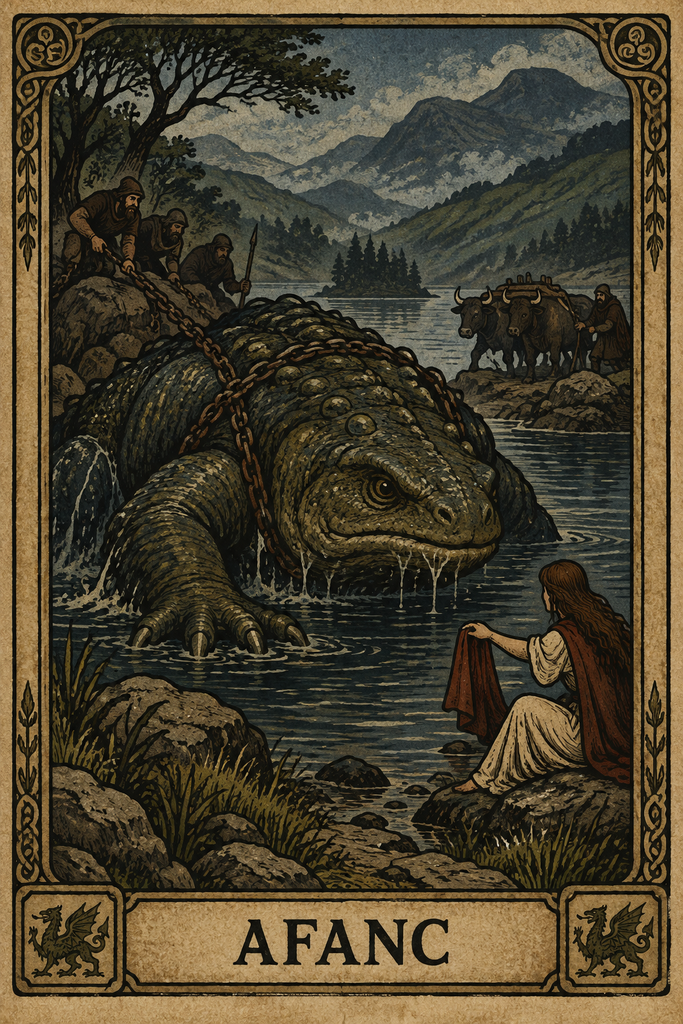
The Afanc is a formidable Welsh water monster associated with Llyn yr Afanc near Betws-y-Coed in the Conwy Valley. It reportedly caused floods, and arrows and spears could not penetrate its hide. A 1693 account later reproduced by John Rhys tells of a girl luring the creature from its pool. It rested its head upon her lap while villagers secretly fastened iron chains around it. Awakening, it clawed away one of her breasts and tried to escape into the water.
Two enormous oxen, called Ychen Bannog, dragged the captive Afanc across the mountains to Llyn Cwm Ffynnon Las. One ox reportedly lost an eye during the journey, giving Pwll Llygad Ych its name. Once removed from the Conwy watershed, the monster could no longer cause floods there. Other Welsh traditions located the Afanc at lakes including Llyn Syfaddon and Llyn Tegid. During an 1875 visit to Bala, linguist Hugo Schuchardt searched Llyn Tegid for the creature.
Cŵn Annwn (Wales)
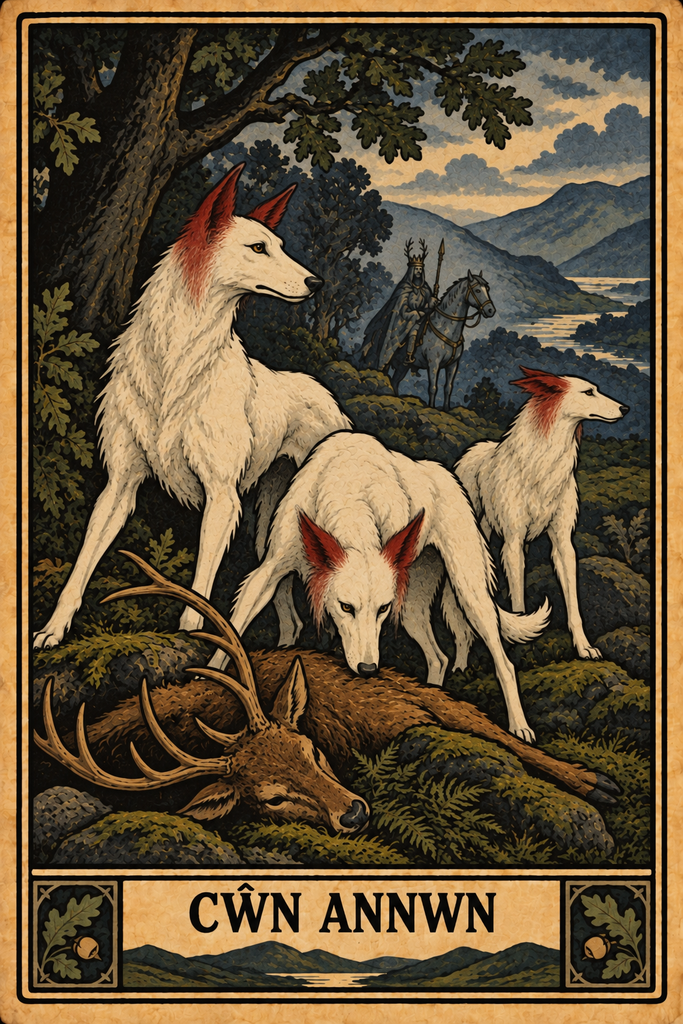
Cŵn Annwn, or Hounds of Annwn, are supernatural hunting dogs associated with the Welsh Otherworld. In the medieval Mabinogi, Pwyll, prince of Dyfed, encounters a strange pack in the woods of Glyn Cuch. Their coats shine white, their ears are red, and they have just brought down a stag. Pwyll drives them from their kill and feeds his own hounds instead. Their master, Arawn, ruler of Annwn, confronts him and demands repayment for the insult.
In later Welsh folklore, the hounds race unseen through the sky, their cries warning of approaching death. Wirt Sikes recorded in 1880 that their howls seemed quieter nearby and louder in the distance. They were also called Cŵn y Wybr, or Dogs of the Sky. In one account, Thomas Phillips heard them crossing Trelech parish along a route funerals never followed. Soon afterward, a woman’s funeral procession took that very route toward her home parish church.
Banshee of Dunluce Castle (County Antrim / Northern Ireland)
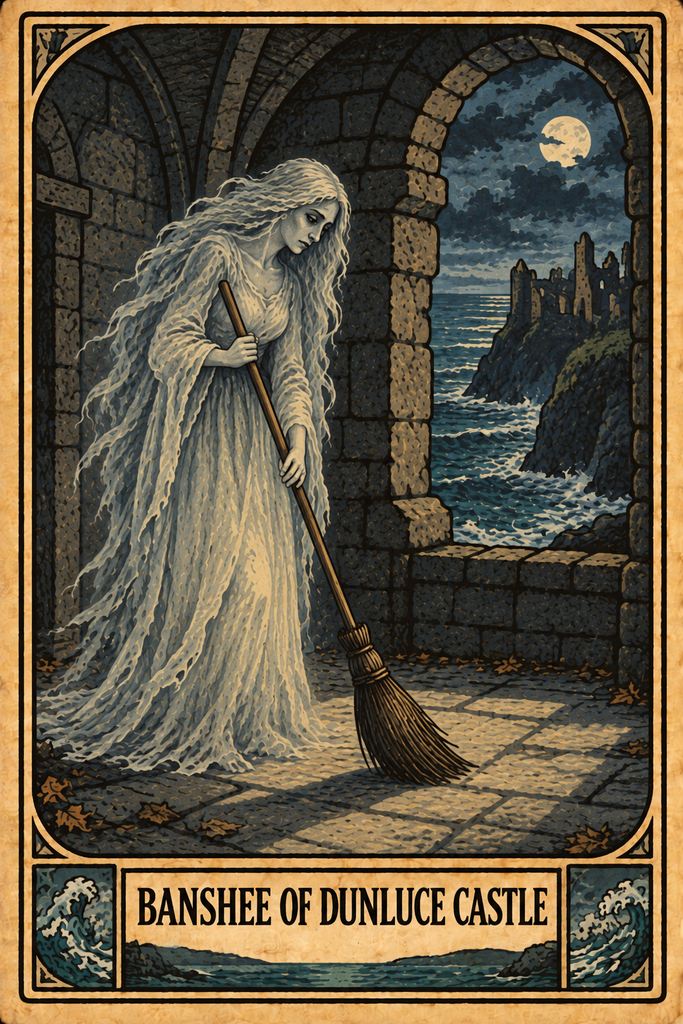
Dunluce Castle in County Antrim has long been linked with a female supernatural presence. An 1841 description says one small vaulted room was thought inhabited by a banshee called Maw Roi. The tale explained why the chamber floor stayed mysteriously swept and free of dust. An 1812 travel account also called the room the favorite abode of Mave Roc.
Modern retellings often identify the spirit with Maeve Roe, a tragic woman whose cries sound around the ruins. That identification seems later than the swept-room tradition, but both now shape Dunluce folklore. Northern Ireland heritage material says the castle’s dramatic history is matched by tales of a banshee. Ghost traditions also accompany the story of the castle kitchens falling into the sea in 1639.
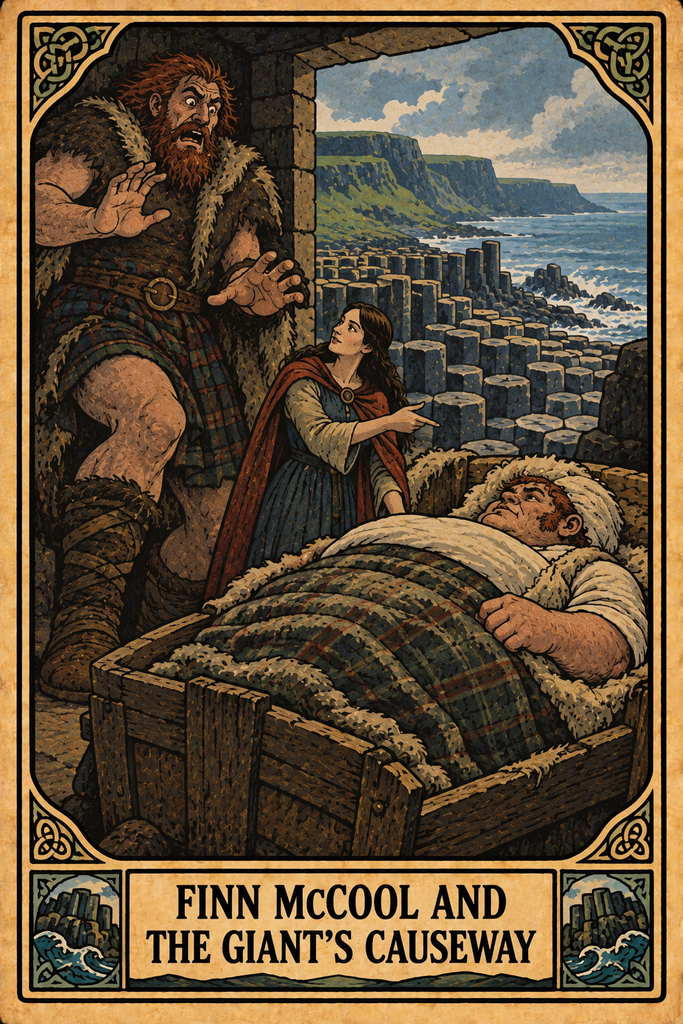
Finn McCool and the Giant’s Causeway (County Antrim / Northern Ireland)
Finn McCool, or Fionn mac Cumhaill, is an Irish legendary hero portrayed as a giant in Causeway folklore. He built a stone road across the sea from County Antrim to challenge the Scottish giant Benandonner. According to a UNESCO heritage account, Finn fell asleep before his rival arrived. His wife Oona disguised him as an enormous baby, hiding him beneath a blanket. Terrified by the infant’s size, Benandonner fled to Scotland, tearing apart the causeway behind him.
A different version recorded by the National Trust tells of Finn building the crossing for love. His grandmother summons storms to destroy the stones, fearing he will leave her for a Scottish woman. In an 1830 poem, Finn finally reaches his beloved but dies from exhaustion. His grieving grandmother turns to stone, becoming a rock formation overlooking the coast. Visitors can still see the Giant’s Boot at Port Noffer, a rock traditionally associated with Finn.